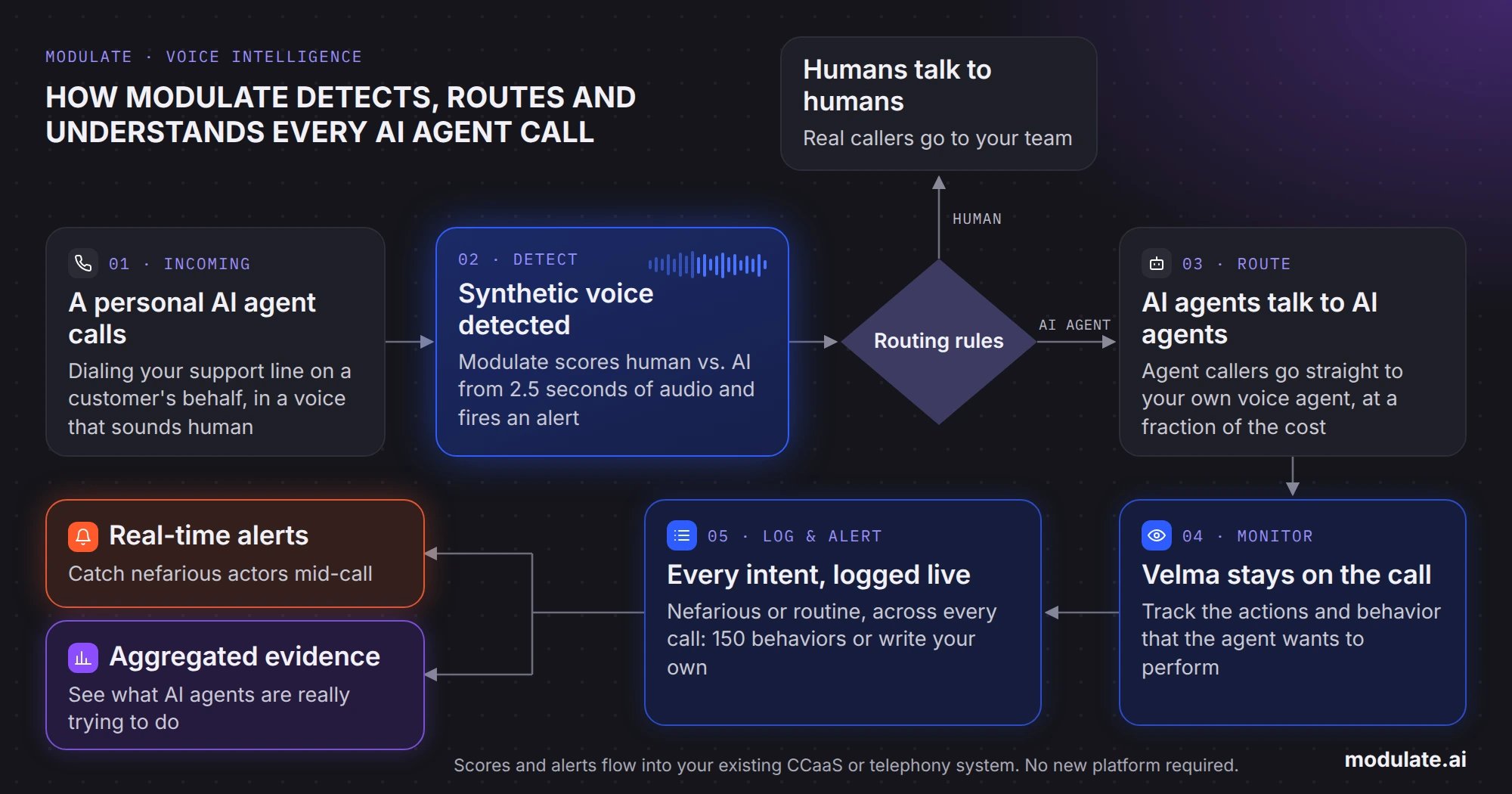
AI Agents Are Calling. Modulate Makes Routing Them Easy.
Introducing Ensemble Listening Models (ELMs): What You Need to Know
January 20, 2026

Mike Pappas
(HE/HIM/HIS)


Why Speech Broke the LLM Playbook
Large Language Models (LLMs) have transformed how we work with text. They write emails, summarize long documents, draft code, and answer questions with remarkable fluency. For written language, they’re incredibly powerful.
But voice is a different problem.
Real conversations carry meaning far beyond the words themselves. Tone, timing, hesitation, emotion, and interaction patterns all shape what’s actually being communicated. When companies apply text-first AI to voice — whether in customer support calls, fraud attempts, recruiting screens, or safety escalations — critical signals get lost in translation.
Consider a simple sentence like: “That’s fine.” Spoken calmly, it signals agreement. Spoken sharply or with a pause, it can signal frustration, resignation, or distrust.
A transcript alone can’t tell the difference. And in high-stakes voice environments, those differences matter. A misread call isn’t just inaccurate; it can drive the wrong decision entirely.
For specialized use cases like voice intelligence, we need a new architectural reset, not a bigger language model.
What is an Ensemble Listening Model (ELM)?
An Ensemble Listening Model (ELM) is not a single monolithic model. It’s a coordinated system of specialized models, each focused on a different aspect of analysis. In the case of Modulate’s ELM, we can quickly and accurately process human speech and behavior, including:
- emotion and stress
- conversational dynamics and escalation
- fraud and manipulation patterns
- AI-generated speech detection
Within ELMs, these models operate in parallel and over time, directly on input data signals. A shared orchestration layer then synthesizes their outputs into insights that are grounded, time-aligned, and explainable.
When it comes to truly understanding human speech, Modulate’s Ensemble Listening Model treats a conversation as something to be listened to, not just the content of a transcript.
How is an ELM different from a Large Language Model (LLM)?
LLMs and ELMs solve fundamentally different problems.
LLMs:
- Optimize for fluent text generation
- Operate on tokens
- Tend toward confident guesses, and therefore hallucinations
- Work best as generalists
ELMs:
- Favor specialization
- More scalable in specific use cases
- Don’t rely on massive data sets
- Increased efficiency
- Reduced cost
The key distinction? LLMs are generalists. Whereas, ELMs can be fine-tuned for specific use cases, making them more cost efficient in their specialized area.
Why Modulate Built a New Architecture Instead of Fine-Tuning an LLM
Voice intelligence isn’t one task — it’s many evolving ones. A real conversation is a dense, multi-channel signal combining language, prosody, timing, emotion, and social context. Two utterances with identical transcripts can convey entirely different meanings when spoken with different tone, speed, or certainty.
Decades of research in speech emotion recognition and affective computing show that emotional and behavioral signals are encoded in acoustic features like pitch, energy, and temporal dynamics. Our ELM for voice analysis goes beyond just transcribing speech and identifying the words spoken.
At the same time:
- Fraud tactics change faster than monolithic models can retrain
- Safety and risk systems require transparency, not black boxes
- Enterprises need systems they can inspect, adapt, and govern
Our conclusion? The problem with using LLMs for voice intelligence wasn’t prompting. It was architecture.
A High-Level Look Inside Modulate’s ELM Approach
Modulate’s ELM approach replaces a single generalist model with dozens of narrow, expert models working together.
Each of our models produces time-stamped signals, not vague labels. An orchestration layer reasons about how signals interact across a conversation. The system remains modular as new risks, behaviors, and policies emerge.
This design prioritizes reliability over fluency, evidence over inference, and evolution over retraining from scratch or relying on massive amounts of irrelevant data as an LLM would.
Making Complex AI Understandable: The Conversation Fingerprint
Multi-model systems only work if humans can trust and interpret them.
That’s why Modulate introduced a conversation fingerprint in our ELM output: a visual, time-aligned map of behavioral signals across a call. Each signal is directly linked back to the underlying audio, allowing teams to see why the system flagged a moment, not just that it did.
Why ELMs Matter Now
The timing isn’t accidental. According to our latest survey findings, voice fraud is rising and costing businesses more. Additionally, AI voice agents are becoming widespread. Regulators are demanding explainability, and enterprises can’t afford hallucinated judgments in real conversations.
ELMs are the better solution for understanding real human speech.
Defining a New Model Class for Voice
Just as computer vision required CNNs and transformers, and robotics required new control architectures, voice intelligence requires models that can truly listen. Modulate believes Ensemble Listening Models are that foundation.
ELMs will not replace LLMs, because they solve fundamentally different problems. LLMs will remain essential. But for understanding real human conversations, ELMs do the work LLMs were never designed to do. Rather than retrofit LLM tools for specific use cases, like voice understanding, ELMs offer a more focused, accurate, and efficient approach.
What Comes Next
We’re redefining the AI architecture that will drive voice intelligence in the future.
Test Modulate's capabilities. We’re letting anyone upload a piece of audio and experience what Modulate’s Ensemble Listening Models can reveal about real conversations. There’s no setup or configuration, just immediate insights.