Best Sentiment Analysis Software: 11 Sentiment Analysis Tools Compared
Call Center Monitoring: Methods, Metrics and AI in 2026
July 8, 2026


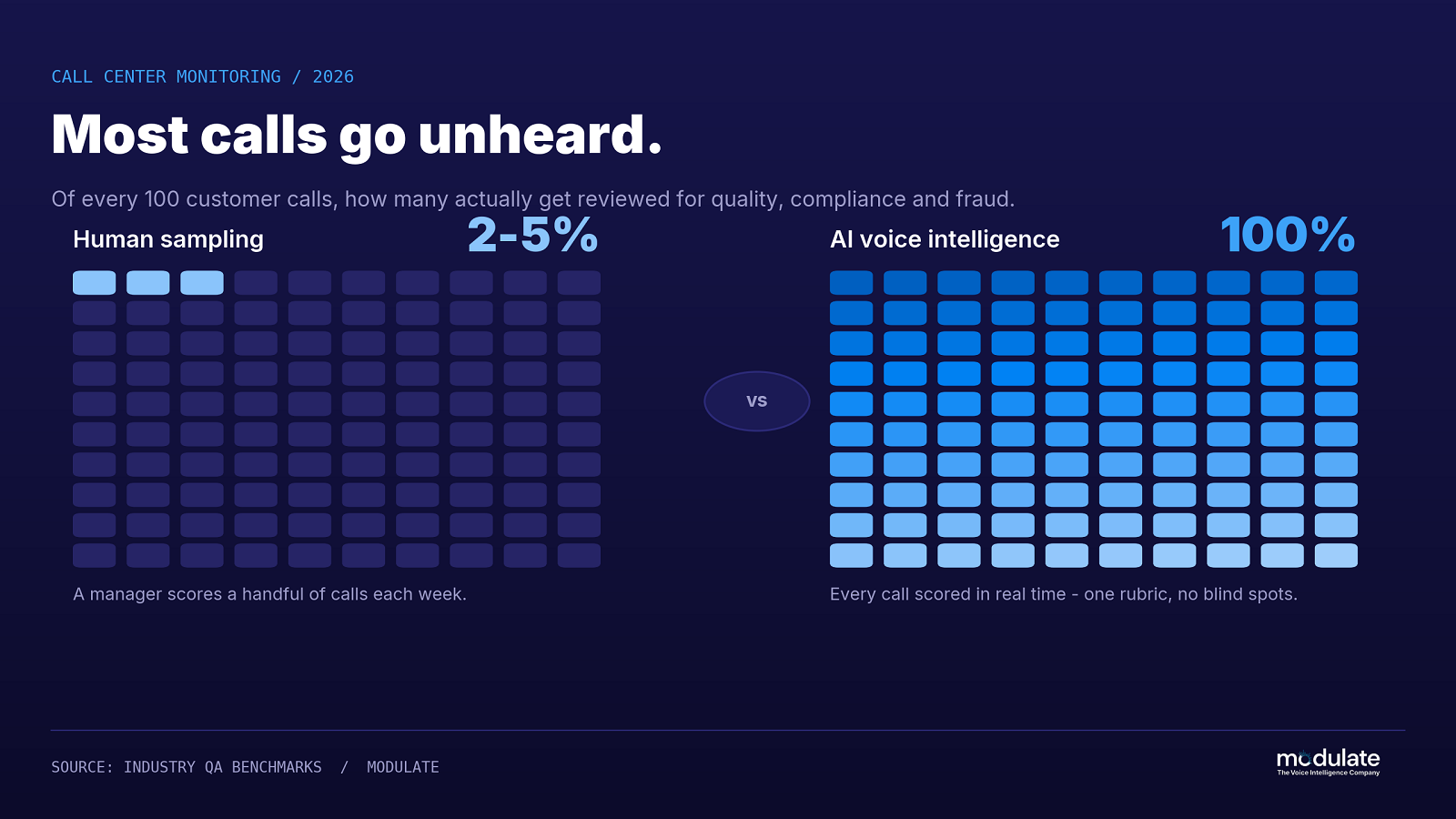
Call center monitoring is how teams review and analyze live and recorded calls to protect quality, compliance and customers. It has become mostly a fraud problem: generative AI fraud losses in the US are projected to reach $40 billion by 2027, from $12.3 billion in 2023 (Deloitte Center for Financial Services). Much of it moves through the call channel. Effective call center monitoring covers the methods teams use to listen, the metrics they track and the way they catch fraud and policy breaches. Manual monitoring samples 2% to 5% of calls; AI-driven call center monitoring analyzes 100% of them in real time. This guide covers call center monitoring methods, metrics and how AI changed the practice from spot-checking to full coverage.
Call centers that leverage speech analytics on all of their calls see customer satisfaction scores increase by 10% and operating costs decrease by 20% to 30%, according to Sprinklr. That gap between monitored and unmonitored is the entire argument for call center monitoring. Here we cover what monitoring entails, how teams approach it, which metrics are worth measuring and how AI evolved the practice from reviewing sampling of calls to analyzing 100% of them.
 MODULATE
Unreviewed Calls Calculator
Manual QA samples a few percent of calls. See how many of your interactions go unreviewed. See what full AI coverage adds. Calculated in your browser.
0
calls go unreviewed every year under manual QA
0
reviewed/year (manual)
0
reviewed/year (AI, 100%)
Why it matters: the call channel is where nearly two-thirds of financial account takeovers begin. Every unreviewed call is an interaction no one scored for quality, compliance or fraud signals.
See how Modulate scores 100% of calls in real time →Method and sources
Unreviewed/year = monthly calls × 12 × (1 minus sample rate). AI coverage assumes speech-analytics review of 100% of calls, per QEval. Account-takeover origin figure, TransUnion.
What Is Call Center Monitoring?
Call center monitoring is listening to, recording and scoring customer interactions for quality, compliance and coaching purposes. Call monitoring answers three key questions for operations leaders:
- Did they resolve the customer’s issue?
- Did the agent follow policy?
- How did the customer feel about it?
Monitoring used to involve a manager listening to a few calls each week and completing a scorecard. Software now automates the bulk of the monitoring process. Instead of reviewing dozens of interactions, we’re now sampling nearly 100%.
The important distinction to remember is monitoring vs. analytics. Monitoring is the process of capturing and scoring customer interactions. Analytics is what you glean from reviewing the big picture. Successful call monitoring programs include both.
Why Monitoring Matters
There are three factors that drive the need for call center monitoring.
Quality is the obvious one. No call center can improve first call resolution or reduce handle time if they don’t know what’s happening on the phone.
Compliance is the second driver. Financial institutions, healthcare and collections face real regulatory risk if a disclosure is missed.
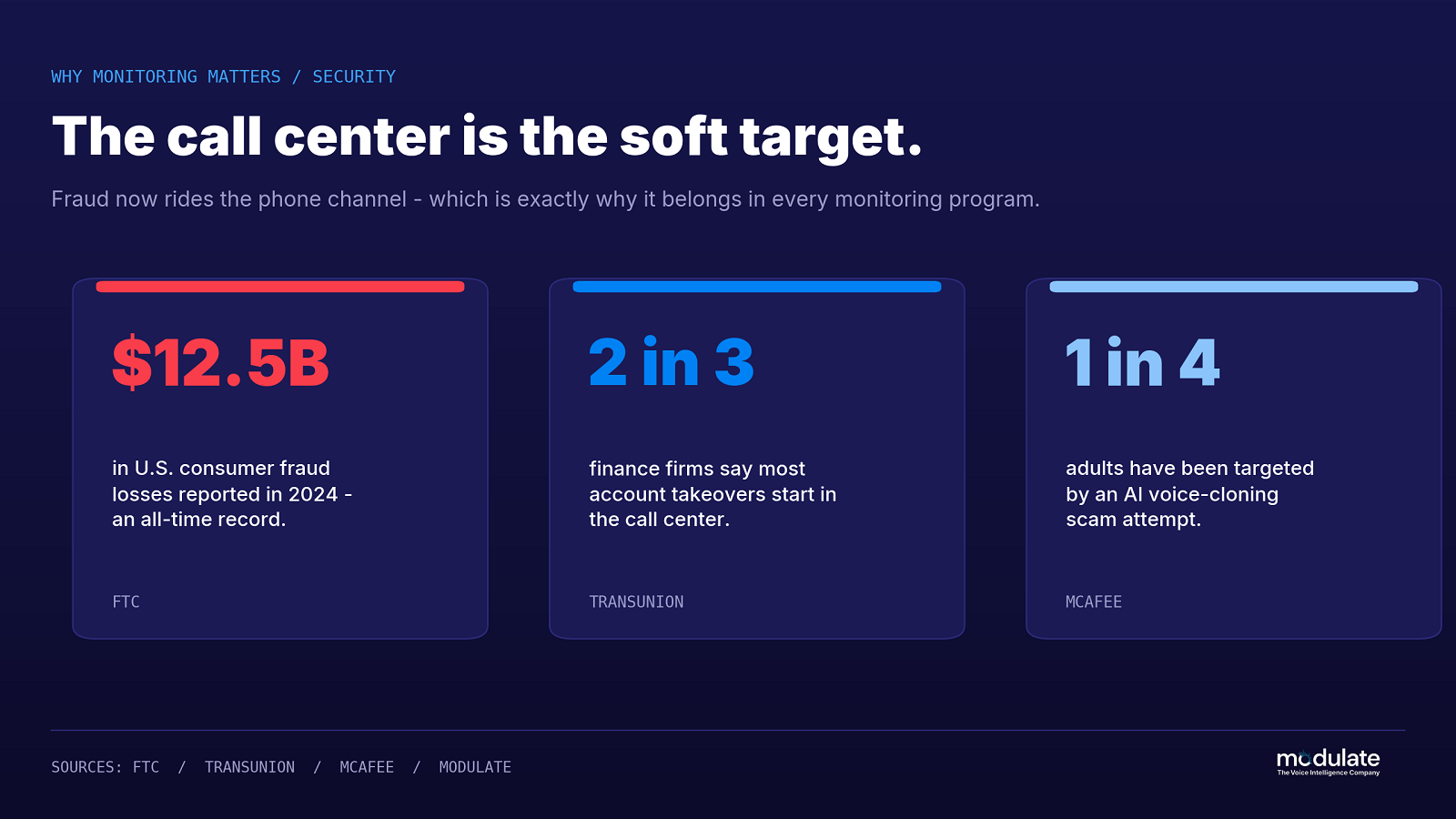
The third reason to monitor calls is security. Fraudsters target the phone channel because they know it is the least monitored. Two-thirds of financial services respondents to a TransUnion survey said most account takeovers originated in the call center. As Brandon Wilson, Senior Account Executive at Modulate, explains:
“Contact centers sit at the crossroads of customer trust and business operations. When you call customer support, you trust the person on the other end to protect your sensitive information. Likewise, agents trust customers to be truthful and straightforward. This mutual trust is exactly what bad actors exploit. They understand these trust dynamics intimately and use sophisticated social engineering techniques to manipulate agents.”
Monitoring is the difference between a team discovering the social-engineering attempt prior to an agent giving access and discovering it on a fraud report three weeks later. The price paid for missing it is very real: The FTC recorded a historic $12.5 billion in consumer fraud losses reported to them in 2024, with a significant portion of those scams involved interacting with a live agent at some point.
Key Call Center Monitoring Methods
Call center monitoring programs typically use a combination of these methods.
Live monitoring. Someone actively listens to a call as it happens, sometimes with the supervisor whisper-coaching the agent (inaudible to the customer). This technique allows supervisors to coach agents in real time but does not scale.
Call recording and review. Capturing calls to score later against a quality rubric. Used as a backbone of QA programs and provides indisputable record in the case of a dispute.
Speech and voice analytics. AI software transcribes calls and digitally analyzes them based on keywords, silence, talk-over and emotional cues. Voice analytics technologies can listen for voice qualities such as tone, pace and volume to determine a caller's emotional state and highlight frustration or confusion. While most vendors analyze sentiment from the transcript, advanced platforms like Modulate’s Velma use machine learning to process the raw audio to identify hidden stress markers, hesitation patterns, and artificially generated speech that would otherwise be missed during transcription.
Many speech and AI vendors will promise scale. Because the computer is doing the evaluations, it can evaluate 100% of calls rather than the sampled 2%-5% that a human team can manage.
Real-time agent assist. Often using the same technology that scores a call, AI can assist during the call with real-time support and push the next-best article of knowledge or compliance warning while the agent is still on the call.
QA scorecards. Scorecards turn subjective opinion into objective, comparable data by using a consistent rating system across agents and teams. Both human evaluators and software models use quality scorecards.
What to Monitor: The Metrics That Matter
What you track defines your monitoring program. The most durable monitoring metrics fall into three categories:
- Resolution metrics: first call resolution, average handle time.
- Experience metrics: customer satisfaction, sentiment trend, escalation rate.
- Conduct metrics script/disclosure adherence, dead air, and increasingly, fraud-risk indicators from the caller.
The biggest mistake teams make is choosing to monitor only those things that can be easily quantified. Average handle time is easy to measure and extremely easy to over-optimize, which is why it's important to balance it with resolution and sentiment.
Monitoring collects the signal. For what to do with it once you have it, see our guide to call center analytics.
How AI Changed Call Center Monitoring
Moving from sampling to coverage is the biggest change underway by far. When models analyze every call, data becomes fact instead of anecdotal. Bias in scoring is eliminated since every interaction runs through the same rubric. Coaching becomes laser-focused since patterns emerge across hundreds of calls instead of a biased sample. And emerging issues are surfaced days earlier. Adoption is catching up with the capability: 76% of contact centers will invest in AI over the next two years, Balto reports.
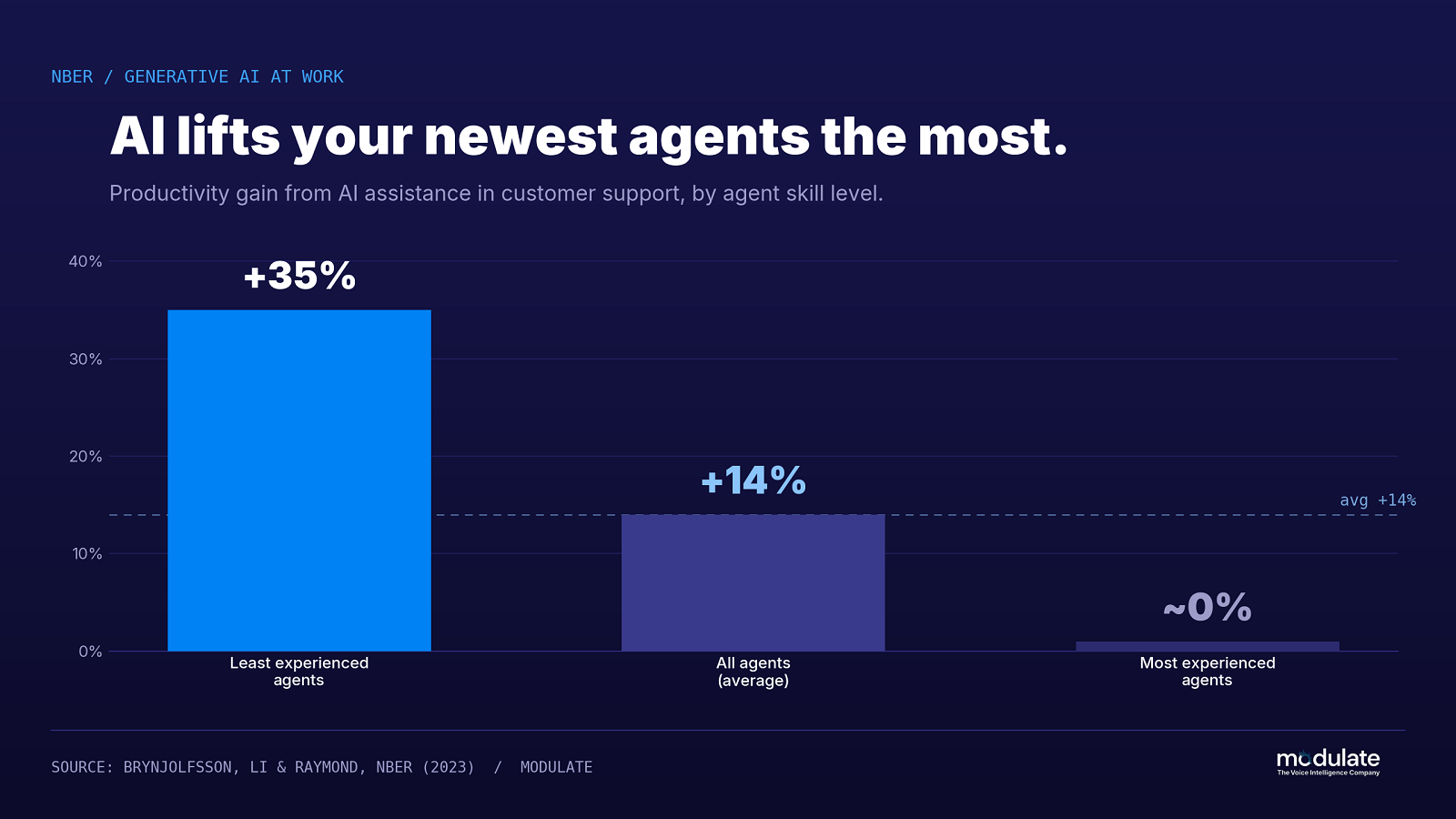
In one large-scale study from the National Bureau of Economic Research (NBER), researchers Erik Brynjolfsson, Danielle Li, and Lindsey R. Raymond studied the impacts of AI tools on customer support agent performance. They found that agents increased productivity by nearly 14%, driven by improvements of 35% for lowest-skilled, least experienced workers while having near-zero or even negative impact on highest-experienced workers. The researchers suggest this disparity is likely because AI can codify and share the tacit knowledge of high performers with other employees, essentially automating at scale what companies try to do manually with coaching through quality monitoring programs.
Voice security is one area where this is most critical for high-risk centers. After all, the same analytics layer scoring for quality can also listen for the tell-tale signs of a synthetic or spoofed voice. With research from McAfee reporting that 1 in 4 adults have experienced an AI voice scam attempt, identifying a cloned voice during a call is quickly becoming less of a value-add and more of a necessity. Voice intelligence platforms score every caller as they talk in real time and notify the agent before the account can be compromised.
Monitoring priorities are shifting fast, and our roundup of call center trends for 2026 covers what is driving the change.
Best Practices for an Effective Monitoring Program
Begin with a calibrated scorecard so every listener scores the same behavior identically. Sample the entire interaction, don’t just cherry-pick the open and close. Always close the loop with coaching. A score that never makes it back to the agent won’t change behavior.
Be upfront with agents about what is and isn’t monitored and why. This transparency reduces the friction that causes employee turnover. Kathy Ross, Senior Director Analyst in the Gartner Customer Service & Support practice, emphasizes the importance of a human-AI hybrid approach:
“While AI offers significant potential to transform customer service, it is not a panacea. The human touch remains irreplaceable in many interactions, and organizations must balance technology with human empathy and understanding. A hybrid approach, where AI and human agents work in tandem, is the most effective strategy for delivering exceptional customer experiences.”
Don't consider fraud alerts an add-on afterthought that you tack on after a loss has occurred. Treat fraud alerts as you would any other first-class monitoring output. And finally, periodically review the program itself. The scoring rubric that was right for last year's call mix is likely outdated as products, scripts and fraud trends evolve. Reviewing and adjusting the program quarterly will help keep your scores relevant.
Modernize Your Call Center Monitoring Stack with Modulate
All of the capabilities described above (full-call coverage, real-time scoring, fraud detection, agent coaching) require one essential ability: voice intelligence performed at live speed and at scale. Meet Modulate. That’s where Modulate fits in.
Most tools that market themselves as AI simply run a large language model over a transcript post-call. Modulate’s voice intelligence platform, Velma, is an Ensemble Listening Model (ELM) that ingests audio directly. Hundreds of targeted models run simultaneously to identify emotion, stress, probability of AI voice, deception techniques that are lost in a transcript.
Velma’s real-time voice intelligence powers customer support across all three pillars. For quality, Velma automatically scores every conversation and surfaces agents who may need coaching without relying on manual sampling.
Velma monitors for fraud by detecting deepfakes and social engineering in real-time, alerting your team so they can take action before it’s too late. And it supports agent well-being by automatically scoring abusive calls and prompting agents to take a break after tough conversations. It also integrates with the systems contact centers already have, eliminating the need to replace existing technology.
Effective call center monitoring in 2026 doesn’t mean listening to more calls. It means understanding every interaction, in real time, for quality, compliance, and security at the same time. Velma is built for exactly that: see Velma in action.
If you are still shortlisting vendors, we compared nine platforms in our guide to the best call center monitoring software.
Frequently Asked Questions
What’s the difference between call monitoring and call recording?
Recording simply captures the call. Monitoring captures the call and scores it against quality, compliance and security standards.
Can AI really monitor every call?
Absolutely. Speech analytics platforms automatically transcribe and score 100% of calls, eliminating the tiny manual sample your team used to rely on.
Does call monitoring assist with fraud?
Yes. Real-time voice analysis can detect social-engineering attempts and synthetic audio during the call, before agents approve access.