Voice Moderation in Grand Theft Auto Online

Executive Summary
This case study examines the impact of voice moderation in Grand Theft Auto Online (GTA Online) using two complementary analyses: population-level changes in voice chat toxicity throughout 2025, and joint research between Rockstar Games and Modulate into how voice chat abuse affects individual player experience.
Voice chat content in GTA Online is analyzed using ToxMod, Modulate’s moderation solution. ToxMod is powered by Velma, Modulate's voice analytics model, and identifies likely violations of Rockstar’s Community Guidelines. Rockstar Games uses the data from ToxMod to enforce its Community Guidelines at scale.
Throughout 2025, voice moderation in GTA Online produced sustained and measurable reductions in voice chat toxicity even as player counts grew substantially. Average daily violations decreased by approximately 35% across the year, while ToxMod maintained over 98% precision. During the initial ToxMod pilot in October 2023, 3.2% of GTA Online players violated Rockstar’s Community Guidelines in any given week. This is on par with the typical 3-5% violation rates seen by Modulate across comparable titles prior to implementing proactive moderation. By Q4 2025, that figure had fallen to 0.49%, placing GTA: Online significantly below the unmoderated average.
Joint research using ToxMod’s anger probability score — a measurement of anger as identified by ToxMod’s vocal sentiment model — found that voice chat abuse appears to be a substantially stronger driver of player anger than challenging gameplay. Players exposed to abusive communication in the previous five minutes show up to 50% higher anger scores, while mission failures and repeated deaths show much weaker effects. High anger is in turn associated with up to a 50% higher probability of logging off within fifteen minutes, identifying a measurable link between abusive voice chat and session abandonment.
Taken together, these findings indicate that proactive voice moderation in GTA Online has produced sustained reductions in toxicity while addressing a behavioral pattern with direct implications for player retention. Healthy online communities are not defined only by reduced toxicity, but by environments where players choose to stay, return, and engage.

Average daily violations across 2025, with ToxMod maintaining >98% precision throughout the year.

1. How Voice Chat Shapes the Grand Theft Auto Online Experience
Grand Theft Auto Online is one of the biggest multiplayer environments in gaming, with millions of players globally diving into the dynamic world of Los Santos and Blaine County to pull-off Heists, compete in Races and Adversary Modes, hang out in social spaces including Nightclubs and Car Meets — all while sharing voice chat sessions.
Voice chat is off by default. For players who choose to enable it to connect and coordinate with others, it offers a rich social layer, and, like any large social environment, it surfaces both healthy interactions and ones that violate Rockstar’s Community Guidelines.
Across digital communities, people who engage in voice chat abuse tend to be a small minority; however, they can have an outsized impact. This case study examines the dynamics of voice chat interactions and the impact of effective voice chat moderation systems on a vibrant gaming ecosystem.
The work was guided by a hypothesis shared between Rockstar Games and Modulate: that proactive voice moderation could materially reduce abusive communication in GTA Online, and that doing so would meaningfully improve player experience and engagement.
2. ToxMod in Grand Theft Auto Online
ToxMod is a voice-native moderation platform built specifically for the dynamics of in-game voice chat. It combines automated detection, powered by Modulate’s voice analytics model Velma, with human-in-the-loop review: ToxMod identifies and prioritizes likely violations of Rockstar’s Community Guidelines, while human moderators evaluate the results and make enforcement decisions. This combination delivers both the speed required for real-time intervention and the judgment required for accurate decisions.
Continuous validation against Rockstar’s Community Guidelines keeps ToxMod’s automated detection tuned to GTA Online’s specific player base and standards. This is the mechanism behind the high precision rates reported throughout this case study.
ToxMod is also privacy-conscious by design. It does not perform speaker identification or generate biometric voiceprints. It analyzes voice chat for behavior that goes against Rockstar’s Community Guidelines and escalates those findings to Rockstar’s moderation team.
2.1 What this Case Study Measures
This case study draws on two complementary bodies of evidence:
- Population-level impact metrics drawn from 2025 ToxMod data, including violation rates and trends over time.
- Behavioral and engagement research drawn from a joint analysis of voice chat abuse and player anger, using ToxMod’s anger probability score combined with GTA Online gameplay session data.
2.2 Methodology
Key characteristics of the analyses:
- Population-level metrics are drawn from ToxMod data covering January 1 – December 31, 2025.
- The behavioral and engagement research draws on a sample of 20,000 players across all platforms, with anger scores aggregated across three-minute time intervals and combined with GTA Online gameplay session data.
- Analyses controlled for in-game gameplay factors such as mission failure and repeated deaths to confirm sources of frustration prior to logoff events.
- Findings on engagement are interpreted directionally and are based on correlational analysis. They do not establish causal relationships.
- All player data is aggregated. Analyses are designed to identify population-level patterns and do not evaluate individual players.
4. Voice Chat Abuse, Player Anger, and Engagement
Background
Beyond population-level metrics, Rockstar Games and Modulate conducted a joint study to understand the link between “rage quitting” — the phenomenon in which angry players quit games faster than their less upset counterparts — and players who are exposed to abuse in voice chat. The data revealed that exposure to violations of Rockstar’s Community Guidelines in voice chat increases the likelihood of rage quitting by up to 50%.
Study Design
ToxMod scores voice clips to estimate the likelihood that the speaker used an angry tone. While this is important context for identifying potential abuse, it also provides an opportunity to better understand how players feel during gameplay. The anger scores of 20,000 players across all platforms were randomly sampled and averaged across three-minute time intervals to produce snapshots of player emotional states. This data was combined with existing GTA Online gameplay session data to determine likely causes of player anger as well as the effects of anger on engagement. The study also controlled for gameplay factors such as mission failure and repeated deaths over short time periods to confirm the source of frustration prior to a logoff event.
Results
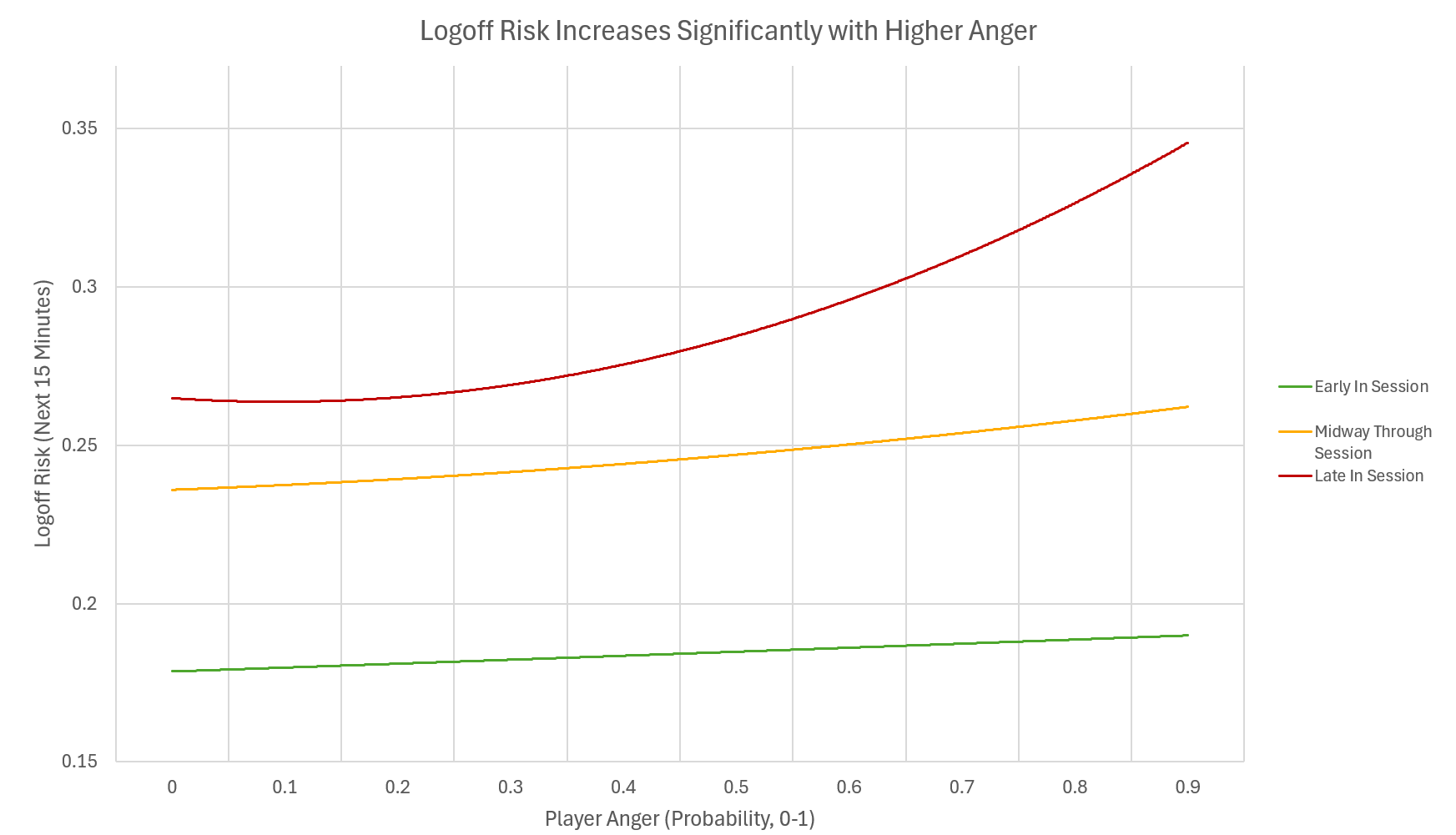
ToxMod’s anger probability score is predictive of substantially higher logoff risk.
Players with high anger scores have up to a 50% higher probability of logging off within the next 15 minutes. This effect is noticeably weaker toward the beginning of sessions, with high anger increasing logoff probability by up to 30%.
Exposure to abusive communication from other players is predictive of substantially higher anger, but gameplay challenges are not.
Players who have been exposed to abusive communication in the last five minutes show up to a 50% higher anger score. Interestingly, in-game mission failures and deaths are very weak drivers of higher anger scores, suggesting that players are far more tolerant of challenging gameplay than they are of abusive communication from other players.
Linking the findings: voice chat abuse drives rage quitting.
Taken together, exposure to voice chat abuse increases the likelihood of rage quitting by up to 50%. Voice chat abuse drives anger, and anger in turn drives session abandonment. This represents a measurable retention cost associated with abusive voice chat behavior — and a corresponding retention benefit from proactive voice moderation that reduces it.
1. Whether the measurement was at the “beginning” or “end” of a session was not determined by the specific session in question, but rather by historical average session lengths computed for each player in the study.
5. What This Means for Player Experience
This case study captures voice moderation in GTA Online across two complementary lenses. At the population level, proactive moderation has produced sustained reductions in toxicity since the initial trial. At the individual level, joint research establishes a measurable link between voice chat abuse and player disengagement.
Healthy online communities are not defined only by reduced toxicity. They are environments where players choose to stay, return, and engage. The findings here suggest that voice moderation, when implemented proactively and tuned carefully, contributes to all three.
Key Terms
- Anger score: A measurement of anger as identified by ToxMod’s vocal sentiment model on a scale of 0–1, where a score of 1 indicates a high level of certainty that the speaker is angry.
- Voice chat abuse: Voice chat content that violates Rockstar’s Community Guidelines in GTA Online.
- Exposure: When a player was in the same session as another player who engaged in voice chat abuse.
- Violation: An incident scored at or above 15.0 by ToxMod, indicating a likely violation of Rockstar’s Community Guidelines.
- Precision: The ratio of correct to incorrect voice chat abuse detection decisions (or true positives and false positives) made by a machine learning model. This is calculated weekly, via human evaluation of a sample provided by Modulate.