How to choose a transcription API that holds up on real-world audio
The 2026 Transcription API Buyers Guide, with 12 leading APIs compared
From the team behind the #1 model on Hugging Face's Open ASR Leaderboard.

About the guide
Most speech-to-text engines look great on clean benchmarks and fall apart on real calls. Crosstalk, accents, background noise, and billed silence all take their toll. For teams turning voice data into analytics, compliance, fraud detection, or AI agent governance, those gaps don't stay in the transcript. They flow into every system downstream.
This guide gives engineering, product, and CX leaders a practical framework for evaluating transcription APIs on the audio they actually have. It covers accuracy, architecture, feature sets, and total cost of ownership.
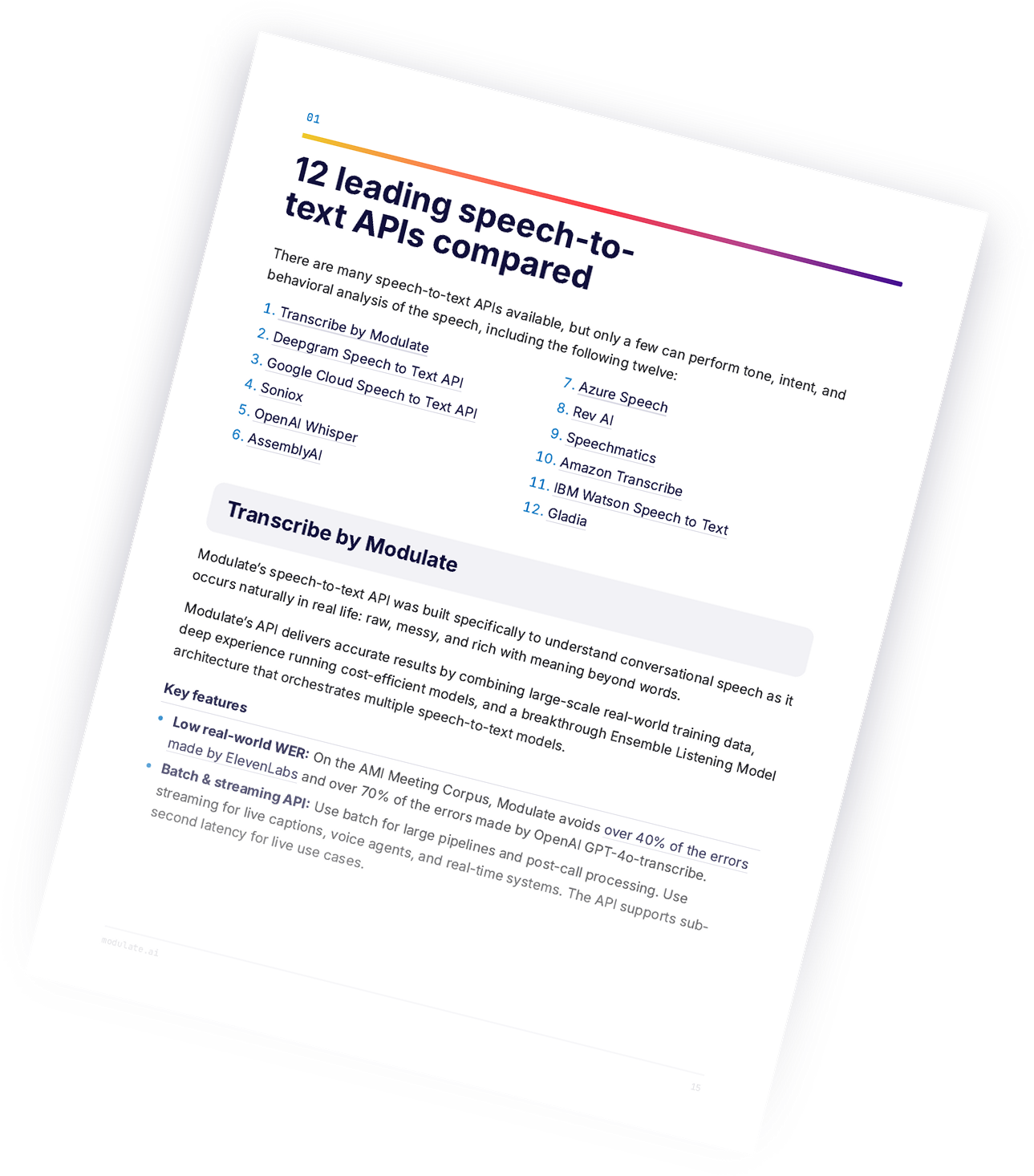
It closes with a side-by-side look at 12 leading speech-to-text APIs, including Deepgram, Google Cloud, AssemblyAI, OpenAI Whisper, Amazon Transcribe, and Modulate. Each one gets its key features, pros, and cons.
What you'll take away
Inside the guide, you'll find:
Why clean benchmarks like LibriSpeech overstate accuracy, and which datasets (AMI, Earnings-22, VoxPopuli) reflect real-world audio
A four-step framework for benchmarking providers on your own recordings, including how to calculate WER
The pricing questions that expose add-on costs for diarization, redaction, and billed silence
Which advanced features matter for coaching, compliance, fraud detection, and agent governance
Key features, pros, and cons for 12 leading speech-to-text APIs
Get the guide
Get instant access to the Transcription API Buyers Guide: how to evaluate speech-to-text on real-world audio, plus 12 leading APIs compared. No spam, just the guide.
Instant PDF download
12 speech-to-text APIs compared
A benchmarking framework for your next evaluation