For enterprises deploying voice AI at scale, t he next architectural challenge is combining speed and responsiveness wit h deeper conversational understanding. This is where real-time voice intelligence becomes increasingly impor tant.
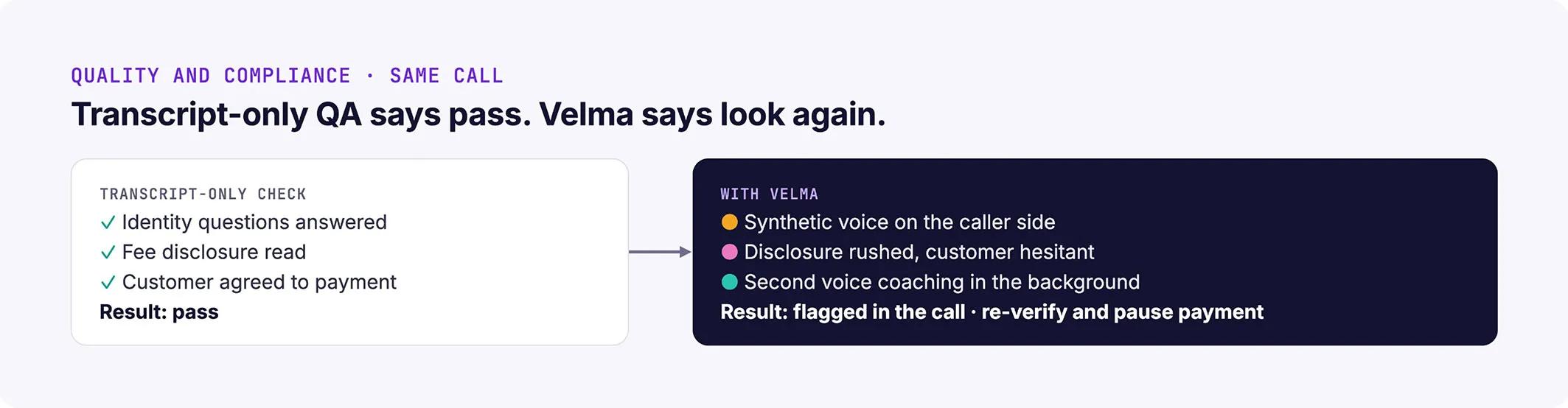
A transcript captures t he words. A more complete voice intelligence system considers t he surrounding acoustic and conversational context.
Conver ting conversations into text can remove impor tant information about tone, emotion, timing, and intent.
Rat her t han relying exclusively on transcripts, audio-native systems analyze characteristics of t he underlying audio to identify signals t hat text-based systems may miss.
Modulate’s Velma platform is designed to provide t his additional layer of conversational understanding, helping organizations identify meaningful events and respond while interactions are still unfolding.
For developers, t he Velma Voice Analytics API provides a way to incorporate audio-native conversational intelligence into existing applications and voice infrastructure.
Understanding more than words
The role of audio-native AI in conversational understanding
Modulate’s Velma is built on an Ensemble Listening Model (ELM) architecture t hat combines what is said wit h how it is said. Unlike approaches t hat depend primarily on analyzing transcripts, t his architecture combines specialized models to interpret acoustic, emotional, and behavioral signals. For a deeper technical explanation, explore t he architecture behind Velma and Ensemble Listening Models.
Fraud and social engineering
Audio-native intelligence can help sur face indicators of social engineering, impersonation, and ot her potentially fraudulent behaviors while a conversation is taking place. Modulate’s voice fraud detection capabilities are designed to identify signals associated wit h deepfakes, coercion, and manipulation during live interactions.
For financial institutions and insurers, voice intelligence for banking and insurance can suppor t fraud prevention, policy monitoring, and agent oversight.
Customer experience and retention
Voice intelligence can help organizations identify signs of dissatisfaction and provide oppor tunities for earlier inter vention. In contact centers, real-time customer experience intelligence can help teams recognize emotional escalation, suppor t agents, and better understand customer interactions.
AI agent monitoring
An independent voice intelligence capability can provide additional visibility into AI-powered conversations. Modulate’s AI voice agent guardrails are designed to monitor interactions, identify risky behavior, and help organizations maintain appropriate oversight of deployed voice agents.
For engineering teams building voice agents, Modulate’s voice understanding capabilities for AI developers provide additional context beyond conventional transcripts.
Employee safety
Voice intelligence can help identify concerning interactions and suppor t escalation workflows intended to protect employees. For contact center environments, voice intelligence for customer suppor t teams can help organizations recognize abusive behavior and suppor t safer interactions.
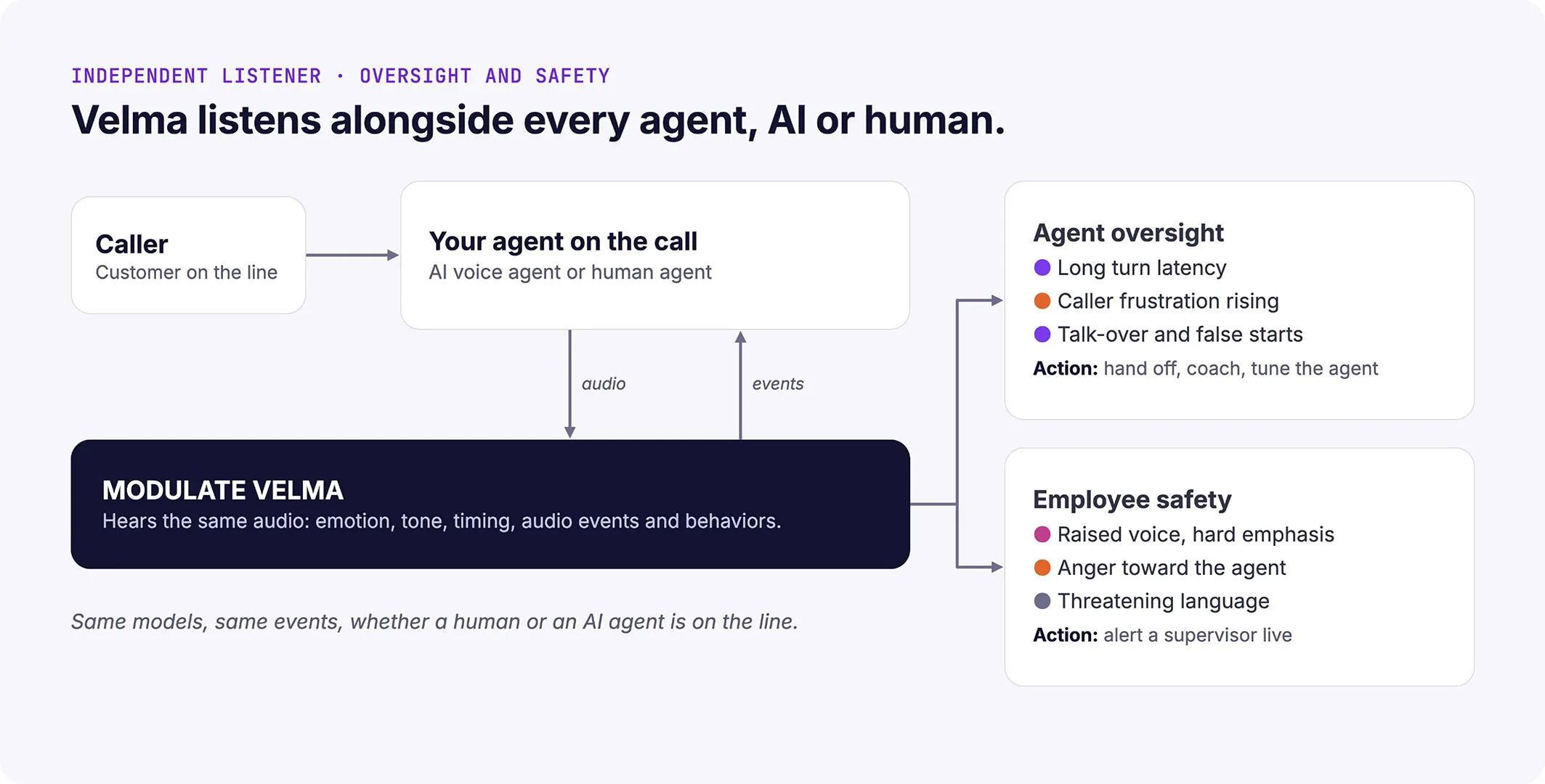
Voice intelligence brings acoustic, emotional, and behavioral signals into view, helping teams understand conversations beyond t he transcript.
Designing for enterprise security, trust, and compliance
Enterprise voice AI operates in environments where conversational mistakes can have consequences beyond user frustration.
Solutions such as real-time policy enforcement and monitoring can help organizations identify deviations from established procedures and suppor t agent assistance during live calls.
In voice-enabled communities, proactive user safety monitoring can help organizations identify potentially harmful behavior before it escalates.
The future of voice AI is conversational understanding
The future of voice AI architecture is not simply about reducing milliseconds between responses. It is about turning real-time conversations into actionable intelligence. Modulate’s work on voice-native conversational intelligence reflects t his shift from retrospective transcription analysis toward continuous understanding and inter vention.
Does your voice AI understand t he conversation?
The difference between a voice AI system t hat responds and one t hat truly understands lies in what it can detect beyond t he transcript.
Modulate’s audio-native voice intelligence platform is built to uncover hidden signals, identify risks as conversations unfold, and turn voice into actionable intelligence.