10 AI Monitoring Templates for Smarter AI Oversight
Best Deepfake Detection Tools: 7 Leading Deepfake Detection Tools Compared (2026)
May 12, 2026


Deepfake detection tools detect synthetic audio, video and images, verify identity and, in the strongest cases, stop deepfake fraud in real time. The best deepfake detection tools do all three, which matters now that generative AI fraud losses in the US are projected to reach $40 billion by 2027, up from $12.3 billion in 2023 (Deloitte Center for Financial Services). These tools differ sharply: some detect deepfakes in video and images after the fact, others monitor live voice cloning and interactions.
Deepfakes are an emerging threat to media integrity, but they’re also quickly becoming a security, identity, and fraud risk.
There's a good chance you've already heard about the many deepfake detection tools out there. Many of these tools don’t accomplish the same thing. Some detect deepfakes in videos and images after they’ve already been generated. Others monitor voice cloning and live interactions. A select few help organizations prevent fraud and impersonation attacks by detecting deepfakes, verifying identity, and responding to threats in real-time.
But what does “deepfake detection” really mean?
We break down the top deepfake detection tools and highlight where they shine (and where they fall short) to help you find the right solution for your use case.
You can start with the interactive tool we built for filtering and comparing deepfake detection tools:
 ●MODULATE
Deepfake Detection Tools Comparison
●MODULATE
Deepfake Detection Tools Comparison
Compare 7 deepfake detection tools
Search, filter by media type and capability, and sort any column. Tap a capability chip to show only tools that offer it.
| Tool | Media types | Real-time | Behavioral | Live intervention | Video | Best for |
|---|
Compiled by Modulate from public product information, 2026. Ratings: Yes, Limited, No. A buyer aid, not an endorsement; verify current capabilities with each vendor.
In this article:
- Modulate
- Resemble AI
- Pindrop
- identifAI
- Reality Defender
- Sensity AI
- Hive
- Best Deepfake Detection Tools Comparison Chart
- What is a Deepfake Detection Tool?
- Features to Look for in a Deepfake Detection Tool
- Frequently Asked Questions
Modulate
Supported Media Types: Audio
Best for: Real-time voice fraud detection and deepfake detection in live conversations (e.g., contact centers, financial services)
Overview
Modulate is a real-time voice conversation analytics platform with deepfake detection and fraud prevention technology. Rather than relying solely on transcripts or user data, Modulate analyzes both what is said and how it’s said by ingesting raw audio and analyzes conversations based on tone, cadence, prosody, patterns of speech, and linguistic content. This combined approach (analyzing both what is said and how it’s said) helps identify signals of synthetic audio, impersonation, or social engineering during a call.
Built for latency-sensitive environments like contact centers or identity verification processes, Modulate analyzes conversations in real-time so teams can respond to threats or risks during a call. Beyond basic deepfake indicators, Modulate detects behavioral signals such as urgency, hesitation, and inconsistency that can help organizations detect fraud or manipulation attempts.
Our benchmark write-up on deepfake voice detection has the full accuracy numbers behind this claim.
Key Features
Real-Time Deepfake Detection: Modulate can detect synthetic or manipulated speech seconds after receiving audio input, allowing teams to take action nearly in real-time on live calls. (Latency will vary based on your deployment method and call conditions.)
Voice-Native AI (Ensemble Listening Model): Rather than solely relying on transcripts or derived data, Modulate’s Ensemble Listening Model (ELM) ingests raw audio and evaluates both acoustic signals and speech content, combining how something is said with the actual words used to assess risk more accurately.
Deepfake + Fraud Detection: Modulate’s platform is built for detecting patterns of fraud at the signal level (deepfake detection) and behavioral/conversation level.
Behavioral and Intent Signals: Modulate detects common social engineering tactics such as sounding scripted, emotional mismatch, hesitation, and high-pressure or urgency.
Detect and Respond in Real Time: Modulate can trigger real-time alerts and plug into downstream workflows while a conversation is happening, allowing a response from an agent or automated systems to occur during an interaction.
Benchmark Performance: Modulate has demonstrated robust accuracy on public synthetic voice detection benchmarks (scoring #1 on the independently validated Hugging Face Speech Arena leaderboard on all three accuracy measures). Performance will vary by dataset and real-world call conditions.
Streaming and Batch Processing: Modulate can process live audio streams for real-time detection use cases, as well as analyze recorded audio for post-call review or investigations.
Easy API Integration: Modulate can be integrated into telephony environments and CCaaS or VoIP platforms. Supports enterprise security and compliance standards such as GDPR, HIPAA, ISO 27001.
Pros
- Can detect and respond to risks during a conversation, rather than after the fact
- Analyzes how something is said, not just what is said
- Robust detection ability on noisy, real-world calls with multiple speakers
- Packages deepfake detection technology with actionable fraud prevention and conversation intelligence capabilities
- Outputs can be used for investigations and auditing
- API-first platform can be integrated into existing voice workflows relatively quickly
Cons
- Audio only, not designed for analyzing video or images for deepfakes
Resemble AI
Supported Media Types: Audio, Video, Images
Best for: Teams building or deploying voice AI that need both generation and detection capabilities in one platform
Overview
The Resemble AI platform integrates voice AI generation, cloning capabilities, and deepfake detection functionalities. The platform allows for the creation of artificial voices and also examines audio to identify signs of manipulation.
Their detection models utilize frame-level signal analysis technology to detect artifacts that are left behind by synthetic speech generation. They offer real-time and batch processing use cases but are not recommended for usage to intervene on live calls. Resemble AI is ideal for secured environments like media production and post-processing.
Key Features
Deepfake Audio Detection (Real-Time and Batch): Identify generated/manipulated speech via frame-level signal analysis.
Voice Generation and Cloning: Generate synthetic speech with control over tone, pitch, and emotion.
Multimodal Detection: Detect deepfakes across audio, video, and images (detection strength will vary by medium).
Watermarking and Attribution: Mark content as verified and help trace generated media back to its source.
Detection + Authentication: Supplement detection with speaker verification to help mitigate risks of impersonation.
Pros
- Offers generation, detection, and authentication all in one platform
- Supports audio, video, and image use cases
- Valuable for producing and verifying media
- Has watermarking capabilities built-in
- Ideal for security teams handling synthetic media at scale
Cons
- Not designed to function as a standalone fraud prevention or real-time intervention solution
- Focuses primarily on media-level fraud signals, lacking behavioral/conversational attributes
- Full use requires usage of multiple platform components (detection only may be overly complex for some teams)
Pindrop
Supported Media Types: Audio (primary), Video (limited support)
Best for: Enterprise voice authentication and fraud detection in contact centers and telephony environments
Overview
Pindrop provides a voice security platform designed around authentication and fraud prevention across phone and digital voice channels. Pindrop’s deepfake detection sits within a platform that aims to understand callers using voice biometrics, device intelligence, and other risk signals.
Primarily used in high-risk industries (banking, telecommunication, etc.), Pindrop detects fraud risk during live phone calls by leveraging audio, device, and behavioral risk signals. Instead of offering a standalone deepfake detection product, Pindrop looks at fraud risk holistically during live conversations.
It does support some video and digital use cases, but their fraud prevention products are primarily used for telephony use cases.
Key Features
Real-Time Deepfake Detection: Identifies synthetic or manipulated audio as it happens.
Voice Biometrics and Authentication: Confirms caller identity using passive voice biometrics.
Liveness Detection and Risk Scoring: Uses a combination of signals to score the caller as human, synthetic, compromised, or suspicious.
Layered Fraud Detection: Scores calls using their proprietary synthetic media models along with their call and device metadata heuristic models (spoofing detection, device and location meta data continuity monitoring, automated dial pattern detection).
Pros
- Includes deepfake detection as part of a wider authentication offering with biometrics, device intelligence, and risk scoring
- Checks against known bad actors
- Built specifically for live use cases in contact centers and high-risk industries
- Looks at multiple signals in addition to audio
- Has established integrations with telephony and contact center environments
Cons
- Does not do conversational content or behavioral analysis
- More expensive than other options
- Can be difficult to implement in large enterprises
- More than needed for basic deepfake detection use cases
identifAI
Supported Media Types: Audio, Video, Images
Best for: Media verification, content moderation, and trust & safety workflows across multimodal content
Overview
identifAI is a deepfake detection platform that authenticates media at scale for audio, video, and images. It provides an additional layer of independent analysis that allows organizations to verify whether media has been tampered with.
Their platform uses signal- and frame-level forensic analysis techniques to spot anomalies that may indicate synthetic or manipulated media. Typically, this is used as part of trust & safety, media verification, and misinformation remediation workflows.
It supports real-time and batch analysis but is geared towards content validation use cases over live conversations.
Key Features
Multimodal Deepfake Detection: Validates the authenticity of media through multimodal deepfake detection techniques. (Depth of detection varies by media type.)
Signal and Frame-Level Forensic Media Analysis: Identifies artifacts within synthetic or manipulated media.
Automated Media Authenticity Scoring: Outputs confidence scores and structured data for validation and audit use cases.
Pros
- Designed specifically for deepfake detection
- Analyzes multiple media types natively in one platform
- Easy to understand scoring and output formats for decisioning and audits
- Ideal for trust & safety/media verification type workflows
- Strictly focused on content-level analysis
Cons
- Do not support streaming or real time cases
- Requires additional tooling for identity verification/response
- Audio models do not perform as well as video/image models
- Small ecosystem when compared to larger players
Reality Defender
Supported Media Types: Audio, Video, Images, Text
Best for: Real-time multimodal deepfake detection across communication channels (e.g., video calls, messaging, and media platforms)
Overview
Reality Defender offers multimodal deepfake detection technology that processes audio, video, images, and text. This tool aims to prevent impersonation and synthetic threats across communication channels such as video, contact centers, and digital media.
Reality Defender evaluates visual and audio artifacts that are indicative of generative media as well as indications that media has been manipulated. Platform use cases include real-time monitoring and channel-agnostic post-processing.
Key Features
Multimodal Deepfake Detection: Evaluates audio, video, images, and text for signs of manipulation. (Depth of detection varies by media type.)
Real-Time Monitoring and Alerts: Detects deepfakes during an active session with in-session alerts.
Multi-Model Detection Approach: Uses numerous models to detect artifacts including face-level inconsistencies and voice anomalies.
Risk Scoring and Explainability: Receive confidence scores on deepfake predictions with visual cues of what signals contributed to the determination.
Modular Deployment: Purchase specialized modules based on media type needed (voice, video, on-demand, etc.).
Pros
- Performs deepfake detection on audio, video, images, and text
- Versatile deployment options; can be used for real-time and/or post-processing use cases
- Multi-model detection increases coverage across formats
- Offers explainable AI with confidence scoring to aid in investigation and compliance
- Built with enterprise solutions in mind (fraud prevention, identity verification, trust & safety)
Cons
- Focused on detection rather than full end-to-end fraud prevention
- Media type coverage is not uniform; detection depth varies
- Some setup and tuning required for optimal use in enterprise applications
- Not as deep into voice-native analysis as some standalone options
Sensity AI
Supported Media Types: Audio, Video, Images
Best for: Continuous monitoring of deepfake threats, misinformation, and impersonation across online platforms
Overview
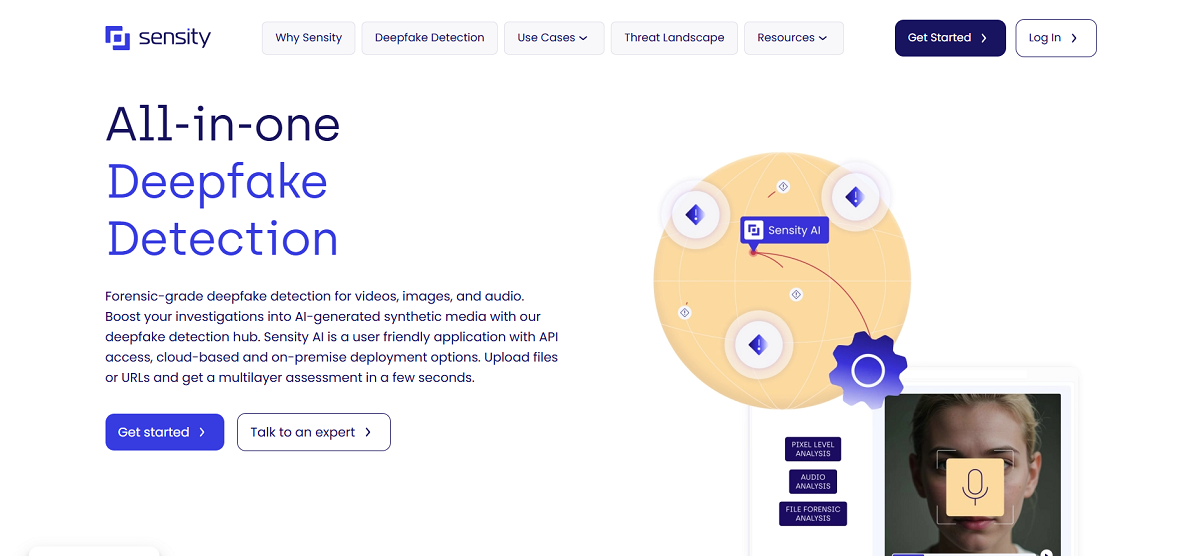
The Sensity AI deepfake detection platform aims to detect synthetic content at scale while monitoring digital channels continuously (social media feeds, websites, etc.). It’s widely used by cybersecurity, law enforcement, and trust & safety teams for the purposes of detection and threat intelligence around impersonation/fraud/misinformation campaigns.
Sensity supports real-time streaming as well as batch analysis use cases.
Key Features
Deepfake Detection for Audio, Video, and Images: Detects manipulated content using multimodal/media analysis. (Depth of detection varies by media type.)
Continuous Deepfake Media Monitoring: Scans sites, social media, and public feeds for emerging deepfake threats.
Media Forensics/Artifact Analysis: Detects manipulated content by analyzing artifacts at the pixel, structural, and audio levels.
Threat Intelligence and Campaign Tracking: Detects and correlates impersonation, coordinated attacks, and deepfake-fraudulent activity across channels.
Pros
- Handles video, videos with audio and images effectively
- Capable of continuous monitoring and media scanning
- Great for monitoring for targeted deepfake campaigns
- Suitable for trust & safety, cybersecurity, and general risk monitoring use cases
- Ability to scale to large-volume enterprise and government use
Cons
- Not as effective for real-time use cases beyond deepfake teleconference monitoring
- Biases more toward visual/media threats over deep voice
- Depending on your workflow, may need secondary system for response
- Media/video performance can vary based on content
- Enterprise setup can take time and tuning
Hive
Supported Media Types: Audio, Video, Images, Text
Best for: Content moderation and AI-generated content detection
Overview
Hive provides API-accessible machine learning models to analyze content at scale, including content classification and moderation solutions. For deepfake detection, Hive detects artifacts and signals associated with generative AI to determine whether the content was AI-generated or manipulated.
Hive’s deepfake detection models are part of its broader platform that includes AI-generated content detection (Hive Detect) and content classification and moderation (Hive Moderation). In addition to a confidence score on whether content was AI-generated or manipulated, Hive Moderation identifies what’s in the media (audio, video, text, images) and whether it violates policies.
Key Features
Multimodal AI-Generated Content Detection: Detects AI-generated content and synthetic media across images, video, audio, and text. Returns confidence scores and authenticity indicators.
Content Moderation and Classification: Classifies content as nudity, violence, hate speech, spam, and other identifiers, allowing teams to automatically moderate or take action on certain types of content.
50+ Metadata Labels: Returns more than 50 metadata labels to describe and classify content. This enables you to set your own rules (block, review, allow) based on the metadata.
API-First Architecture: APIs that integrate into your existing platforms and workflows for real-time processing.
Manual and Automated Workflows: Supports manual analysis, allowing users to upload files to the Hive Detect interface for investigation. Automated scanning is available via APIs.
Content Attribution: Identifies the generative AI model that was most likely used to create the content.
Pros
- Multimodal coverage across audio, video, images, and text
- Ideal for content moderation and trust & safety workflows
- Flexible API integrates easily with existing platforms
- Provides automated decision endpoints for content moderation (block, review, allow)
Cons
- Does not do conversation or behavior analysis
- Not designed for real-time use cases such as fraud prevention during live conversations
- Classification results must be used with your own moderation or decisioning system (no built-in enforcement workflows)
- Does not analyze context
- Does not maintain audit logs
Best Deepfake Detection Tools Comparison Chart
●MODULATE
Deepfake Detection Software Comparison
How 7 deepfake detection tools compare
Modulate, Resemble AI, Pindrop, identifAI, Reality Defender, Sensity AI and Hive Detect across 19 capabilities. Scroll sideways to see every platform. The feature column stays in place.
| Feature | Modulate | Resemble AI | Pindrop | identifAI | Reality Defender | Sensity AI | Hive Detect |
|---|---|---|---|---|---|---|---|
| Real-Time Detection | Yes | Yes | Yes | No | Yes | Yes | Yes |
| Batch Detection | Yes | Yes | No | Yes | Yes | Yes | No |
| Primary Use Case | Fraud prevention (contact centers, voice security) | Voice AI + deepfake detection | Call center fraud detection & authentication | Media verification | Enterprise deepfake detection & impersonation prevention | Threat intelligence & misinformation detection | AI-generated content detection and moderation |
| Detection Approach | Ensemble Listening Model (ELM): Audio signal + behavioral + conversational analysis | Neural audio/video models + watermarking | Metadata heuristic analysis. Multimodal AI models (audio/video), biometric identification/bad actor matching, dial pattern detection | Multimodal AI models (audio, visual, metadata) | Multimodal AI models (audio, visual, metadata) | Media forensics + OSINT monitoring | Multimodal AI models (audio, video, images, text) |
| Voice Deepfake Detection | Yes | Yes | Yes | Yes | Yes | Yes | Yes |
| Video Deepfake Detection | No | Yes | Limited | Yes | Yes | Yes | Yes |
| Image Deepfake Detection | No | Yes | No | Yes | Yes | Yes | Yes |
| Text / LLM Content Detection | No | No | No | No | No | No | Yes |
| Behavioral / Intent Analysis | Yes | No | No | No | No | No | No |
| Liveness Detection | No | No | Yes | No | No | No | Yes |
| Fraud / Security Capabilities | Deepfake + social engineering + behavioral fraud detection | Deepfake detection + watermarking + voice auth | Deepfake + authentication + fraud risk scoring | Detection only (limited fraud workflows) | Detection + risk scoring + investigation tools | Detection + threat intelligence | Fraud detection identity verification + document verification |
| Fraud Prevention Workflows | Yes | No | Yes | No | No | No | Yes |
| Identity Verification / Biometrics | Limited | Yes | Yes | No | No | No | Limited |
| Real-Time Alerts | Yes | Limited | Yes | Limited | Yes | Limited | Limited |
| Live Intervention Capability | Yes | No | Yes | No | Yes | No | Yes |
| API Available | Yes | Yes | Yes | Yes | Yes | Yes | Yes |
| On-Prem / Air-Gapped Deployment | Limited | Yes | Yes | No | Yes | Yes | Yes |
| Multi-Modal Capability | No | Yes | Yes | Yes | Yes | Yes | Yes |
| Best For | Real-time voice fraud detection | Voice AI teams | Contact center fraud | Media verification | Enterprise detection | Threat monitoring | Content moderation |
Compiled by Modulate from public product information, 2026. Yes = full capability, Limited = partial, No = not offered. Verify current capabilities with each vendor.
What is a Deepfake Detection Tool?
A deepfake detection tool is software that detects whether audio, video, images, or text were tampered with or created by AI. You feed the tool a media file or stream it online content, and the detector checks for signs that the media is real or generated.
Essentially, deepfake detectors are machine learning models that have been fed thousands or millions of examples of real and fake media. Over time, these models recognize patterns that indicate the subtle clues generative AI inserts when creating fake media.
These signs vary depending on the medium. Some are human-detectable signs, while others are machine-level signals that are not easily perceptible to the human eye or ear.
Human-detectable signs:
- Audio (voice deepfakes): distorted tone, unnatural rhythm, or background noise that doesn’t line up
- Video and images: facial abnormalities, inconsistent lighting, or unnatural blinking
- Text: repeated phrases or statistical patterns that aren’t natural for humans
Machine-detectable signs:
- Audio (voice deepfakes): spectrogram artifacts, timing irregularities, and other signal-level anomalies
- Video and images: pixel-level inconsistencies, compression artifacts, or mismatched physiological signals like facial blood flow or breathing patterns (video only)
- Text: statistical distributions, model-specific generation patterns, or token probabilities
The detection software can work in one of two ways:
- Real-time detection that works on live content, such as phone calls, live streams, or video meetings
- Batch processing of files for post-hoc verification
But different deepfake detectors are designed to solve different problems. Media verification use cases focus on analyzing content after the fact. Security applications and fraud prevention solutions are optimized for use during an interaction.
Deepfake detection can help you spot manipulated content. But that’s just one piece of the puzzle. You also need to stop attacks as they’re happening, confirm identities, and determine the intent behind an interaction.
Features to Look for in a Deepfake Detection Tool
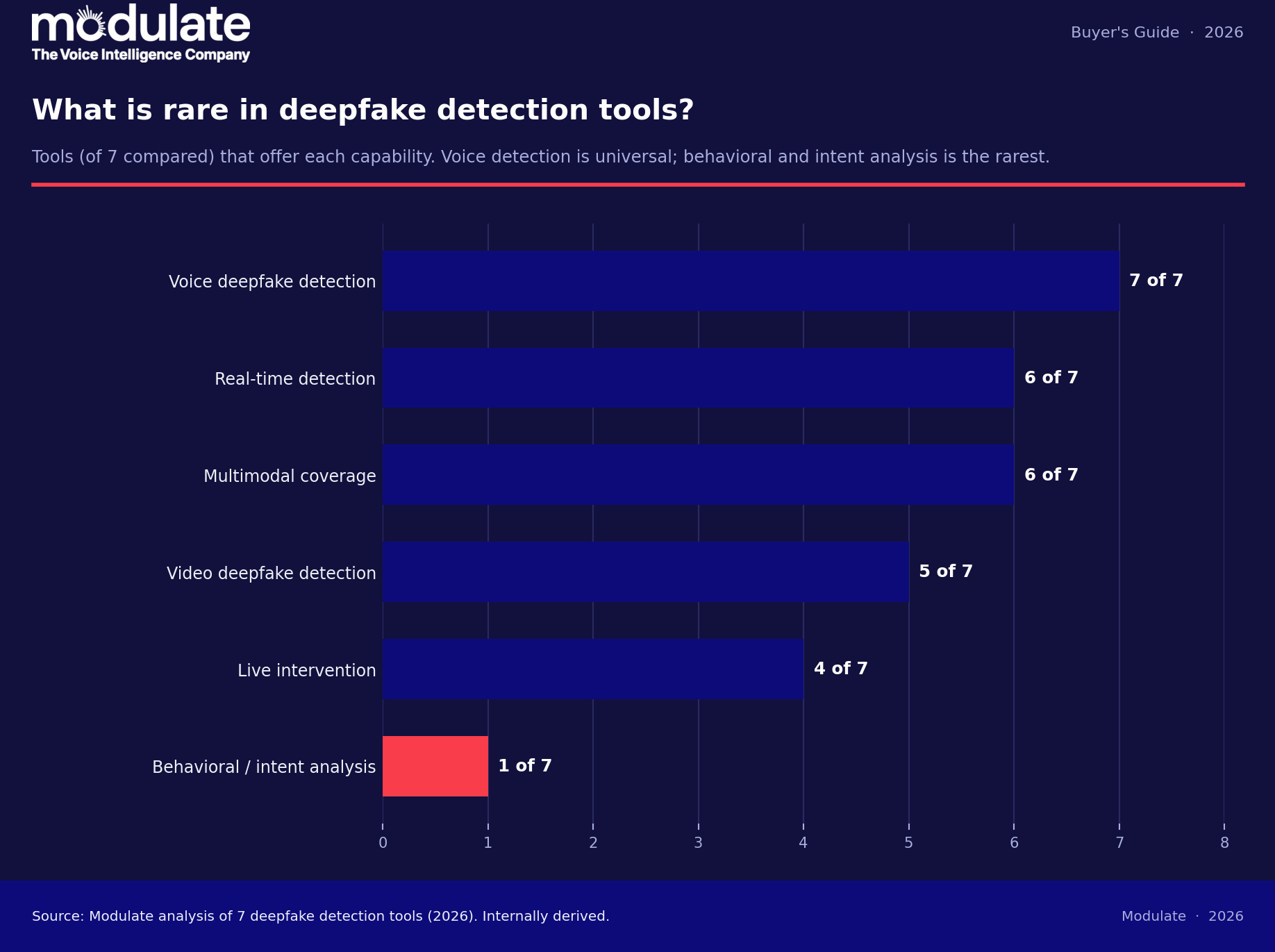
Deepfake detection software varies widely. Some specialize in media forensics and verification. Some are meant for fraud prevention or identity verification. Others offer large-scale monitoring solutions.
Don’t just be swayed by a demo. Make sure the tool is right for your intended use case. Use this list to compare features that matter when selecting deepfake detection software.
New to the topic? Start with our explainer on how to detect deepfakes, then come back to the comparison.
Real-Time vs. Batch Processing
Your use case should dictate the type of solution you need.
Will you be detecting deepfakes during a live phone call or video chat? Do you need to analyze files after they’re uploaded?
- Real-time detection is necessary for live use cases like fraud prevention.
- Detecting deepfakes after the fact is useful for verifying media.
If you care about speed, low-latency and fast response times should be a requirement.
Supported Media Types (Audio, Video, Images, Text)
Deepfake detection tools vary on the types of content they support.
- Audio - Voice cloning and vishing scams
- Video/Images - Impersonation attacks and media forensics
- Text - AI-generated text detection
Pick a tool that supports the content types you care about. A video-analysis tool won’t catch voice cloning. A text-analysis tool won’t help with media forensics.
Level of Analysis
Tools can detect deepfakes on a superficial level. Or they can dig much deeper.
Basic detection software looks for:
- Visual artifacts
- Audio artifacts
- Known signatures or patterns
Advanced software detects deepfakes by analyzing:
- Behavior
- Context
- Intent
- Biometrics/signals
The latter is important for defending against the next generation of deepfakes
Performance with Real-World Content
Some tools look for surface-level artifacts. Others go deeper.
Challenge your vendors with scenarios you’ll encounter, such as:
- Background noise
- Compression artifacts (Skype calls, Whatsapp videos, etc.)
- Low quality video
- Multiple speakers talking at once
If possible, test with your own content (not their demos).
Fraud Detection and Prevention
Detection is just the first step. What you do with that information matters too.
Ask about:
- Fraud scoring
- Identity verification
- Fraud signals
- SIEM integration
If your use case involves stopping fraudulent activity, detection isn’t enough.
Advanced Behavioral Analysis
Most software focuses on what was said (or generated). Less focus is put on how it’s being used.
For voice and conversational use cases, look for tools that can identify:
- Social engineering patterns
- Emotional exploitation
- Scripted or coached responses
This is especially important in contact centers and financial services.
Liveness and Identity Detection
If you’re verifying someone’s identity, you need to ensure a human is on the other end of the line.
Look for:
- Liveness detection (this prevents replay attacks)
- Biometric identification (facial recognition, voice identification)
Identity verification shouldn’t just rely on something the user knows. It should know who is speaking as well.
Integration and Architecture
How will this tool fit into your existing workflow?
Do they provide:
- APIs to embed detection capabilities into your software?
- Compatibility with common telecom, video, or identity providers?
- On-prem deployments? Air-gapped environments?
Don’t sacrifice flexibility for detection power.
Volume and Monitoring Capabilities
Detection can be done on a one-off, per-file basis. But some use cases require monitoring.
Ensure the tool can:
- Process video, audio, and text at scale
- Monitor content or interactions in real-time
- Scale as your company grows
It’s More Than “Does It Detect Deepfakes?”
A better question is:
Does it help me solve my specific use case?
Knowing what you need the tool to do will help you prioritize features. If you’re looking for a media verification tool, detection accuracy is your primary concern. If you’re looking to prevent vishing or voice cloning fraud, real-time detection and fraud prevention capabilities should be your focus. If you’re verifying the identity of your users, you need identity proofing and liveness detection.
Deepfake detection is just a tool. The value you derive from it depends on your use case.
Frequently Asked Questions
How effective are deepfake detection tools?
Vendor claims range drastically depending on solution, media type, and conditions presented. While vendors claim anywhere from 50% to 100% accuracy in controlled testing, performance will vary based on recording quality, compression levels, background noise, audio/music, and many other real-world factors. The only way to know for sure is to test detection accuracy with your own data.
Are deepfake detection tools able to process media in real time?
Detection solutions differ in that some can process live audio/video streams and return results in real time, while others only offer APIs for post-processing media files. Real-time detection is necessary for preventing fraud and stopping manipulation during live calls while most media verification uses batch or bulk processing.
What kinds of deepfakes can these tools detect?
It depends which platform you choose. Some vendors focus on voice deepfake detection while others may focus on video, image, or text. There are also multi-modal platforms that support several types of media but not all vendors use true multi-modal deepfake technology.
Can deepfake detection stop fraud from happening?
On their own, most deepfake detection solutions can detect manipulated content but cannot stop fraud from occurring. Typically, fraud prevention requires a few pieces from several different platforms such as identity verification, risk scoring, and real-time workflows for human intervention.
How does deepfake detection differ from identity verification?
Deepfake detection tells you if content was synthetic or not. Identity verification tells you if someone is who they claim to be. Some products offer both features, but they address different use cases.
Can deepfake detection tools be integrated into my existing infrastructure?
Absolutely. Most tools offer APIs and SDKs that allow you to easily integrate their technology into your applications, contact center platform, identity verification system, or content moderation pipeline.
What’s the difference between real-time detection and batch analysis?
Real-time detection occurs while content is being created/uploaded/transmitted. For example, if you want to scan every call as it happens in your contact center, you’ll need a real-time solution. Batch analysis involves reviewing content after-the-fact, such as an uploaded video or an already-recorded call.