
Modulate ML Team Announces New Public Entity Transcription Benchmark
40+ Call Center Statistics for 2026: AI, CX & Performance
July 29, 2026


Key Takeaways:
- Contact centers are experiencing increased pressure from customers, employees and fraud. This pressure continues to create an urgency for real-time intelligence.
- AI adoption isn’t what sets top performing call centers apart from the rest. Call centers that have executed on AI are winning.
The call center industry is facing one of the most significant transformations in its history. Today, 88% of call centers use AI in at least one business function. By 2034, the global call center AI market is expected to grow from about $3 billion today to over $13 billion. Customer expectations are higher than ever, with 88% of customers saying they expect a faster response time than they did one year ago and 74% of customers expecting companies to be available 24/7. If you don't meet those expectations, you'll lose business. Poor customer experience puts $3.8 trillion in global sales at risk every year.
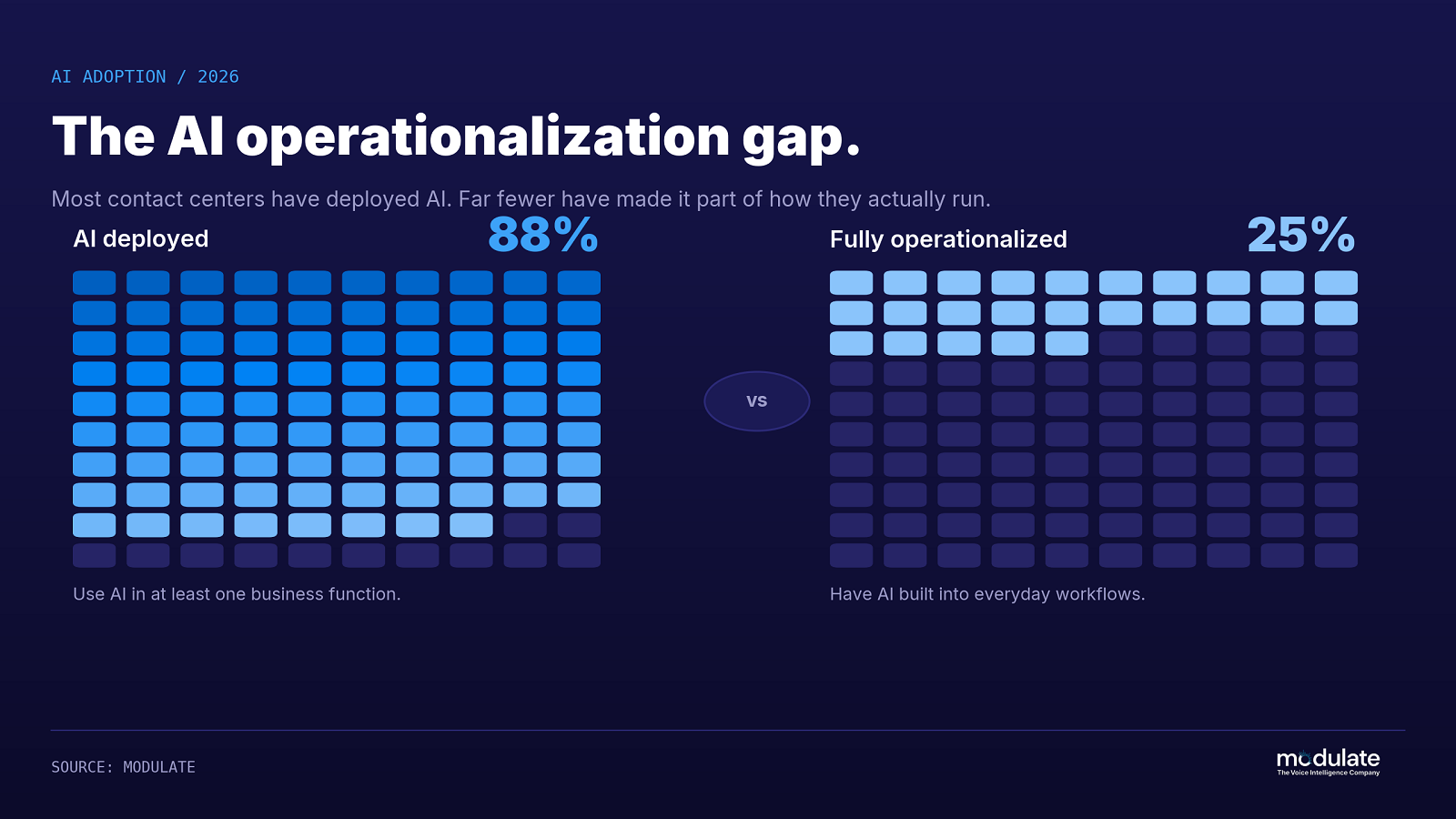
Adoption alone isn’t enough. Although most contact centers have invested in some type of AI technology, only 1 in 4 organizations have truly operationalized AI into their everyday work processes. It’s the space between early adoption and successful operationalization where competition will be won or lost. Read on for statistics that will give you an unbiased look at where the industry stands in 2026, covering everything from AI ROI, performance benchmarks, talent gaps, to increasing security risks.
 MODULATE
Contact Center Cost-to-Serve Calculator
Estimate annual savings from shifting routine contacts to automation, using 2024–2025 benchmark costs. Adjust any input. Math runs in your browser.
$0
estimated annual savings from automating routine contacts
0
contacts automated / year
0%
cut in cost-to-serve on those contacts
Method and sources
Savings = monthly calls × 12 × automatable share × (human cost minus AI cost). Default human cost $3 to $6 and AI cost $0.25 to $0.50 per interaction, per Freshworks. Automation can offset up to 50% of contacts, also Freshworks. Automating routine volume does not remove the need to secure live calls: most account takeovers still begin with an agent.
Market Size and Growth
1. Call center AI will be a $2.98 billion market globally in 2026, expanding at a compound annual growth rate of 20.80% through 2034 (Fortune Business Insights).
2. By 2034, the market is expected to reach $13.52 billion, more than 4x growth over the forecast period (Fortune Business Insights).
3. North America holds the largest share of the call center AI software market, driving worldwide demand (Fortune Business Insights).
4. The global conversational AI market size is projected to grow from $17.05 billion in 20 25 to $49.80 billion by 2031 (MarketsandMarkets).
AI and Automation Adoption
5. AI is now present in at least one business function for 88% of organizations, up from 78% just one year prior (McKinsey).
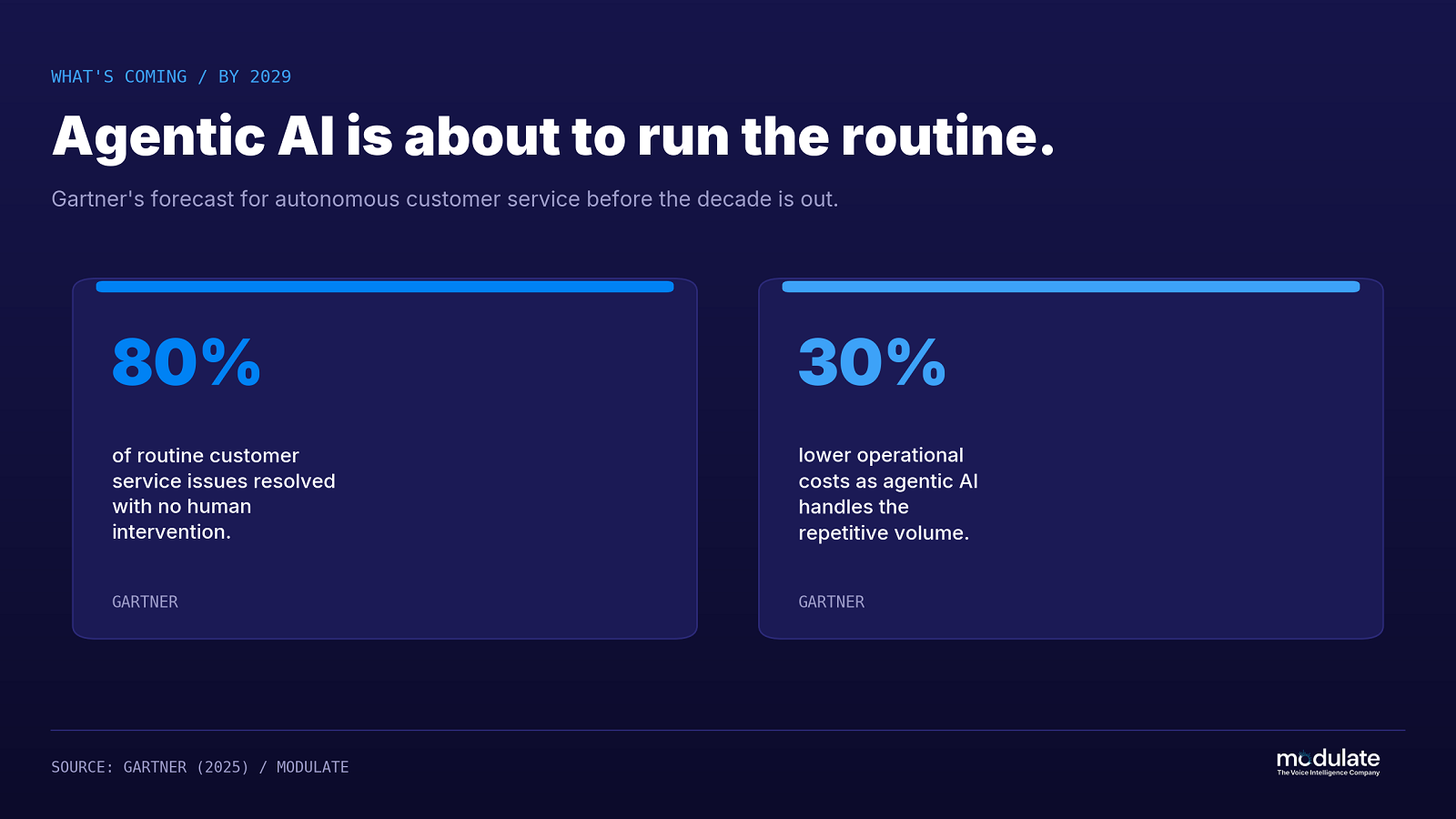
6. By 2029, Gartner predicts agentic AI will solve 80% of routine customer service issues without human intervention and reduce operational costs by 30% (Gartner).
7. 74% of organizations say their most advanced generative AI project has met or exceeded ROI expectations (Deloitte).
8. Call centers running speech analytics report spending 20% to 30% less and seeing CSAT scores increase by 10%, while enabling AI to analyze 100% of calls instead of relying on manually analyzing a small sample of calls (McKinsey).
9. Service innovation leaders, defined as the top-quartile contact centers from Deloitte Digital’s 2024 Global Contact Center Survey, are 8 times more likely to report the deployment of generative AI than organizations with below-average service capabilities (PR Newswire / Deloitte Digital).
10. Those top-quartile performers are 4.6x more likely to report excellent customer satisfaction and 2.5x more likely to report excellent employee satisfaction than their below-average counterparts (PR Newswire / Deloitte Digital).
ROI and Cost
11. Effective conversational AI provides greater than a 20% decrease in cost- to-serve (McKinsey).
12. Conversational AI has the potential to decrease human handled contacts by 50% (McKinsey).
13. Conversational AI could lower contact center agent labor expenses by $80 billion by 2026 (Gartner).
14. Support agents equipped with AI technology handle 13.8% more inquiries per hour (NBER).
Performance Benchmarks
15. The average cross-industry first call resolution rate is 69% (SQM Group).
16. Ideal FCR rate ranges from 70% to 79%. World-class call centers resolve 80% of problems on the first contact (SQM Group).
17. Despite the debate around the 80/20 service-level rule, it continues to be an effective target: 80 percent of calls should be answered in 20 seconds (Call Centre Helper).
18. The national average handle time (AHT) increased to 697 seconds (or 11.6 minutes) in SQM Group's 2024 benchmarking report. This represents an 18% year-over-year increase (SQM Group).
19. For the typical midsize call center, every 1% increase in FCR rate equates to $286,000 in annual savings (SQM Group).
20. Around 6% is considered standard when it comes to call abandonment rate. A call abandonment rate below 5% is good. If your call abandonment rate is over 10%, that’s a problem (SQM Group).
21. When customers are placed on hold, CSAT decreases by 13% and FCR falls by 16% when compared to calls where customers are never put on hold (SQM Group).
Customer Expectations and Loyalty
22. 63% of consumers will switch to a competitor after just one bad experience (Zendesk CX Trends 2025).
23. 88% of customers expect faster response times than a year ago (Zendesk 2026 CX Trends).
24. 74% of consumers now expect customer service to be available 24/7 (Zendesk 2026 CX Trends).
25. 71% of consumers expect personalized interactions, while 76% are frustrated when they do not get them (McKinsey).
26. More than eight out of ten CX leaders (85%) believe that a customer will leave their brand due to a single unresolved problem (Zendesk CX Trends 2026).
27. Weak customer experiences are hurting the bottom line. It’s estimated that poor customer experiences are putting $3.8 trillion in global sales at risk (Qualtrics XM Institute).
28. In 2024, US customer experience quality reached an all-time low and declined for the third year in a row, according to Forrester’s annual CX Index. Performance deteriorated across all three dimensions that Forrester measures: effectiveness, ease of use, and emotion (Forrester).
29. Just 3% of companies could be considered customer obsessed (they put customers’ needs, wants and satisfaction at the core of their businesses), though 81% think they are (Forrester).
30. IIn the 2025 Forrester Global CX Index, a quarter of US brands scored lower for the second year in a row, and just 7% improved. (Forrester)
The Agent Workforce
31. Yearly call center attrition averages between 30% and 45% (Insignia Resources).
32. Turnover in the call center increased to 31.2% annually in Metrigy’s 2024 study (Metrigy).
33. Attrition within the first year ranges from 69% to 73%, indicating that the majority of turnover occurs within 12 months of employment (Insignia Resources).
34. Remote call centers experience 15 to 20 percentage points less turnover than physical locations (Insignia Resources).
35. 37.6% of contact centers reported no attrition issues in 2022, up from 23.4% the previous year (Call Centre Helper).
36. More than 75% of contact center executives report agents feel overwhelmed by systems and information (CX Dive / Deloitte Digital).
37. At organizations that have already implemented generative AI, about 53% of agents say they feel overwhelmed during calls, compared with 81% of agents at organizations that have not yet implemented it (CX Dive / Deloitte Digital).
38. 87% of contact center agents say they are suffering from high levels of stress, and more than half experience daily burnout, sleep problems, or emotional drain (CX Today / ILR School, Cornell University and DeGroote School of Business, McMaster Report).
39. Customer satisfaction improves by 26% when call center employee turnover is maintained below 15%, according to Metrigy (TechTarget / Metrigy).
Fraud and Security
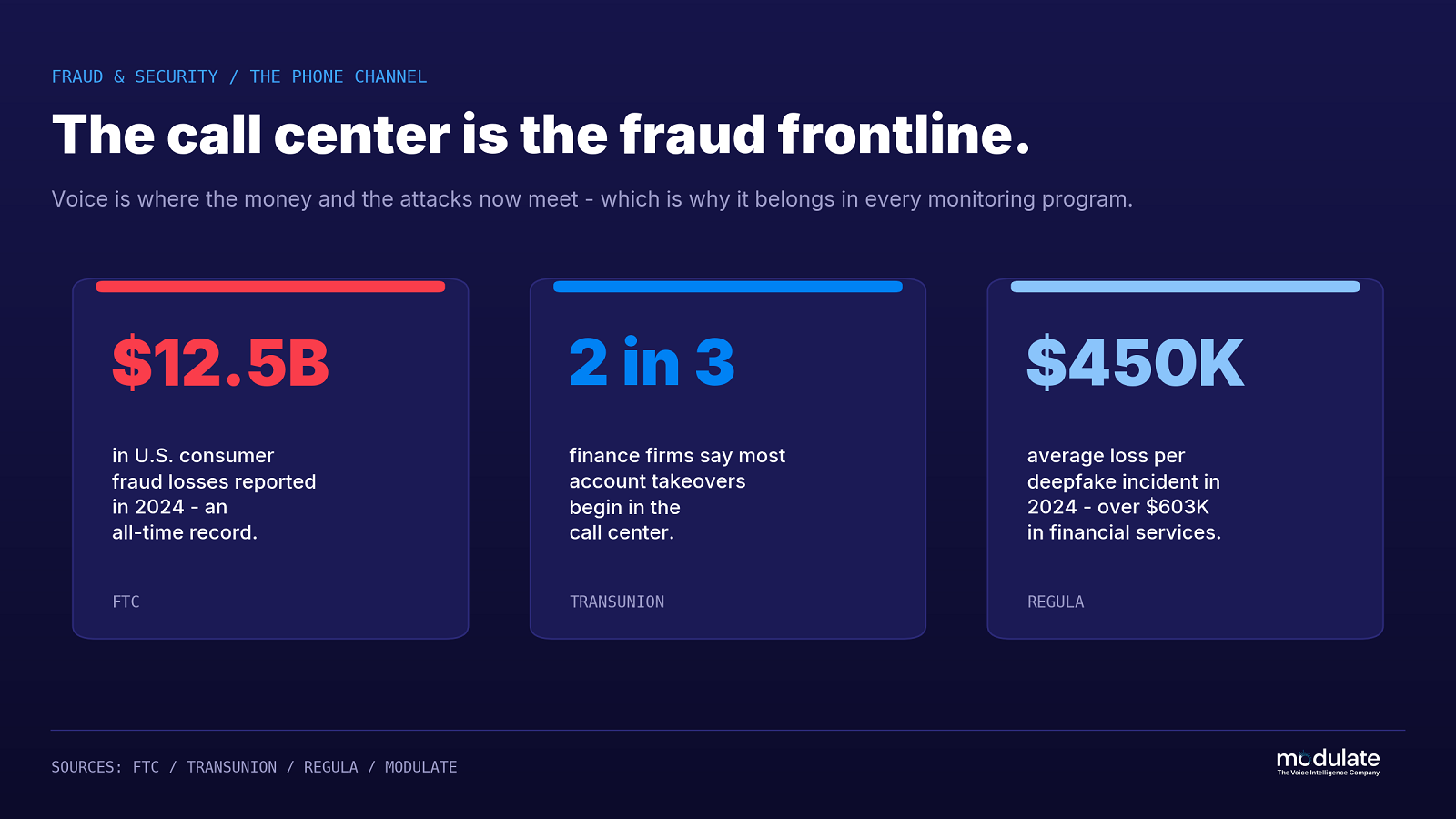
40. The FTC recorded a then-all-time high $12.5 billion in consumer-reported fraud losses in 2024, up significantly from the year prior (Federal Trade Commission).
41. Nearly two-thirds of financial industry respondents say most account takeovers begin in the call center (TransUnion).
42. Deepfake attempts were made approximately every five minutes in 2024 (Entrust).
43. Companies faced average losses of almost $450,000 per deepfake incident in 2024. The financial industry’s average exceeded $603,000 per incident (Regula).
Turning Call Center Monitoring Data Into Action
What do these numbers tell us? Call centers are being attacked from all directions: increasing customer expectations, an escalating talent crunch, widespread AI fueled fraud, growing pains of AI adoption vs. actual operationalization. Knowing the numbers is one thing. Having the ability to improve upon them is another.
Modulate's voice intelligence platform, Velma, was built specifically to tackle the most urgent issues highlighted in this report, and do it all simultaneously and in real time. Where typical models only work off of transcripts retrospectively, Velma is an innovative voice-native Ensemble Listening Model (ELM) that assesses what is really going on in a conversation as it’s happening. It picks up on tone, emotion, stress, intent, and deception indicators not revealed in transcripts alone.
Bridging the AI operationalization gap. Only 1 in 4 organizations have fully operationalized AI into everyday business processes. If your pilot is great, but unreliable or doesn’t integrate with your existing stack, it’s just a project. Velma works directly with the telephony, CCaaS, and ticketing systems that contact centers are already using, such as Genesys, Five9, Zendesk, Zoom, and more.
Reducing burnout and attrition. With most agents experiencing burnout and annual turnover rates as high as 45%, the human toll on contact centers is taking its toll. Modulate's workforce management solution for contact centers scores and flags abusive and aggressive calls, highlights emotionally charged interactions for manager review, and prompts agents to take breaks following tough customer interactions, empowering supervisors to take action on behalf of agents who are too stressed to advocate for themselves. Studies have proven that retaining churn under 15% can increase customer satisfaction scores by 26%, and Modulate provides operations leaders with the real-time visibility they need to make that happen.
Preventing fraud before it happens. With an increasing portion of financial account takeovers originating in the call center, and deepfake attempts every five minutes, post-call review is simply too slow. Modulate's commercial fraud solution employs world-class deepfake detection to warn agents in real-time, during live calls; detects social engineering by flagging urgency clues and a coercive tone of voice; and correlates suspicious activity across calls to identify coordinated attacks before they strike. Without this, you’re facing an average loss of $450,000 for each deepfake-related incident.
Driving CX at scale. Modulate powers customer experience at scale for contact centers that are fighting back against the three-year industry-wide decline in customer experience quality that Forrester recently reported. Modulate's CX solution captures and analyzes 100% of conversations (not just manual reviews of a sample), provides agents with real-time emotion and temperament context, and scores every conversation to identify exactly what great reps are doing that others aren't. The result: a repeatable process to improve first call resolution, reduce handle time, and deliver the personalized experience 71% of consumers expect.
If anything is clear from the benchmarks highlighted in this article, it’s that leading contact centers in 2026 have moved beyond shallow AI experiences. Modulate helps by delivering voice intelligence that’s right out of the box, magnitudes cheaper than LLM alternatives, and designed with privacy, compliance, and auditability in mind.
Frequently Asked Questions
How much is AI truly impacting the call center industry?
AI is having a significant impact on the call center industry. AI has been deployed by 88% of companies into at least one business operation. Human-handled contacts drop up to 50%, while agents answer 13.8% more inquiries per hour. AI analyzes 100% of calls vs humans manually reviewing a small percentage. Currently, the call center AI industry is a $3 billion market and is expected to reach $13+ billion by 2034. Gartner estimates that by 2029, agentic AI will autonomously resolve 80% of standard customer service interactions.
Is AI investment delivering a positive return on investment (ROI)?
For mature adopters, yes. 74% of organizations report that their leading-edge generative AI effort is realizing or beating ROI expectations, and when implemented effectively, conversational AI has been shown to drive more than 20% reductions in cost-to-serve and reduce costs by 20–30% in contact centers leveraging speech analytics. Here’s the catch: Only 25% of organizations have completely deployed AI technologies into production, suggesting that there’s a lot of opportunity left on the table for the rest of the industry.
What are the most critical performance benchmarks for a call center?
The key performance metrics you should be tracking:
- First Call Resolution (FCR): The industry average is 69%, world-class is 80%+. Improvements here are worth $286,000 per 1% improvement.
- Service level: Defined as 80% of calls answered in 20 seconds or less.
- Average Handle Time (AHT): 697 seconds in 2024, up 18% year- over-year.
- Abandonment rate: The standard is 6%. Higher than 10% is considered abnormal.
- Hold usage: Time on hold decreases CSAT score by 13% and FCR by 16%.
How bad is the agent turnover problem, and how does it affect the business?
Industry-wide annual turnover rates range from 30-45%. 69-73% of new agents leave within their first year on the job. 87% of agents report their job is highly stressful, and over 50% experience daily burnout. Study after study has shown how improving agent retention helps the bottom line: turnover below 15% can increase your CSAT scores by as much as 26%. Remote operations have a built-in advantage: We consistently see 15-20 percentage points lower turnover than traditional brick-and-mortar call centers.
What sets the top-performing contact centers apart from the rest?
AI, specifically how far they’ve operationalized it. “Service innovators” in the top quartile are 8x more likely to have deployed generative AI than their less advanced peers, and the impact is evident: They’re 4.6x more likely to have excellent customer satisfaction and 2.5x more likely to have excellent employee satisfaction. It’s about operationalization, not just adoption.