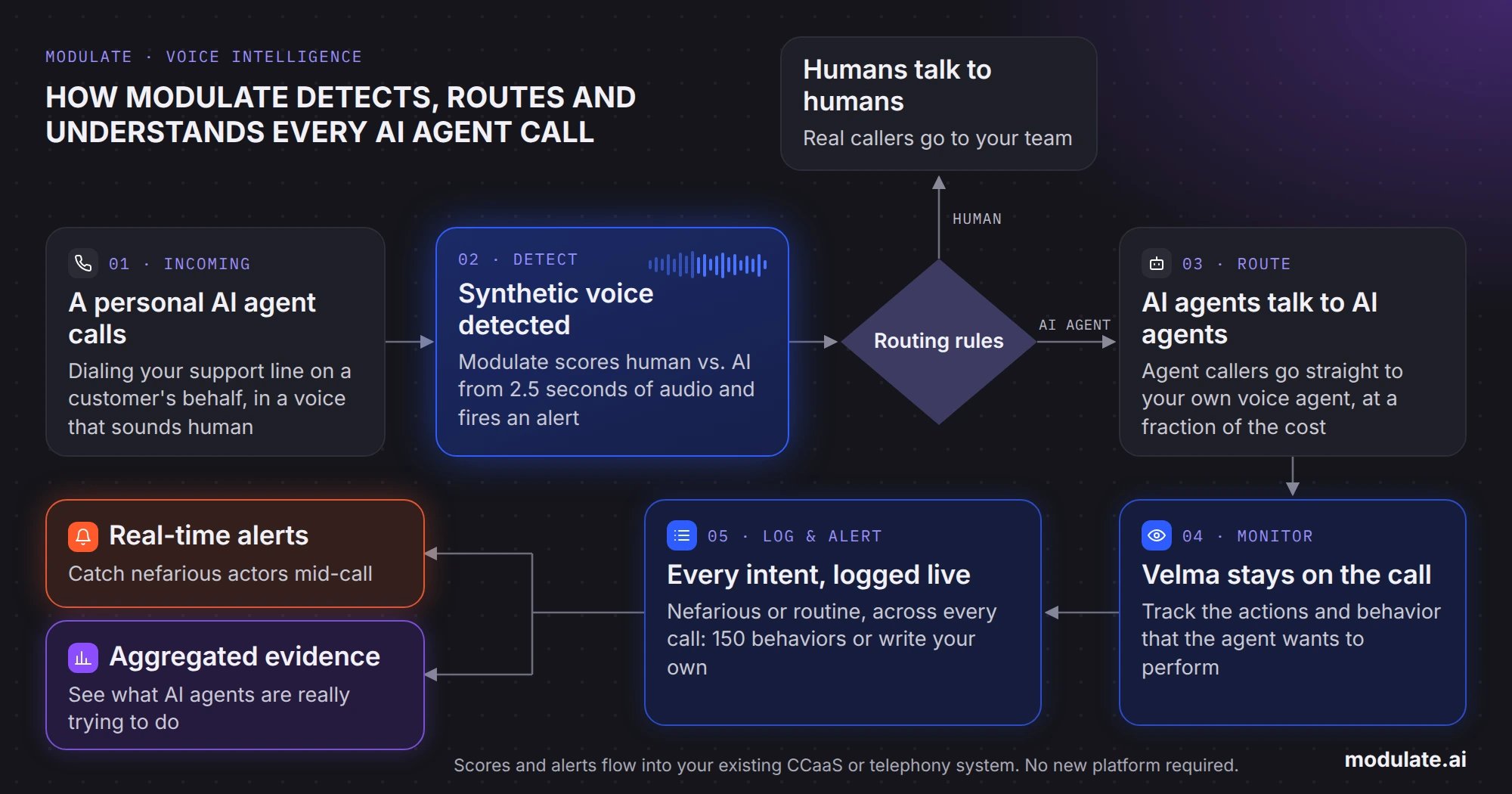
AI Agents Are Calling. Modulate Makes Routing Them Easy.
Fraud Got Smarter. So Did Detection: AI Fraud Detection Trends for 2026
July 24, 2026


Twenty-six percent (26%) of U.S. consumers have lost money to digital fraud within the past year, according to TransUnion’s H1 2026 Update to the Top Fraud Trends Report. Businesses are noticing, too. According to Trustpair, 71% of companies in the U.S. have experienced an increase in AI-powered fraud attempts in the past year (Fraud in the Cyber Era: 2026 Fraud Trends and Insights).
While businesses are rightfully concerned, AI isn't just helping fraudsters. Organizations are beginning to harness the power of AI to identify suspicious activity, monitor customer activity, and prevent fraud from occurring. Some promising trends are emerging that show that, while fraud is on the rise, so is organizations' ability to rise to the challenge.
The Fraud Arms Race Has Reached a Tipping Point
Fraud is getting smarter and faster, largely thanks to creative scammers and the availability of high-quality AI. “Criminals are weaponizing both consumer trust and emerging technologies. As GenAI accelerates the sophistication and scale of criminal operations, the threat landscape is evolving faster than ever for U.S. consumers and businesses,” says Naureen Ali, U.S. Head of Fraud at TransUnion.
This concern is echoed by Mike Pappas, CEO and co-founder of Modulate: “AI-powered tools available for the price of a tank of gas have given fraudsters unprecedented reach, speed, and sophistication,” he says.
At the same time, businesses are under pressure to protect customers while offering a speedy experience. “While headline-making deepfake attacks grab public attention, the true damage plays out quietly inside contact centers: soaring handle times, overwhelmed agents, frustrated customers, and verification processes that bog down service,” Pappas explains.
“The problem isn’t lack of vigilance, it’s lack of visibility,” says Pappas. “You can’t detect what you can’t measure, and most organizations simply don’t have the tools to analyse the sound of risk.”
“Addressing this requires a new generation of identity‑centric defenses that combine advanced analytics, adaptive authentication and multilayered fraud detection. Organizations must match fraudsters’ technological innovation to stay ahead of rapidly changing schemes,” says Ali.
Fraud Isn’t Just Growing. It’s Getting More Expensive.

Fraud has always been a problem, even before generative AI. U.S. fraud losses reached $5.8 billion in 2021 (one year before ChatGPT’s release), while internet crime losses were $6.9 billion. (FTC, FBI)
In 2024, consumers reported losing over $12.5 billion to fraud, a 25% increase from 2023. This staggering sum isn’t just annoying. Fraud can affect customer loyalty when your business manages their money or identity. (FTC)
Thirty-eight percent of consumers who reported fraud in 2024 lost money due to fraud. That’s an increase from the 27% of consumers who filed a report in 2023. Basically, more fraudsters are successful than in years prior. (FTC)
Fraud departments are drowning in scam reports as well. The FTC received fraud reports from 2.6 million consumers in 2024, in addition to more than 1.1 million reports of identity theft through IdentityTheft.gov. (FTC)
Scammers are going where the money is. As such, they’re using slicker scripts, impersonation and social engineering tactics to reach their targets. The unfortunate result is that it can be difficult to know what’s legitimate and what’s a scam. Consumers reported losing $5.7 billion to investment scams in 2024, the highest dollar loss of any category. (FTC)
Financial Crime Is Going Global, Fast
INTERPOL supported the recovery of $439 million in proceeds from financial crime around the world in 2025. That’s great news, but it also highlights how big and interconnected fraud rings have become. (World Border Congress)
The total number of notices and diffusions related to fraud jumped 54% since 2024. Translation: transnational fraud is becoming more complex and harder to pursue once it’s already occurred. (INTERPOL)
Crime doesn’t respect borders. Whether it’s human trafficking or fraud scams, criminals operate on a global scale. INTERPOL supported member countries in more than 1,500 transnational fraud cases involving lost assets valued at $1.1 billion. (INTERPOL)
Europe alone processed an estimated $750.2 billion in dirty money last year. Fraud contributed $103.6 billion of that total. (Verafin)
Businesses have increased investments in fraud prevention tools over the years. But simply allocating more money doesn’t guarantee success. Financial institutions only catch around 2% of worldwide financial crime proceeds, even though many dedicated up to 10% of annual revenues on AML programs between 2015 and 2022. That’s why businesses are increasingly looking to AI-powered tools rather than static rulesets. New transaction-monitoring technologies are able to keep pace with rapidly expanding transaction volumes. In fact, transaction volumes are exploding. (McKinsey)
The global payments industry grew at about 7% per year from 2018 to 2023. From 2023 to 2028, that number is expected to rise 5% annually. More payments are generally a good problem for businesses to have. But it also means there’s more activity to monitor for suspicious behavior. (McKinsey)
AI Is Raising the Stakes for Identity Fraud

Awareness of AI-driven fraud is increasing. A 2024 survey conducted by Ping Identity found that more than half of organizations (54%) believe that AI will result in an increase in identity fraud. (Ping Identity)
The frightening thing isn’t just increased fraud. It’s far more sophisticated fraud at a scale no human could achieve alone. If organizations don’t get ahead of it, businesses will be faced with billions of dollars in expensive headaches down the line. Without preventive measures in place, generative AI could increase U.S. fraud losses from $12.3 billion this year to $40 billion by 2027, or a CAGR of 32%. (Deloitte)
AI-powered cybercrime may reach $10 trillion a year by 2030. That number is almost unimaginable. But generative AI is drastically reducing the expense and manpower required to massively scale scams, impersonations, phishing attempts, and social engineering attacks. Criminals these days don’t need huge crews. They just need smarter automation. (Protegrity)
We’ve all seen the typical phishing email. That’s nothing new. But the Deloitte Center for Financial Services thinks generative AI could drive email fraud losses to $11.5 billion by 2027. Fraudsters can realistically sound like (and look like) anyone using AI, so they won’t need proficiency in English, graphic design, or massive amounts of free time. AI will do all the heavy lifting. (Deloitte)
Voice cloning is becoming more difficult to detect. In a study conducted by researchers at Queen Mary University of London, cloned voices successfully tricked listeners 58% of the time, while generic AI voices fooled listeners 44% of the time. (“Voice clones sound realistic but not (yet) hyperrealistic” via PLOS One, as reported by ACA International and The University Network)
Deepfakes are growing exponentially. The number of Deepfake files grew from 500,000 in 2023 to more than 8 million in 2025. (DeepStrike, as reported by ACA International)
Deepfakes are increasingly used to carry out fraud. North America saw the largest regional jump for deepfake-related fraud with an increase of 1,740% from 2022 to 2023. (Sumsub Research, as reported by Statista)
Synthetic identity fraud is considered a threat by 88% of organizations. Forty-six percent (46%) have already experienced it. Voice fraud has been experienced by 37% of organizations, while 29% of organizations have experienced deepfake-related fraud. (Regula)
The same generative models are reshaping music, where synthetic audio is already mainstream.
Consumers Are Worried, but They’re Also Open to AI Protection
Consumers are aware that technology is advancing at a rapid pace. And many believe that fraudsters are advancing right along with it. 88% of consumers are at least somewhat concerned that scammers will use AI to commit identity fraud. (Javelin, as reported by Visa Acceptance Solutions)
Consumers aren’t balking at the use of AI, either. Almost half of consumers (49%) say they’re comfortable with their financial institution using artificial intelligence to fight fraud, provided they can explain how it works. (Javelin, as reported by Visa Acceptance Solutions)
In fact, most people are okay with AI stepping in, as long as companies use it responsibly. Only 15% of consumers say they’d prefer non-AI methods for identity fraud protection. (Javelin, as reported by Visa Acceptance Solutions)
There’s still a confidence gap, though. Just 36% of consumers trust that their financial institution is already using AI responsibly to detect and prevent identity fraud. That puts pressure on organizations to show (not just say) that their fraud tools are working in customers’ best interests. (Javelin, as reported by Visa Acceptance Solutions)
Financial institutions aren’t waiting around for synthetic identity fraud to get worse. Identity verification is a tremendous need, and companies are stepping up. 83% plan to invest in new onboarding tools to detect synthetic identity fraud, while 36% plan on strengthening account management capabilities. (Datos Insights, as reported by Visa Acceptance)
Businesses Know the Old Playbook Isn’t Enough

Just 7% of organizations believe that they’re “more than moderately prepared” to fight AI-powered fraud. Which means a lot of companies still have legacy systems that weren’t designed for such a rapidly evolving threat landscape. (ACFE Anti-Fraud Technology Benchmarking Report, as reported by SAS)
If identity is easier than ever to fake, then verification needs to be more intelligent than ever. A report from Ping Identity revealed that 97% of organizations struggle with identity verification. Close to half (49%) say their fraud prevention strategy is only somewhat effective at preventing credential compromise. (Ping Identity)
Plenty of companies are experimenting with the technology, but few have operationalized it. Only 28% of organizations have fully deployed AI or machine-learning-driven fraud detection at scale. (FICO)
Even organizations with fraud systems in place still struggle with implementation. 33% say false-positive rates are high or very high. Preventing fraud is important, of course. But too many false positives frustrate both customers and security teams by flagging legitimate interactions. (FICO)
More than 4 out of 5 (84%) organizations say that budget or financial restrictions are an obstacle when it comes to implementing anti-fraud technology solutions. That said, more than half (55%) of organizations plan to increase their anti-fraud technology budgets within the next two years. (ACFE 2026 Anti-Fraud Technology Benchmarking Report, as reported by SAS)
AI Fraud Detection Is Starting to Deliver Real Results

AI fraud detection is a worthwhile investment. The Harvard Business School recently profiled a Tier 1 UK bank that cut its fraud alerts in half with machine-learning-driven fraud detection. The AI spotted 30% of fraud before payment was even attempted and helped drive a 20% reduction in fraud overall. (Harvard)
Fraud prevention shouldn’t only stop bad guys from doing bad things. Ideally, it also lifts unnecessary friction off of good customers. J.P. Morgan says its AI-powered payment validation screening did just that, reducing account validation rejection rates by 15% to 20%. (J.P. Morgan)
Organizations using proactive analytics can’t prevent all fraud. But they do see losses that are 50% lower than those of companies that don’t use AI-powered analytics. (ACFE)
AI delivers value in many ways, but if you ask executives, they believe its greatest value comes from fraud prevention. IBM found that 61% of banking executives see fraud risk detection as the AI use case with the most business value. (IBM)
Fraud rarely follows a script anymore, so detection tools can’t, either. Research published in MDPI found that machine learning-based fraud detection systems can outperform rule-based systems by identifying anomalous behavior patterns in real time. That’s just one way businesses are finding new paths to reduce friction and prevent fraud. (MDPI)
Stop Fraud with Velma’s Real-Time Voice Intelligence
Fraud is happening at an accelerating rate. Contact centers are on the front lines. Every call presents an opportunity for social engineering fraud, impersonation attacks and account takeover attempts. Fighting back requires technology that can detect the subtle indicators that humans can’t.
Modulate’s Velma voice intelligence platform can do just that. By listening for cues like tone, pacing, stress levels, as well as pauses and interruptions Velma detects risk indicators and behavioral changes as they happen, rather than hours later when it’s already too late. Rather than relying on outdated rules and reactive reviews like traditional fraud detection systems, Velma provides real-time, voice-native intelligence on every call.
Trained using 500+ million hours of real-world conversation data, Velma was built to perform in the noisy, ever-changing environments where fraudsters thrive and other solutions won’t catch them. Learn how Velma’s voice intelligence can empower your organization to detect fraud before it becomes a loss. See how Velma's voice intelligence can empower your organization to detect fraud before it becomes a loss.
Frequently Asked Questions
What types of fraud are traditionally the most difficult to detect?
Traditional fraud systems often miss scams that don't appear suspicious on the surface. Synthetic identities, account takeovers, social engineering, and policy abuse can evade rule-based systems since they often appear "normal." That's led companies to start using behavioral analysis and real-time monitoring to identify these newer scams.
What’s the difference between rule-based fraud detection and AI-powered fraud detection?
Rule-based fraud detection systems trigger on rules that you set, like credit card transactions exceeding a dollar amount or coming from an abnormal location. Artificial intelligence looks for suspicious patterns and anomalies that humans don’t always expect but can help organizations catch fraud as it’s happening. But you don't have to pick one fraud detection method. Both systems can detect different types of fraud and you should take advantage of both.
How can businesses reduce fraud without frustrating legitimate customers?
It’s tricky. Too many roadblocks lead to false positives, longer processing times and dropped carts. But too few safeguards leave you open to risk. More organizations are shifting to adaptive fraud programs that analyze context and behavior. This allows low-risk transactions to remain frictionless for your customers while applying added scrutiny to suspicious activity.