Modulate ML Team Announces New Public Entity Transcription Benchmark
AI Monitoring in Healthcare: Why Voice Intelligence Matters More Than Ever
July 30, 2026


Key Takeaways:
- Healthcare organizations can better understand the hidden compliance risks, potential fraud red flags and patient experience opportunities buried in everyday interactions through AI monitoring.
- AI monitoring enables proactive identification of compliance risk and helps uncover negative patient experience trends that humans overlook when buried deep in call data.
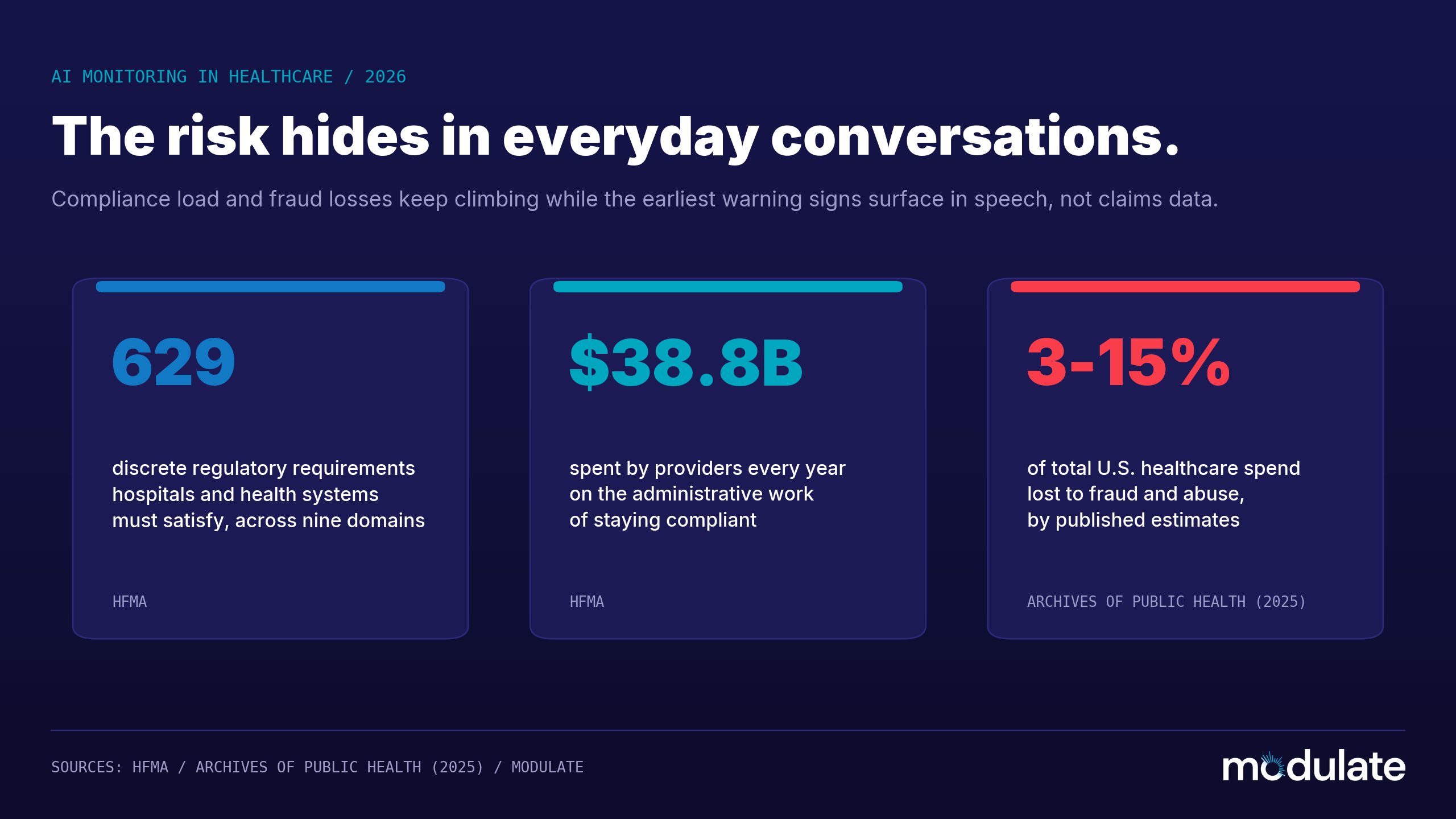
The U.S. healthcare system processes billions of patient interactions every day. And it’s missing the majority of risk embedded within those transactions. Healthcare providers like physicians, clinics and hospitals face 629 unique regulatory requirements spread across nine categories. They spend almost $39 billion each year on administrative paperwork trying to maintain compliance. Oh, and let’s not forget fraud: Medical fraud and abuse siphons off billions of dollars annually from the healthcare system. Experts estimate healthcare fraud to be anywhere from 3% to 15% of total healthcare spend. Many of the earliest signs show up well before it affects claims: It starts in speech.
AI-powered monitoring can help close those gaps. Not by adding more staff to your team, but rather intelligently listening to conversations already happening. In this blog, we will discuss what AI monitoring is, how it’s changing the game for healthcare operations, why voice is healthcare’s most underutilized asset, and how better monitoring equals better patient care, compliance, and fraud prevention.
What Is AI Monitoring in Healthcare?
There’s a lot of data being created in healthcare. However, it doesn’t always fit neatly into fields and dashboards. Sometimes our data is captured through conversation: A patient sounding confused reading medication instructions. A suspicious claims interaction. A call center call that triggers potential fraud. This is where AI monitoring in healthcare comes into play.
AI monitoring taps into artificial intelligence to make sense of those interactions and data. By spotting patterns and surfacing risks, AI monitoring can reveal insights that human analysts would likely miss if working at scale. And since it works at machine speed, it can identify issues that would be impossible to catch otherwise.
However, continuous monitoring is about more than automation to allow healthcare teams to complete manual tasks more quickly. Monitoring allows organizations to see what’s really going on: where risk is rising, where patients are experiencing gaps in care or where critical information is being missed.
The Case for AI Monitoring in Healthcare
The U.S. healthcare system handles millions of patient transactions daily, and most of the risk hiding within them is invisible. The average healthcare call center receives 2,000 calls per day. Patients make 3.5 calls on average every time they attempt to schedule an appointment. Hidden behind each call is hidden compliance exposure, untapped patient experience insights and fraud risk.
The price of regulation is already sky-high. As we mentioned earlier, hospitals are subject to 629 discrete regulatory requirements across nine categories. Hospitals and healthcare providers spend $38.8 billion a year on paperwork and administrative activities just to comply with government regulations. This amounts to $1,196 per admission that’s spent on compliance. Non-compliance with these regulations can come at a hefty price tag as well. Regulatory fines range from $100 to $50,000 per incident. Healthcare data breaches cost $10.93 million on average.
Fraud further complicates matters. Medical fraud and abuse accounts for an estimated 3% to 15% of total healthcare dollars spent each year, and is getting harder to catch. The U.S. Department of Justice recovered $2.9 billion through civil fraud settlements just in fiscal year 2024 alone. But they can only prosecute a fraction of the cases they’re aware of. Often the first indication of fraud will not be found in your billing. You’ll find it in your conversations.
And throughout all of this, the patient experience continues to suffer. Studies indicate that 96% of patient complaints are due to poor customer service and patients who report negative phone experiences are four times more likely to seek care elsewhere. For an industry already burdened with staffing shortages and increasing costs, there’s never been more on the line when it comes to missing these warning signs.
“The next wave of innovation in voice technology focuses on real-time dialogue and emotional recognition, making AI interactions feel more human-like,” explains Launch Consulting. “These advancements allow voice assistants to detect nuances in speech, understand emotional states, and respond with appropriate tone and empathy—features that are particularly beneficial in healthcare.”
How AI Monitoring Is Changing Healthcare
Staffing shortages and compliance demands are just some of the many challenges healthcare providers face. AI monitoring won’t fix these problems overnight, but it is already helping many organizations that are stretched thin.
Reduced Risk
AI monitoring detects anomalies that deserve a second look. Instead of relying on random sampling or manual detection, healthcare organizations can identify suspicious patterns or interactions that may require further scrutiny before they escalate. This matters because risk in healthcare often happens silently, cloaked in ambiguous terms or overlooked information.
Better Compliance and Quality
Let’s face it. Healthcare is one of the most regulated industries out there. Staying compliant is easier said than done. AI monitoring won’t replace your compliance experts, but it can help:
- Identify if employees are following correct processes
- Communicate necessary information to patients
- Analyze patient conversations for quality
- Identify gaps in call handling and other parts of the patient journey
AI won’t replace your quality assurance teams, but it will make QA scalable. Use AI to understand patterns across more touchpoints and improve the patient experience by eliminating compliance blind spots.
Earlier Fraud Detection
Healthcare fraud can cost your organization a lot of money. Not only is it expensive, it’s also becoming more difficult to detect. Older fraud monitoring looks for easily detected anomalies like changes in billing or unusual account activities. But some of the first indicators of fraud occur during a phone call, well before suspicious activity shows up on a report.
AI monitoring can help you catch less obvious indicators of healthcare fraud such as:
- Discrepancies in information
- Attempts at impersonation
- Common social engineering scams
- AI voices and deepfakes
Voice Data Is A Goldmine for Healthcare Monitoring

All healthcare begins with conversation. Patients phone to make appointments, inquire about medications, confirm insurance, describe symptoms, coordinate care, and question bills.
We live in a world where care is delivered conversationally. Most care providers do not listen to or analyze their voice data though. Instead, they transcribe conversations, survey patients, and manually review quality. Transcripts, surveys and manual reviews are valuable data points, but they don’t tell you everything. In fact, quite frequently, how something is said tells you more than the words that are spoken.
Voice intelligence is one of AI monitoring’s powerful tools for that very reason. Instead of searching for keywords, AI monitoring analyzes conversational nuances and behavioral insights from thousands of calls. This allows you to spot risk earlier and understand your patient experience on a deeper level than traditional monitoring can capture.
Velma, Modulate’s voice intelligence platform, picks up on the nuances present in natural conversations, including the use of healthcare terminology. Instead of transcripts or rudimentary detection rules, Velma listens to actual voice signals to determine your true risk.
Better Monitoring Matters
Healthcare providers have never had access to more data. The struggle is knowing which signals to care about. AI monitoring allows you to look beyond manual or reactive monitoring and identify risks before the harm occurs. But there’s a bigger opportunity in your everyday conversations with patients. When you have the right tools, you can surface important context that traditional monitoring cannot.
Manual listening just isn’t enough. It can’t scale to meet the growing complexity care providers face. Voice intelligence can help. Discover how Velma’s voice intelligence can help you surface conversational insights faster: watch Velma in action.
Frequently Asked Questions
Will AI monitoring meet HIPAA compliance?
If you buy, implement, and operate it correctly, it can. Look for AI monitoring providers who build their offerings with robust security, privacy protections, and healthcare-specific compliance in mind.
What kinds of conversations can AI monitor?
AI can be applied to any conversation, including patient support calls, virtual visits, appointment setting, insurance verification, billing conversations, care coordination discussions, internal QA calls, etc.
Can AI monitoring be used to detect healthcare fraud?
AI monitoring is useful for identifying signals of potential fraud risk, particularly when used in conjunction with legacy rule-based fraud detection strategies. The best systems score interactions by fraud potential and automatically escalate to human analysts for review.