AI Agents Are Calling. Modulate Makes Routing Them Easy.
Is Deepgram Worth It? What the Base Price Doesn’t Tell You
October 15, 2026

Parker Ennis
(HE/HIM/HIS)

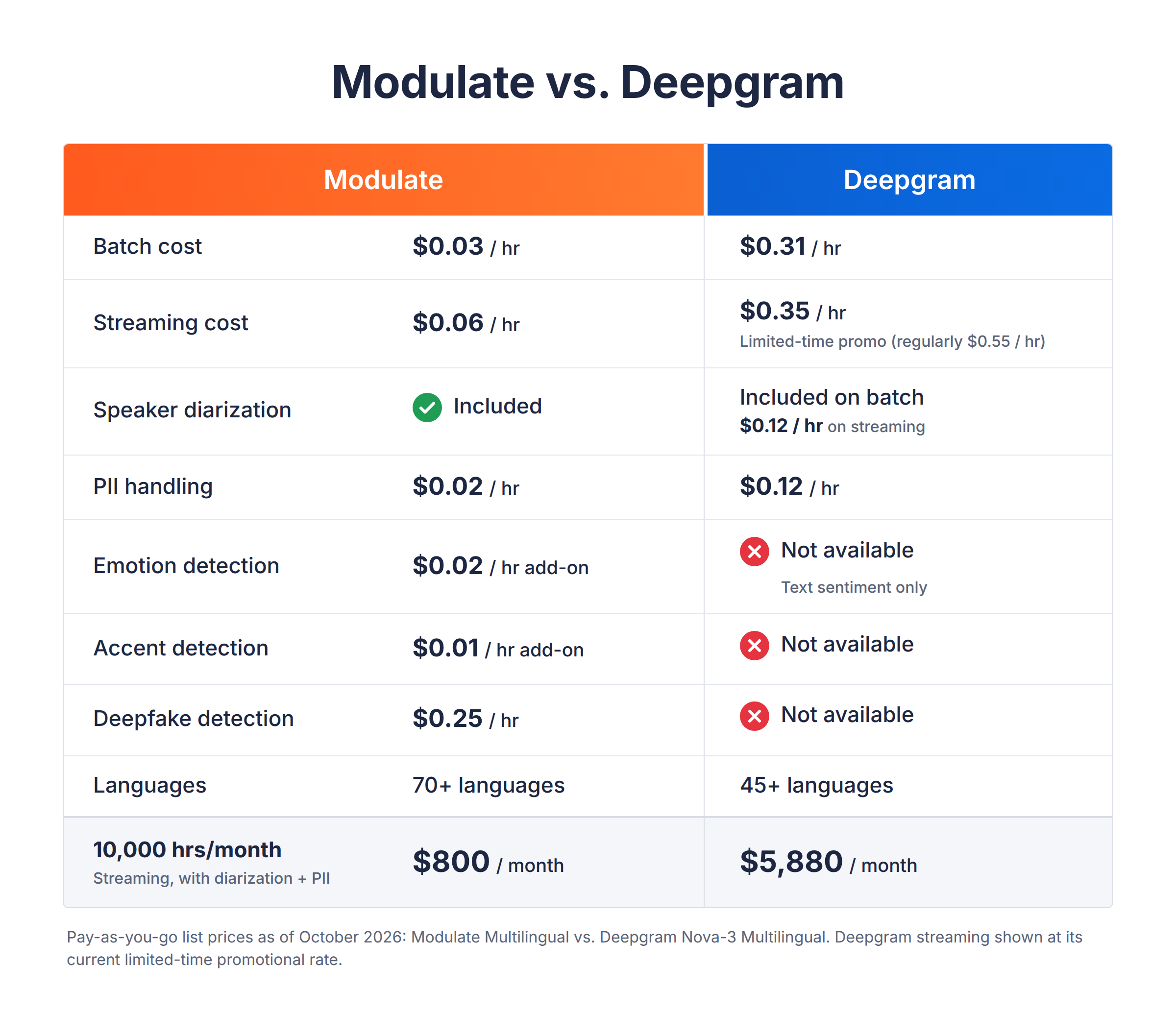
TL;DR: At 10,000 hours a month with speaker diarization and PII handling, Deepgram’s published pay-as-you-go rates come to about $5,880 a month for streaming and $4,320 for batch. The same workload on Modulate runs $800 and $500. (Prices checked October 2026; Deepgram’s streaming rates are currently promotional.)
If you’ve ever been in any conversation on text-to-speech tools, you’ve heard Deepgram thrown in as a well-known solution. Word-of-mouth can be a strong signal of a reputable solution, but it’s not always fully accurate.
Deepgram has invested a lot to optimize its solutions. For latency-dependent customers, they have models reaching sub-300 milliseconds. They support customers at large scale, having processed over a trillion words. They offer Speech-to-Text, Text-to-Speech, Voice Agent APIs, and Audio Intelligence, hitting on key features needed in a variety of voice-based workflows.
Deepgram can be a great fit - if your requirements and capabilities are right:
- You need a unified API for your voice agents
- You have in-house technical resources to add other solutions (such as deepfake or emotion detection), which Deepgram can’t provide
- You need on-premise deployment
- You’ve got an extensive budget or are running at a consistent scale without risk of significant cost increases
But if you’ve ever used credits for any system in your tech stack, you know that they can go fast, real fast, especially as you scale. When that happens, those initial costs start to creep past your budget.
As those costs get more out of control, you start to weigh the question, “how much is API usage really worth?”
Okay, say you’re growing too fast. You choose the enterprise plan with Deepgram. After all, you need add-ons like redaction and diarization, and that’s the most cost-effective option they have.
You’ve hired a team to build on that API for custom intelligence, PII redaction, and analytics… features that every production deployment requires.
So, here we are again, asking whether or not these costs are worth it. It’s not when there are more affordable options than ever before, with more features baked into the base pricing. Features that Deepgram doesn’t offer at all.
For now, let’s just inspect the Deepgram cost issue a little further.
A quick look at Deepgram’s pricing

Deepgram’s pricing page is pretty straightforward, which is how they describe their pricing as well (“Straightforward costs for projects at any scale”). Below is just a quick look into their pay-as-you-go and growth plans.
Nova-3 Multilingual pricing (as of October 2026)
Deepgram lists its rates per minute and meters usage by the second, so there's no rounding up. Note that its streaming rates are a limited-time promotion. If you're budgeting for next year, plan against the regular rates.
So, if you’re streaming 10,000 hours a month through Deepgram, you’ll pay roughly $3,480 a month on pay-as-you-go at today’s promotional rate. On the Growth plan, you’ll pay about $3,000 for the same hours, saving you $480 a month. Once the promo ends, those numbers become $5,520 and $4,680.
If you’re a developer or start-up, this may work for you for a while, but as you scale into a larger organization, you’ll start seeing the credits go faster, and your money right along with it.
Enterprise pricing transparency
Enterprise pricing is notoriously cagey. You never know the true cost until you sit with a sales team while they upsell you on every feature they can.
The same can be said for the lack of transparency on Deepgram’s enterprise page.
As we move along this article, we add up the costs for you for a simple, straightforward comparison.
It is worth noting here that pricing for a Deepgram enterprise account depends on the features you decide to add on, which may be all of their available features, as you may soon come to realize.
(P.S… Deepgram's pricing stops at Growth; above that, it's "contact sales." Modulate publishes its commitment tiers on our pricing page: annual credit buckets starting at $30K, with up to 10% off pay-as-you-go rates and stronger uptime and support SLAs as you move up. Credits work across both the API and the Modulate Platform.)
Base transcription costs up to 10x more than it needs to
It’s understandable if you looked at the base pricing for Deepgram and thought it was reasonable. Most people are familiar with that level of pricing from their text-to-speech APIs, especially for such a notable one.
It’s just that… you can get superior quality for less cost, if you know where to look.
Okay, let’s make a simple comparison with Modulate’s pricing. Here’s what those same 10,000 hours a month cost on each, base transcription first, then the features most production deployments add:
On base transcription alone, Deepgram costs about 6× more for streaming and 10× more for batch. Once you add the features most production deployments need, the gap holds at roughly 7–9×.
The cost of features every production deployment needs
Some of the most basic features you need include diarization, accent detection, PII tagging, and emotion detection.
Diarization is included in the base price of Modulate’s API, and the rest are low-cost add-ons ($0.01–$0.02/hr). Deepgram doesn’t offer emotion or accent detection at all, and the add-ons it does offer (redaction, plus diarization on streaming) cost $0.12/hr each.
Diarization as a streaming add-on
Just about every bit of your audio, whether it's meetings, support calls, or interviews, contains multiple speakers. That’s why it’s such a standard part of post-processing in enterprise STT pipelines.
In other words, without diarization, all downstream analytics break. Going without diarization just isn’t feasible for most companies.
Deepgram includes diarization on pre-recorded audio but charges $0.12/hr for it on streaming, which adds $1,200 a month at 10,000 hours. Modulate includes it on both.
It’s a similar story with redaction
Redaction is a necessity for any organization that needs to make its speech data legally usable in a production environment.
If the deployment touches anything personal, financial, or health-related, then redacting personally identifiable information (PII) or protected health information (PHI) isn’t just about compliance. It’s also about protection, reducing massive costs, and increasing reliability downstream.
Without automatic redaction, you’ll need to pay for a team or another tool to scrub the transcripts, create and maintain manual compliance audits, and build custom regex pipelines.
On Deepgram, redaction is another $0.12/hr on both batch and streaming, or $1,200 a month at 10,000 hours. On Modulate, PII/PHI tagging is $0.02/hr, or $200 a month.
You still need emotion detection
You might be able to add diarization and PII redaction with Deepgram, but that isn’t the case with emotion detection. Deepgram offers sentiment analysis on the transcript text, but nothing that reads emotion from the audio itself.
You’d need a separate vendor and a separate pipeline.
You’d incur latency, extra costs, and extra failure points.
You’d also lose the ability to do real-time emotion-aware workflows.
It’s true you could get away without emotion detection, but if you’re in need of any of the following, you’re really going to need emotion detection. It is now foundational for:
- Churn risk — catching customer frustration or disengagement before it turns into a cancellation
- Agent coaching — surfacing tone issues, escalation risk, or empathy gaps
- Fraud detection — identifying stress, hesitation, or deception cues
- Compliance risk — flagging pressure, distress, or escalation that the words alone don’t show
Modulate detects 9 different emotions from the audio signal itself, time-aligned per speaker, for $0.02/hr on top of transcription. No second vendor, no second pipeline.
Accent detection is also absent from Deepgram’s add-ons
While not essential for every deployment, accent detection is essential for those that are global, or that want multilingual support and demographic analytics (regional trends, customer experience differences, etc.).
Of course, if you’re also attempting to detect fraud or engage in risk scoring, you’ll need to be able to identify accent shifts and inconsistent speech profiles.
There is another factor in the necessity of accent detection that we haven’t yet accounted for: accuracy.
Accent mismatch is a major driver of ASR errors. A 2026 paper on ASR accent adaptation (access an easily consumable HTML version of the paper in the top right hand corner of the page) notes that recognition degrades on accented speech because acoustic-phonetic and prosodic shifts create a mismatch with the training data.
That’s why knowing which accents are in your audio matters. It tells you where to expect errors, and where to double-check.
Because Deepgram does not offer accent detection, you would again have to use a separate accent detection service, which means more latency and integration complexity. Ergo, more cost.
Modulate provides accent identification natively, with per-speaker accent labels for $0.01/hr, so you can break your accuracy and CX metrics down by accent instead of relying on one blended number.
Deepfake detection isn’t on Deepgram’s menu at all
Voice cloning is now a standard fraud tactic against contact centers, banks, and insurers. Deepgram doesn’t offer synthetic-voice detection, so that’s another vendor and another integration. Modulate’s Deepfake Detection is the top-ranked model on Hugging Face’s Speech DF Arena leaderboard, returns a verdict from 3 seconds of audio, and costs $0.25/hr.
Deepgram’s accuracy on real-world audio is lower than its headline number
In our latest piece, Deepgram vs. Modulate, we examine Deepgram’s accuracy on more challenging real-world datasets. Deepgram reports a 5.26% median batch WER for Nova-3.
But here’s what that number leaves out:
- That 5.26% comes from Deepgram’s own internal test set (2,703 files, about 82 hours across nine domains). It’s a median, and because the dataset isn’t public, no one else can reproduce it.
- Error rates climb well above that headline number when you test Deepgram against more challenging, conversational audio.
- In our testing, Deepgram’s WER reached 28.1% when benchmarked on AMI Corpus, one of the most rigorous datasets due to the realistic nature of the audio (it contains accents, jargon, and multiple speakers, as well as background noise).
On that same dataset, Deepgram’s error rate was nearly double Modulate’s (28.1% vs. 14.9%).
A 28% error rate doesn’t just mean a few more mistakes. It means that more than 1 in 4 words is wrong.
Negations flip the meaning from “did not” to “did”. Summaries hallucinate. Intent classifiers misfire. But most of all, every downstream system inherits the errors of the ASR layer.
This is why accuracy is the biggest cost driver in the entire speech‑to‑text pipeline, not the per‑hour price.
Judge ASRs on real-world performance, not clean benchmarks
Vendor-run benchmarks on private test sets, Deepgram’s included, naturally show a model in its best light. Public datasets are the check, but only if they look like your audio.
And the most-cited public set, LibriSpeech, is… too clean.
It’s 1,000 hours of 16 kHz read English speech from LibriVox audiobooks. Meaning, it is read rather than conversational, and largely lacks the accents, emotional variance, background noise, and other markers of a real, live conversation.
Most modern models score well on it, which is exactly why it doesn’t tell you much.
The audio in your own datasets would be a far greater measure of the accuracy of the API. But more complex datasets like TalkBank, AMI Meeting Corpus, or Vox Populi are also far greater measures of accuracy under real-world conditions.
WER isn’t the whole story, either. A transcript can score well overall and still get the names, account numbers, and product names wrong, which are the words downstream systems depend on most. That’s why we published the Entity Transcription Benchmark, an open dataset on Hugging Face that measures named-entity accuracy, with Modulate and Deepgram Nova-3 compared head to head.
You get up to 400 free hours to see the difference for yourself
Deepgram has the credibility of an established platform, but its lack of foundational features and reduced accuracy in real-world conditions (not even counting increased latency when adding separate systems to cover those missing features) makes it a costly option.
It’s even more costly when you consider solutions such as Modulate, which includes diarization, offers the other features for a few cents an hour, posts a lower error rate on conversational benchmarks like AMI, and has a base price 6–10x lower than Deepgram’s.
It’s the difference between paying $5,880 streaming/ $4,320 batch (about $70,600/$51,800 per year) vs. $800 streaming/ $500 batch ($9,600/$6,000 per year).
The cost differences go beyond the basic plans and add-on differences between Deepgram and Modulate.
Instead, it’s about fundamental model limitations and the impact on downstream systems. This is where the true business impacts lie.
Run a fair bake-off: pull two or three hours of your own real calls, run them through both APIs, score both with the same text normalizer, and compare WER, entity accuracy, diarization, and your all-in cost per hour with the add-ons you actually need.
Test the differences of Modulate’s Transcription API for yourself with up to 400 free hours!