
50+ Best Call Center Analytics Dashboards for 2026
AI Agents Are Calling. Modulate Makes Routing Them Easy.
October 15, 2026

Carter Huffman
(HE/HIM/HIS)

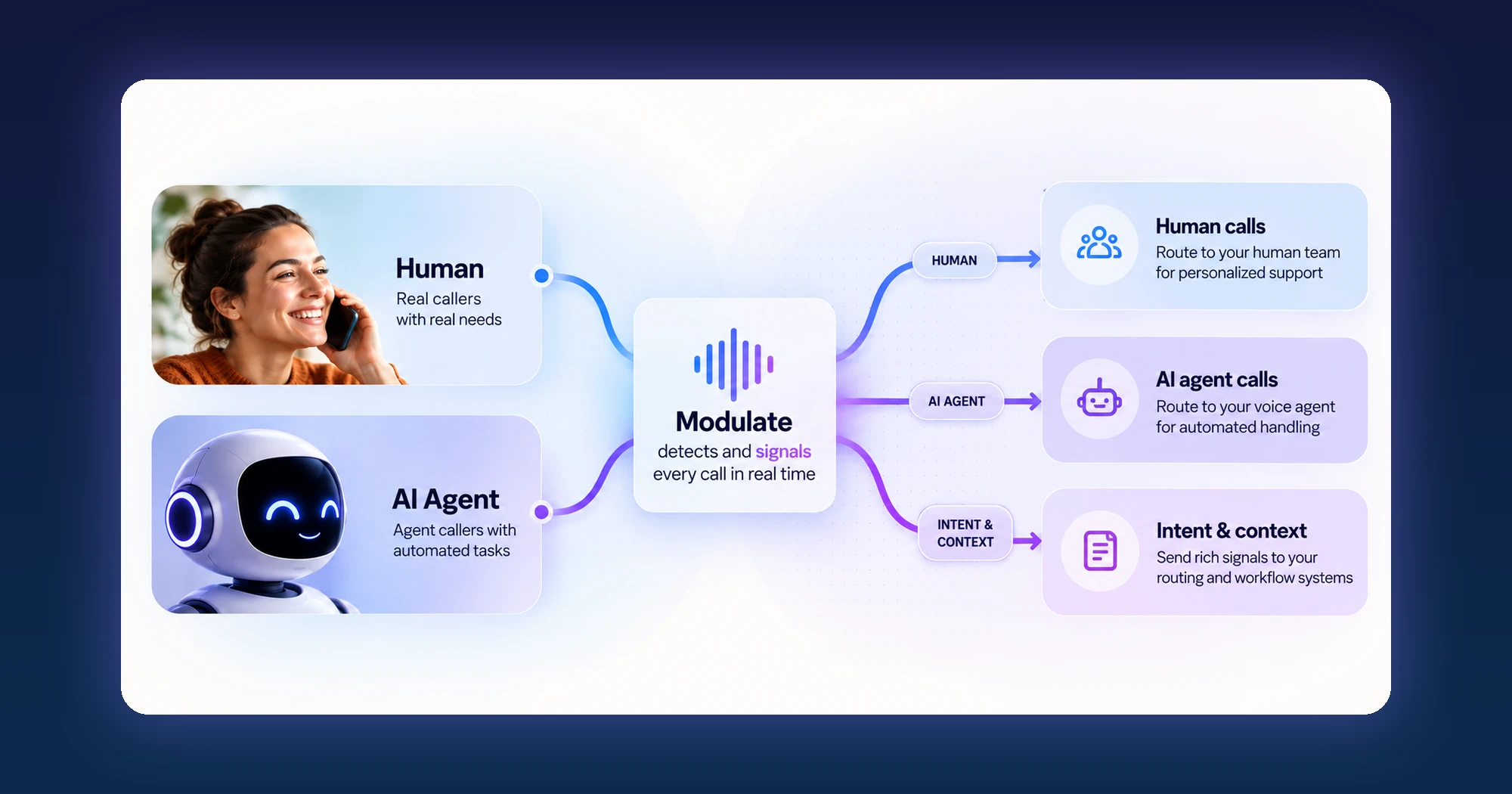
Humans to humans. Bots to bots. A smarter way to handle the next generation of customer calls.
Last week, an AI assistant called Walgreens on behalf of a customer to ask a simple question: Was an item in stock?
The response?
“We don't speak to AI.”
And the call ended. This reaction is natural - humans don’t want to waste time talking to AI callers, and companies don’t want to waste that time. But with the rise of Muse, Dots, and other sophisticated personal agents, rejecting these calls translates to lost business and unhappy customers.
The Problem: Your Human Agents Cannot Handle a Flood of AI Callers, but You Can’t Afford to Ignore Them
Personal Agentic AI is rapidly creating a future where many customer service calls are made by agents on behalf of the customer. AI agents can handle reservations, appointments, inquiries, and other tasks without the customer’s direct involvement. In many cases a customer may not know how many calls the agent is making - “plan a 7 day trip and give me three options” can turn into 21 separate dinner reservation phone calls conducted by independent sub-agents in parallel.
At the same time, businesses cannot deploy AI agents to handle all incoming calls. AI agents do not display the empathy or sophistication to handle complex human conversations effectively and dissatisfaction with AI call handling is increasing year-over-year, even as the models behind the agents improve. Human agents are still required to meet high human customer satisfaction rates.
Businesses increasingly need a way to triage their calls - deploy human agents to handle complex human needs, while finding a cost-effective and scalable way of handling AI agent calls. And with the proliferation and advancement of Voice AI technology, the solution cannot rely on the adoption rate of AI Agent identification protocols or on a human’s ability to identify bots by the sound of their voice.
The Solution: Humans Talk to Humans. Bots Talk to Bots.
The solution is to separate human and AI bot callers as quickly as possible, in order to route them to different systems designed for their different interactions. For example, AI agent callers can be routed to extremely cost-effective AI voice agent responders, which can be configured with lower quality voice models because the user experience isn’t as critical. By comparison, human callers can be routed directly to human agents or to more sophisticated systems to handle their needs with empathy and understanding.
Imagine an AI assistant calling an airline to check flight availability. Instead of navigating a traditional phone tree or waiting for a human representative, the assistant is recognized as an AI caller and routed directly to the airline's voice agent.
The two agents handle the routine interaction and the customer gets the information they need. No human time is spent responding to the voice agent, cost is minimized, and the Voice AI caller accomplishes its task with no issue.
Now imagine a human calling that same airline because their flight was canceled and they're stranded in an unfamiliar city.
That person may need empathy, reassurance and creative problem-solving.They should have an appropriate path to human support.
How Modulate Makes Intelligent Call Routing Possible
At Modulate, we've spent years building audio-native AI models that understand voice beyond just the words being spoken.
Our Synthetic Voice Detection Model can analyze as little as 2.5 seconds of incoming audio to determine whether speech is likely human or AI-generated.
This can route AI callers to AI agents and human callers to human agents, from the very first utterance.
And because Modulate delivers this capability through an API, businesses can integrate it with existing contact center and telephony infrastructure that supports streaming audio. Modulate’s synthetic voice detection is an added component to your existing call routing infrastructure, not a replacement.
Here's how it works:
- A call comes in. Modulate analyzes the incoming audio in real time.
- We identify the caller type. Our Synthetic Voice Detection Model provides a probability score indicating whether the voice is likely human or synthetic.
- Your contact center routes accordingly. Human callers can be directed to human support, while AI callers can be routed to AI-powered workflows.
- The conversation continues intelligently. Modulate's audio-native conversation understanding model, Velma, can identify requests, behaviors and potential risks, helping businesses determine when additional verification or escalation is appropriate.
Our technology provides an independent signal from the audio itself, including when a caller doesn't explicitly identify as AI.
The Result: Better Experiences, Lower Costs, Smarter Operations
Intelligent Bot Routing with Modulate’s synthetic voice detection capabilities delivers efficiency while preserving customer experience - and it’s a solution that’s scalable and iterable over time.
Based on our analysis at Modulate, a six-minute voice AI interaction can cost approximately $0.20, compared with roughly $2-5 for a human-handled call, depending on the operating model. By contrast, the cost of a poor customer experience for a human caller can be dramatic and lead to churn and brand damage. When human callers are routed correctly, human representatives can spend more time on complex, sensitive, and high-value conversations instead of routine requests that can be handled through automation.
And customers using personal AI assistants can get things done without waiting on hold or navigating systems designed exclusively for humans.
Beyond the routing stage, Modulate’s Velma model can apply different behavior analysis and fraud/security monitoring depending on the call type - a human call has different needs and different monitoring requirements than a conversation between two voice agents. With Modulate’s flexible behavior definitions and monitoring, call centers can iterate and optimize their flows separately for bot calls versus human calls, using real data at scale derived from conversational analysis. This also avoids the problem that bot callers are not appropriate for traditional call quality measurement tactics such as end of call surveys.
Ultimately, the pace of innovation and development in the Personal AI Agent space is increasing every day, and the proliferation of agents performing calls and interacting with the world is causing new challenges for traditional support and customer experience centers. Those who leverage technology to solve these challenges and adapt their processes and flows to fit this wave of agentic callers will be able to handle this traffic cost effectively and provide even better experience for their customers - bot and human.
Ready to make your contact center AI-agent ready?
Modulate's Synthetic Voice Detection technology helps businesses identify AI callers in real time and route interactions intelligently, using the infrastructure they already have.
Learn more about Modulate and discover how intelligent call routing can work for your business.