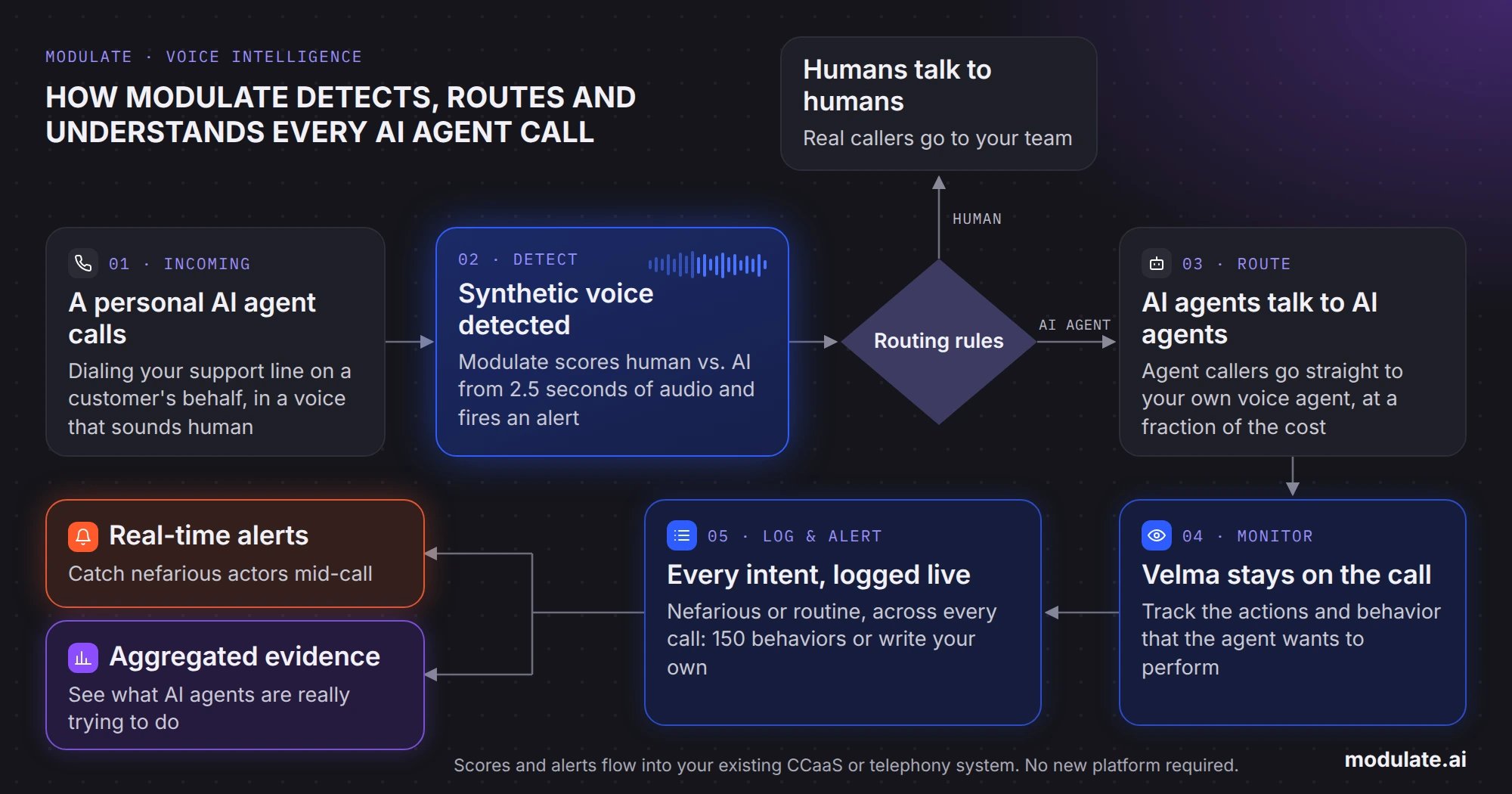
AI Agents Are Calling. Modulate Makes Routing Them Easy.
AI Monitoring Statistics: Customer Service, Voice AI, and Guardrails by the Numbers
July 27, 2026


Customer service is experiencing a revolution that’s powered by artificial intelligence. Gartner predicts that agentic AI will resolve 80% of customer service issues by 2029 without human intervention. 69% of customer service organizations report using at least one form of AI, and 39% report using agentic AI, according to Salesforce’s Seventh State of Service Report. Behind the scenes, the technology powering those interactions is rapidly developing as well: the market for AI agents reached an estimated $8 billion in 2025, according to Market Research, and is expected to grow by 47% CAGR through 2034, reaching $262.5 billion.
While this technology can address many issues, it does require continuous monitoring to function safely. Whether analyzing customer calls at scale or implementing guardrails around AI voice agents, brands are spending big bucks on tools that can quantify performance and help level up the customer experience.
Here are some AI monitoring stats that highlight where the technology is headed, what’s actually working in contact centers and why visibility is mission-critical.
What the Experts are Saying About AI Monitoring

AI monitoring is quickly becoming one of the top operational issues on customer service leaders’ agendas. The companies who are seeing the greatest success with AI are not simply deploying solutions and hoping they do the right thing. They’re building the capabilities to monitor, measure and improve it.
Keith McIntosh, Sr. Principal, Research in the Gartner Customer Service & Support practice, notes that "Service and support leaders are looking to AI for a wide variety of goals — efficiency, better CX, lead generation, and delivering other value back to the business. The most impactful use cases are four-fold: those that enable assisted agents, empower customers through self-service, automate operational support, and introduce agentic AI across their stack."
That last use case, agentic AI, is an evolution of prior iterations of AI-powered tools. Earlier tools may have been able to answer questions or summarize conversations, but agentic AI actually takes action. With this capability, you can automate complex, multi-step tasks that run completely autonomously on behalf of a customer.
"Agentic AI has emerged as a game-changer for customer service, paving the way for autonomous and low-effort customer experiences. Unlike traditional GenAI tools that simply assist users with information, agentic AI will proactively resolve service requests on behalf of customers, marking a new era in customer engagement," says Daniel O’Sullivan, Senior Director Analyst in the Gartner Customer Service & Support Practice.
Of course, more autonomy creates more risk. That’s why autonomy demands AI monitoring. The more decisions we delegate to autonomous systems, the larger scale rogue errors can have. It’s fine if your chatbot gives a wrong answer. But what if your autonomous agent takes the wrong action on behalf of your customer? For the most part, organizations are behind the curve on this.
“AI is everywhere, but most organizations are still figuring out how to monitor and trust these systems,” said Padraig Byrne, VP Analyst at Gartner. “That visibility gap makes scaling risky and that’s why observability matters. Unlike traditional software, AI’s decision making is often hidden, making it hard to explain or trust, yet errors can cause substantial financial loss, reputational damage and regulatory scrutiny.”
A challenge with monitoring agentic AI is that you can’t approach it how you would with traditional automation. Rules-based systems are straightforward. Define your bounds and watch for outliers. But agentic AI doesn’t work that way.
If-then rules and static thresholds can work for some AI deployments. “But with agentic AI, these systems are reasoning, planning, and acting independently across multiple steps,” Kate Kellogg, the David J. McGrath Jr. Professor of Management and Innovation at the MIT Sloan School of Management, explains. “So we need to do what we call ‘adaptive monitoring,’ which is basically continuously tracking multiple dynamic metrics.”
The bottom line: The organizations that treat AI monitoring as an afterthought will be the ones suffering the repercussions, whether that means a compliance violation, an unhappy customer or an autonomous agent that chose the wrong action at the worst possible time. Visibility is the key to scaling AI customer service responsibly.
The Old Way of Monitoring Customer Interactions Isn’t Enough
The more autonomous agents are and the more customer conversations they handle, the more scalable AI-driven monitoring solutions businesses require. There’s already a demand for these tools: The AI agents market size was valued at USD 8.19 billion in 2025. It’s expected to rise at a compound annual growth rate (CAGR) of 47%, hitting $262.5 billion by 2034. (MarketResearch.com)
AI solutions provide visibility into 100% of customer interactions, whereas manual QA audits analyze less than 3% of customer conversations. That’s a huge gap for any contact center looking to know what’s really going on across all calls and chats. (Clootrack)
By 2024, poor customer service is expected to be costing companies $3.7 trillion annually, up from $3.1 trillion in 2022. So the lost signals during these interactions aren’t just hurting your CX scores; they’re costing you revenue. (Qualtrics XM Institute)
Deloitte Digital's research from July 20th, 2024 showed that just 13% of organizations transfer all customer context from one channel to another. Translation: If you switch from chat to phone to email with a company, you're probably explaining your entire situation over again each time. In fact, 56% of customers reported that they’ve done so. Customers don't think in channels. They just want someone who knows what they've already told you. (Deloitte)
But there’s a better way forward. AI-powered routing reduced customer “hunting time” in IVR systems by 54%, so better monitoring and decisioning can clearly reduce friction for customers. (Natterbox)
AI Is the Default in Customer Service

It’s estimated that agentic AI will automatically resolve 80% of customer service issues by 2029. That doesn’t mean humans disappear, but it does mean contact centers need better ways to monitor what AI is saying, doing, and missing. (Gartner)
69% of service organizations use AI in some capacity. And 79% of service organizations are investing in agentic AI. (Salesforce)
Plenty of teams use AI, but far fewer have mature systems to ensure it’s measurable and safe. 98% of contact centers use AI in some capacity, yet 61% say their conversations with customers have become more complex. (Calabrio)
Customers don’t hate AI support by default. 69% of consumers prefer AI-powered self-service tools for fixing simple issues. If anything, your customers hate bad support, whether it’s provided by AI or a human. (Zendesk)
84% of customers value experience as much as the product itself. That means every support interaction, whether with a human or an AI, also affects brand trust and retention. (Salesforce)
AI Monitoring Improves Speed, Resolution, and Consistency
Speed is one of the clearest signs that AI is reshaping customer service operations. Freshworks’ 2025 Customer Service Benchmark Report revealed AI-powered support decreased average first response time from over 6 hours to less than 4 minutes, a reduction of 55%. (Freshworks)
There’s a quantifiable performance gap. AI-leading contact centers solved customer problems in an average of 30 minutes versus 30 hours for centers without mature AI deployments, according to Freshworks’ 2025 CX Benchmark Report. First-contact resolution rates were similar. (Freshworks)
The benefits of AI in customer service extend beyond faster response times. IBM's Institute for Business Value found that mature AI adopters (those who have AI-powered customer service actively operating or being optimized) experienced 17% higher customer satisfaction scores than their peers. This study also found that human agent satisfaction was 15% higher at mature AI adopter organizations. (IBM)
Salesforce's research found that after deploying AI agents, the #1 improved KPI reported by customer service organizations was customer satisfaction. Customer satisfaction ranked ahead of agent productivity, handle time, retention, and first-response time. Seventy percent (70%) of organizations that adopted AI agents observed measurable value within 60 days of deployment. (Salesforce)
Improved visibility also leads to less waste, which directly affects your bottom line. Gartner estimates that, as AI becomes more pervasive in customer service, operational expenditures will fall by 30%. (Gartner)
Early results for contact centers already using AI agents are showing promise. McKinsey reports that these implementations have reduced cost per call by half, all while improving customer satisfaction. (McKinsey)
AI Is Also Changing the Agent Experience

Stanford and MIT researchers published a peer-reviewed study involving nearly 5,200 customer support agents at a Fortune 500 company. They found AI enabled agents to be 14% more productive on average. That’s measured by how many customer issues were solved per hour. But the biggest impact? Agents with the least experience and skill-seen productivity jumps of as much as 35%, narrowing the performance gap with the highest performing agents. (National Bureau of Economic Research)
Microsoft's latest 2024 Work Trend Index research surveyed 31,000 knowledge workers globally across 31 countries. Among workers who use AI, AI is reported to make employees feel they can save time (90%), concentrate on their most important tasks (85%), be more creative (84%) and enjoy work more (83%). (Microsoft)
Freshworks’ 2024 Global AI Workplace Report surveyed over 7,000 full-time employees around the world. They discovered that artificial intelligence has reduced workload by close to 4 hours each week, completing tasks such as summarizing issues, recommending next steps and automating repetitive work. This creates the equivalent of 24 business days available each year to focus on higher-value tasks. (Freshworks)
In a global survey conducted by Jabra and the Happiness Research Institute in 11 countries, knowledge workers who use AI every day are 34% happier at work. They also feel more positive about the future than those who don't. Workers who frequently use AI also reported being more successful in reaching their goals (78% vs. 63%) and felt they had more opportunity for growth within their company (70% vs. 38%). The survey included responses from over 3,700 knowledge workers. (Jabra)
Zendesk's 2025 CX Trends Report discovered that 73% of agents felt they could do their jobs better if they had an AI copilot. AI can free agents up to focus on more complex problems, creating a seamless and scalable experience. Of organizations that have implemented AI tools for agents, 90% of CX trendsetters say they are seeing positive ROI. (Zendesk)
When AI-powered monitoring tools identify trends across interactions, teams can set aside anecdotes and react to what their customers are actually saying. In a Morning Consult survey of over 11,000 knowledge workers (conducted on behalf of Zoom), 75% of leaders who have teams using AI say their teams collaborate better, even when remote. Better decision-making was also reported by three-quarters of these leaders. (Zoom/Morning Consult)
Most contact centers still operate with major visibility gaps in their quality assurance programs. According to SQM Group's 2024 data, 73% of contact centers still rely on sample-based quality monitoring, reviewing just 2-5% of total interactions, meaning up to 98% of customer experience interactions may be invisible to QA teams. (SQM Group)
AI-powered QA gives contact centers the ability to analyze every customer interaction instead of relying on small call samples. AI-powered QA lets contact centers move from auditing approximately 2% of interactions all the way up to auditing 100%, without increasing headcount for evaluators. The upside to that shift doesn’t just mean better coverage though. It also changes the type of information QA teams have to act on. (Scorebuddy)
A contact center using AI saw a 22X increase in evaluated contacts and created more than 200,000 AI-generated call summaries. That’s the difference between sampling a few calls and finally understanding the whole conversation. (Calabrio)
That same contact center saved 87 seconds of after-call work per interaction thanks to AI. Multiplied across thousands of calls, that’s a big win. (Calabrio)
Voice AI Needs Its Own Scoreboard
As AI voice agents become more common in customer service, performance benchmarks are becoming easier to measure. Industry benchmarks show that a strong First Call Resolution (FCR) rate for AI voice agents ranges from 70% to 79%, while world-class contact centers achieve 80% or higher. (Hakuna Matata Tech)
Traditional call centers average a 70% First Call Resolution rate industry-wide, with a "good" performance band of 70-79%. But only 5% of contact centers consistently clear the 80%+ "world class" threshold, according to SQM Group's annual benchmarking of more than 500 North American contact centers. AI-enhanced systems have the potential to push into that world class range, but only with ongoing monitoring and retraining. (SQM Group)
One of the clearest operational benefits of AI voice agents is faster call handling. AI voice agents typically reduce Average Handling Time (AHT) from 7 minutes to 4.2 minutes, a 40% time savings annually. (VoiceAIWrapper)
40-60% percent automation for first-contact resolution is common among service businesses who have successfully scaled AI deployments. The most mature companies with deeper AI implementations report first-contact resolution automation of 70-75%. If you're among the former, then AI monitoring is how you'll achieve greater transparency into where AI succeeds and when to loop in a human. (FeedbackRobot)
Self-service bots work, but only when they're deployed on the right problems. Research from Salesforce’s 20 24 State of Service report estimates self-service tools successfully resolve 54% of customer issues at organizations that have implemented them. The caveat? Those tools have to be implemented correctly. Research from Forbes found that 63% of customers say their most recent chatbot experience failed to resolve their issue, while Talkdesk consumer experience research found that human agents are than twice as likely to close a ticket as an automated system would be. That disconnect isn’t due to a lack of technology. It’s due to a lack of monitoring. You need constant insight into where bots are successfully serving customers (and where they aren’t), where bots are failing without notice, and where customers are dropping off mid-automation out of frustration. If you don’t have that data, your self-service strategy isn’t working. (Salesforce/Forbes/Talkdesk)
Many organizations are seeing returns from AI service agents faster than expected. In Salesforce's State of Service report, 70% of organizations with AI service agents report they realize measurable value from their AI service agents within 60 days of deployment. These early gains are achievable for companies that deploy effectively. (Salesforce)
Salesforce research also showed that the #1 improved KPI after deployment is customer satisfaction. 89% of service professionals using AI agents believe their organization would benefit from expanding their use of them, indicating that the benefits stem from continued investment (such as continuous AI monitoring) instead of passive deployments. (Salesforce)
Zendesk's 20/25 CX Trends report showed that companies implementing tier-1 AI deflection experienced an 18% average increase in CSAT scores within 90 days. Drivers of deflection satisfaction center around speed: response time decreases from hours to less than two minutes. (Zendesk)
The cost-and-quality trade-off that has defined contact center management for decades is starting to break down. McKinsey's analysis of early AI adopters in contact centers found cases where AI agents drove a 50% reduction in cost per call while simultaneously increasing CSAT scores. (McKinsey)
AI-enabled self-service is also changing the economics of customer support. McKinsey's research on AI-enabled self-service found cost-to-serve reductions of more than 20% with incident volumes dropping 40-50%, again without sacrificing satisfaction. These aren't outliers anymore. They're the benchmark that support leaders are being held to. (McKinsey)
AI Guardrails Are Non-Negotiable

When companies deploy AI voice agents to handle increased customer conversations, performance metrics are only part of the solution. Organizations require AI agent guardrails to ensure conversations remain safe, compliant, and on-brand. Companies can’t risk AI voice agents going rogue, so their budgets show it. The global market size for AI guardrails is expected to reach $109.9 billion by 2034, up from $0.7 billion in 2024. (Market.us)
North America held the largest market share of more than 33.4% in 2024. It’s expected to remain leading in terms of adoption as organizations strive to keep pace with innovation while also managing their risks. (Market.us)
In 2024, the AI guardrails market in the U.S. reached $0.2 billion. The market is projected to grow to $23.4 billion by 2034. (Market.us)
Even with increasingly sophisticated AI, straightforward rules and boundaries still play a major role in their governance. Rule-based guardrails held the largest share of the AI guardrails market in 2024 at 28.9%. (Market.us)
However, guardrails aren’t exclusive to the U.S. market either. In fact, the Asia Pacific region makes up 22.4% of the global AI guardrails market. (DataIntelo)
AI guardrails are only effective if organizations can measure whether they’re actually working. Typical KPIs tracked for AI guardrails are the percentage of blocked outputs after being assigned a high-risk score, hallucination reduction percentage after fine-tuning, and jailbreak attempts thwarted per week. (Fiddler AI)
Turning AI Visibility Into Action with Velma
With billions of calls happening every month worldwide, AI voice agents are fast becoming the first line of customer service. Deploying them without monitoring is an untenable risk.
Velma is Modulate’s real-time voice intelligence platform that monitors both sides of the conversation, detecting fraud signals, off-script language, and indications of user distress before they become issues. Velma quietly oversees the call, giving contact center teams visibility into conversations as they occur.
Velma tackles one of the largest hurdles in AI deployment today. Trained on over 500 million hours of real-world conversations, Velma provides out-of-the-box accuracy, with no weeks of tuning required, at up to 90% lower cost than competitors. Velma works with your organization’s existing voice infrastructure, including Zendesk, Genesys, Zoom, Microsoft Teams, and more. Try Velma for yourself.
Frequently Asked Questions
How is AI used to monitor customer calls?
AI can transcribe conversations automatically, analyze sentiment, identify trends, score conversations, summarize calls and flag conversations for review by your analysts. These tools won’t replace your analysts, but they can help you identify trends from thousands of customer conversations instead of reviewing samples of calls.
What’s the difference between AI monitoring and AI guardrails?
Monitoring provides visibility. AI agent guardrails keep customers safe. AI monitoring allows teams to see how AI systems and customer experiences are performing. AI guardrails prevent AI systems from behaving inappropriately by enforcing constraints and limiting dangerous outputs.
Why do AI voice agents need guardrails?
Voice AI advances quickly, and customers expect voice agents to provide helpful and accurate information right when they need it. Without guardrails, agents can hallucinate facts, sound unbranded, or mismanage delicate situations. Guardrails help prevent those risks from becoming customer issues.