AI Agents Are Calling. Modulate Makes Routing Them Easy.
Voice Analytics: Use Cases, Applications, and the Future of Audio Intelligence
July 23, 2026

Voice is one of your richest and least leveraged business channels. Every phone call, patient interaction, sales presentation, or support transaction generates information beyond words. Voice analytics uncovers tone, emotion, hesitation, and intent: nuances that had historically escaped large-scale analysis. Voice analytics makes it possible. Harnessing speech recognition, natural language processing (NLP) and machine learning, voice analytics platforms convert audio into structured, actionable data.
This demand can be clearly seen in pricing of the market. Market Research Future estimated that the global market for voice analytics was worth around $4.2 billion in 2025, and projected that number will grow to $13.7 billion by 2035. The same report estimated a compound annual growth rate (CAGR) of 12.68% from 2025 to 2035. Research from The Business Research Company estimated faster near-term growth, expecting the market to grow in size by a 18% CAGR through 2030. The larger market for speech analytics was valued at $5.7 billion in 2026, and is expected to reach $13.31 billion by 2034.
Factors contributing to this growth include maturation of AI technology, increasing demand for customer experience (CX) enhancement, wider adoption of cloud-based platforms, and growing focus on fraud and compliance. McKinsey findings indicate that contact centers using speech analytics see a 10% boost in customer satisfaction, a fact that's spurred widespread enterprise adoption. By 2026, 80% of companies expect to use AI-powered voice tech within their CX operations, establishing voice analytics as a mainstream business initiative.
“The customer service function has a growing level of influence over AI initiatives. This historically people-and-process driven function has evolved into a technology-focused one.”
- Kim Hedlin, Senior Principal, Research in the Gartner Customer Service & Support Practice
That trend is already apparent in adoption statistics: According to a 2024 Gartner poll of 187 customer service executives, over three-quarters of respondents say they are experiencing pressure from senior management to deploy AI-powered voice technology. Another 44% are already testing AI voicebots that directly interact with customers.
In this guide, we’ll explore use cases for voice analytics across verticals, including contact centers, sales teams, healthcare, security, media and more. We’ll dissect the primary applications within each vertical and highlight what to look for in platforms that claim to serve each vertical. We'll also explore how new developments in voice-native AI are expanding the potential of what voice analytics solutions can achieve.
What Are the Benefits of Real-Time Voice Analytics?

Most voice analytics analysis is done post-call: recording conversations, processing them overnight and reviewing insights the following morning. While there’s tremendous value to this model, particularly for QA, trend analysis and compliance auditing, real-time voice analytics works on a different timetable. By analyzing conversation as it happens, real-time analytics can surface insights and trigger action while the call is still in progress, giving your agents a chance to change its outcome.
The primary value of this type of system is intervention. If a customer’s voice indicates frustration halfway through a call, real-time analysis can notify a supervisor, prompt an agent with an appropriate response, or kick-auto off a customer retention offer before the caller hangs up mad. If an agent misses a compliance statement, the system flags it as it happens, rather than catching it during an audit three weeks later. The difference between catching an error at minute four of a call vs. day four after the call can be the difference between retaining a customer and losing one.
The pace of agent development is accelerated by real-time analytics in a way that post-call coaching simply can't match. Instead of learning during their weekly coaching session that their tone while handling objections often comes across as defensive, agents are able to receive and incorporate feedback while the call is happening. This creates a much tighter development loop. Mistakes are identified earlier, course corrected more quickly, and less likely to become habits.
Looking at the bigger picture, real-time data proves just as valuable for the entire company as it does for specific customer exchanges. When you’re capturing and structuring sentiment, topic, and behavioral signals on every call as they happen, you can identify brewing problems (a product defect causing an uptick in angry calls, a script change that is not landing well) in hours instead of days. In a world where the cost of inaction rises exponentially by the minute, that time savings is critical.
The cost of this tradeoff is technical complexity. Processing at scale in real-time demands low-latency infrastructure. Additionally, most platforms deploy a hidden bottleneck: they run a two-step pipeline where the audio is first transcribed to text then the language model is run over the transcript. This intermediate step not only adds latency but also throws away critical information about the conversation (tone, emotion, prosody, hesitation, stress) before your model even sees it.
Acoustic-native architectures avoid this limitation by working with the audio waveform directly. Modulate's flagship product, Velma, is an Ensemble Listening Model (ELM) that detects over 150 behaviors (50 built-in behaviors + 100 additional behaviors as templates) and 20+ emotions straight from audio, bypassing the transcript entirely. Modulate's published benchmarks indicate Velma surpasses top-tier models from major AI research institutions in conversation understanding accuracy across various datasets, all while being considerably more affordable (starting at $0.75/hr).
Below is a comprehensive look at the key use cases across industries.
Voice Analytics Use Cases in Customer Experience & Contact Centers

Originally, voice analytics took hold in contact centers, and it continues to be its primary application. Voice analytics has evolved into a strategic differentiator for call centers. Used effectively, a combination of tone, sentiment, intent and conversational context can create new opportunities for early warning detection, scalable quality assurance and personalized service.
Call Quality Monitoring
QA teams have traditionally assessed agent performance by having supervisors listen to and manually score a tiny fraction of calls (usually 2-5%). Manual scoring is slow, subjective, and easily gamed. Voice analytics means every call is measured automatically against a specific rubric. Did the agent convey empathy when the customer became frustrated? Did the agent make all required disclosures? Did the agent stay on script without sounding like a robot?
Scores are delivered consistently and at scale, allowing QA teams to focus on coaching and improvement rather than the drudgery of listening and scoring calls. And over time, patterns emerge (who consistently struggles with de-escalation, which script elements lead to higher satisfaction, etc.) that turn call quality into a continuous improvement tool. Modulate's Velma analyzes not just agent speech, but how it's spoken, flagging tone and stress indicators that would be completely invisible to a transcript-only review.
Customer Sentiment Analysis
Voice conveys emotion. When customers speak faster, increase their pitch, or start giving short clipped answers, they are providing objective acoustic indicators of frustration: clues that they are likely unhappy often before they say so explicitly. With real-time sentiment analysis, agents and supervisors can be alerted while the call is still active, and can take action to de-escalate the call before it leads to a complaint, request for refund or social media post.
Sentiment scoring after the fact can also allow organizations to measure not just what happened during a customer journey but how it felt. Velma detects over 20 different emotions directly from audio (such as frustration, anxiety, and fear) rather than indirectly through word choice, allowing for far greater accuracy, especially in situations where a customer may be trying to sound polite while feeling otherwise.
First-Call Resolution Tracking
If a customer is calling back the second or third time about the same problem, something failed the first time. Voice analytics allows you to identify precisely what. Tag calls by topic, outcome and sentiment, then correlate those records against if that customer placed another call within a predetermined period. From there you can clearly identify root causes of repeat calls. Is it a certain problem with a product? A training deficiency with your agents? A process that falls short in giving customers a true resolution?
Feed that information into coaching, your knowledge base and operational changes that will lower call volume and enhance the customer experience at the same time.
Churn Prediction
Rarely does a customer poised to churn declare their intentions on initial contact. Rather, there are hints: subtle escalations in frustration across several calls, inquiries about the competition, increasingly frequent unresolved complaints. Voice AI can correlate tones of voice and speech patterns with past churn data to create models that can identify at-risk customers as it happens.
Scale is the throughline across these contact center use cases. As McKinsey partner Julian Raabe, who leads the firm's speech analytics work in EMEA, explains:
“Speech analytics is one of the key enablers that we will see in the coming years that will drive the performance of organizations. And it’s not about replacing agents with chatbots, and so on. What we see as the big opportunity is how we can enable agents to be more effective through real next-best actions, to predicting potential outcomes, and helping agents to succeed in these, to use voice analytics at scale for coaching and training, ideally in real time. If we can do that, I believe strongly that we will be able to uplift at scale the performance of customer care operations.”
Sales & Revenue Enablement Use Cases

Voice analytics can be thought of as the sales coach that never sleeps: one that can listen to every interaction, not just the ones a manager gets to sit in on.
Sales Coaching
An organization can review recordings of their top sellers to pinpoint exactly which phrases, pacing, sequences of questions, and objection handling techniques lead to closed deals. What reps ask more open-ended questions during discovery? How long do top closers wait before discussing price? What phrases do they use when a prospect shares a budget objection?
Organizations can take this information and begin programmatically baking it into training and real-time agent assist tools. Sales coaching becomes less of a guessing game and more of a science. And slowly but surely, your best reps will narrow the performance gap with their peers through specific changes to their behavior backed by data.
Deal Risk Scoring
You won't always see clear indications when a deal is faltering. Often, the danger signals are auditory: a prospect who suddenly goes quiet, says more “umms,” speaks more hypothetically (“we’ll think about it” or “maybe down the road”) or tunes out when discussing next step
Voice analytics solutions can pattern-match these indicators against historical data to create a risk score for each call, instantly flagging cooling deals for manager review. Empowering sales teams to act in advance (by following up, reaching a new stakeholder, or revising the proposal) can help prevent deals from getting cold.
Competitive Intelligence
Sales calls are potentially your richest source of competitive intelligence, and are typically the least systematically mined. Voice analytics can surface every single mention of a competitor name, price comparison, or feature-gap across thousands of calls to deliver a real-time, aggregate view of your competitive landscape. Product teams learn exactly what prospects are saying they like about competitors’ solutions.
Marketing teams discover which competitive claims are resonating and which aren’t. And sales leaders can identify emerging threats (new competitors gaining traction, pricing shifts undermining deals) long before quarterly win/loss reviews.
Compliance & Risk Management Use Cases

Regulated industries are held to stringent standards regarding what is said on customer calls. Voice analytics automates enforcement and proof of those mandates at scale.
Regulatory Compliance
Financial services, insurance, healthcare and utilities must comply with regulations about what is said on customer calls, and when. Voice analytics automates compliance monitoring by scanning every call for required disclosures, prohibited words or phrases, and deviations from approved scripts. Compliance teams have a complete audit trail based on data, rather than spot checks or self-reporting. If a violation occurs (perhaps an agent skipped a required fee disclosure, or used a word the regulator has flagged), the system can alert supervisors to take immediate action, rather than finding out during a future audit.
Velma supports compliance use cases through its policy enforcement capabilities, which allow organizations to define compliance behaviors in plain language that can be detected directly from audio.
Fraud Detection
Account takeover (ATO) fraud is rampant. In 2024 alone, adults in the U.S. lost $15.6 billion to account takeover attacks, marking a 23% increase year-over-year. Account takeover incidents rose 13% year-over-year, while incidents of multi-accounting climbed 10%. Also increasing in prevalence (and concern) are AI-enabled forms of fraud like deepfakes and voice-cloning. 74% of financial and retail executives said deepfake and voice-cloning incidents pose a moderate or extreme threat to their organization.
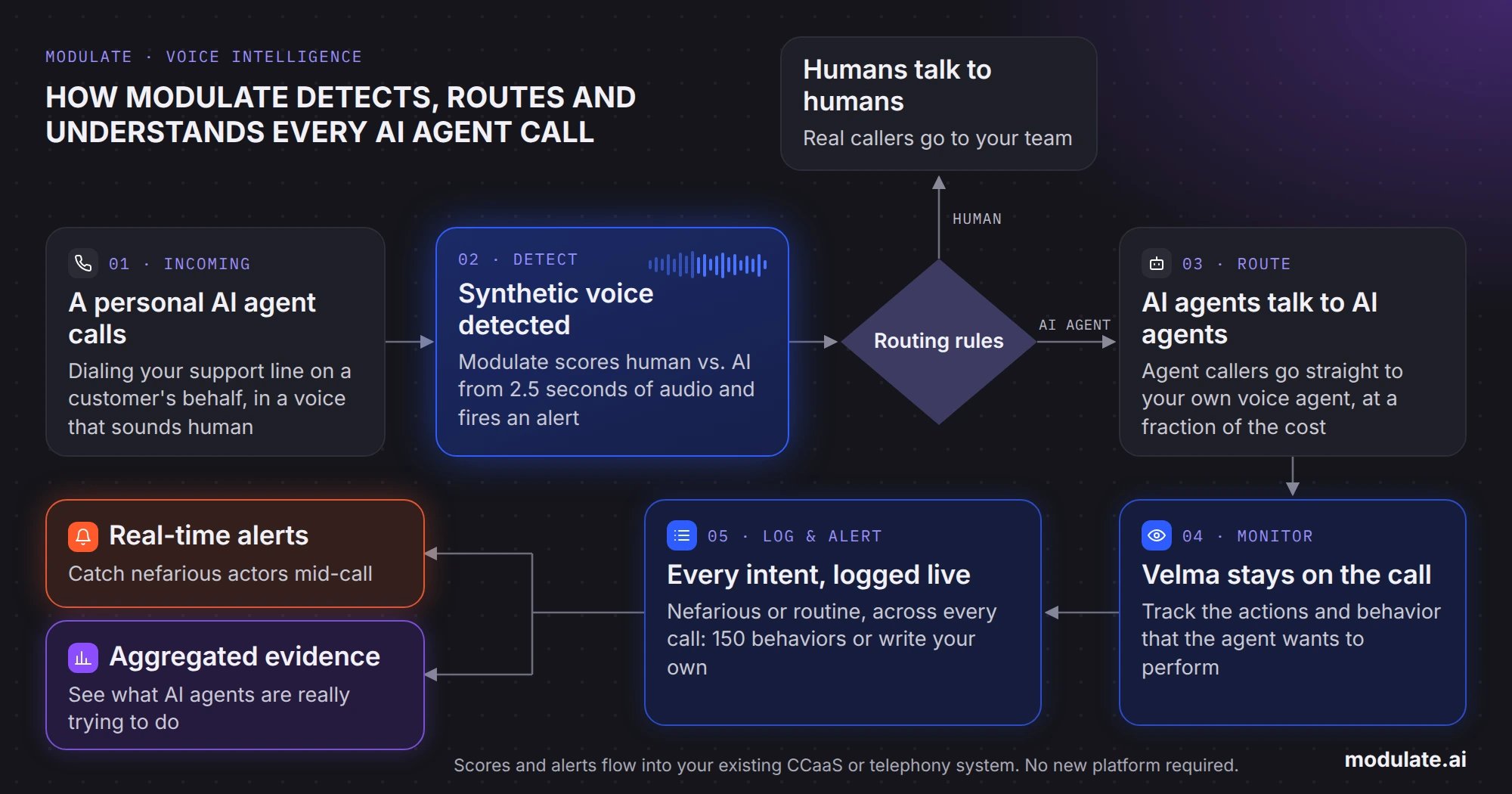
These voice analytics platforms offer a defense against fraudsters utilizing voice spoofing, artificially generated audio, or similar social engineering schemes. By analyzing acoustic and behavioral patterns, these platforms can detect synthetic audio used to mimic a CEO’s voice. In addition to spotting synthetic voices, the technology can detect behavioral anomalies during a live call: unnatural pauses, unnatural robotic responses that sound like a script, or behavior that mimics patterns of known fraud. Agents and fraud teams can step in to stop the call and prevent fraudulent transaction completion.
Modulate’s commercial fraud prevention solution detects executive impersonation attempts, payment redirect fraud, and identity verification fraud. Built on Velma, an Ensemble Listening Model (ELM), Modulate’s solution is designed specifically for this use case.
Dispute Resolution
If a customer disputes something that was said on a call (an agent promised a refund, lied about a product, forgot to mention a fee), the traditional method of resolution is lengthy and depends on whoever can locate the appropriate recording and take the time to listen to it. Voice analytics makes this process instantaneous and searchable.
Transcripts and sentiment scores can be produced on-demand, specific phrases can be pulled up in seconds, and the full context of the conversation is stored in an easily-searchable format. Resolution time plummets, organizations are safeguarded against false claims, and customers with legitimate complaints have an accurate record of what occurred.
PII Redaction
When a customer says their credit card number, SSN or account credential during a call interaction that information is captured into the audio recording. This exposes data that is sensitive under PCI and GDPR regulations. Voice analytics technology identifies sensitive data as the word is spoken and can redact/mask that data from call recordings before the recording enters any storage system or downstream applications.
Modulate’s Transcribe PII/PHI Redact solution automatically flags sensitive data inline for redaction within both transcript and audio recordings. This occurs in real-time or during ACD post-call processing. All of this is done without interrupting the agent or embarrassing the customer with on-hold secure-password entry screens.
Voice Analytics Use Cases in Healthcare

Healthcare has become one of the most exciting (and sensitive) applications of voice analytics, with use cases ranging from administrative efficiency to early detection of disease.
AI Fraud Detection
Healthcare fraud costs the United States approximately $300 billion every year (about 10% of all healthcare spending), and incidents are on the rise. From fiscal year 2020 to fiscal year 2024, health care fraud offenses rose almost 20%, according to the U.S. Sentencing Commission. Much of this increase occurs not through claims data, but through real-time voice: phone calls to care teams, telehealth visits, and customer interactions where criminals deploy synthetic voices, social engineering tactics, and stolen identities to manipulate caregivers and swiftly execute fraud before any transactions are flagged.
Legacy fraud prevention methods rely on examining claims data after the fact to catch these types of schemes. Velma's fraud detection solution uses advanced AI to listen to live conversations as they occur, detecting fraudsters using deepfake and spoofed voices, identifying social engineering red flags like pressure and urgency, and scoring each call for fraud risk as it happens. If the call is deemed suspicious, additional authentication can be triggered, transactions can be put on hold, or the call can be routed for review to prevent fraudsters from succeeding.
Mental Health Monitoring
Depression, anxiety, PTSD, bipolar disorder: researchers have found quantifiable vocal biomarkers that correspond with these conditions, and that can change as a patient’s condition improves or worsens. These biomarkers include speech rate, pitch variability, energy and frequency of pauses.
Voice analytics can detect these cues over the course of a clinical visit (or, in early-stage research, passively through consumer devices) helping doctors notice when someone is slipping between visits rather than waiting for the patient to come in or complain. It’s a nascent use case that will require significant validation; if it pans out, though, allowing doctors to detect mental health episodes before they reach crisis point could be one of the most meaningful applications of the technology.
Patient Experience Analysis
Patient satisfaction surveys only measure a tiny fraction of patients, and only those who self-select to respond. Voice analytics can measure every patient interaction (from intake calls to nurse triage conversations to post-discharge follow-ups) for cues of satisfaction and dissatisfactions like confusion, anxiety or frustration at scale.
If patients are repeatedly expressing confusion about discharge instructions or emotions during scheduling calls, health systems can pinpoint where processes can improve. Not only does this create a more holistic and truthful view of the patient experience than survey scores can provide, but it also allows organizations to prioritize care experiences that will make the biggest difference in quality of care and patient loyalty.
Clinical Documentation
Physician burnout has been frequently discussed, and the administrative burden (i.e., sitting down to write notes after seeing patients) is one of the leading contributors. Voice analytics technologies can transcribe and structure the conversation between a physician and patient in real time, automatically create a draft note, identify diagnoses and medication changes, and even populate fields in EHRs without the clinician ever having to type a single word.
Instead of spending 30 minutes to an hour on after-visit notes following a clinic session, providers can focus on the delivery of care while AI creates their record. Transcripts are becoming far more accurate thanks to advances in clinical NLP, making ambient documentation one of the fastest growing use cases in health tech.
Medication Adherence
Patients given instructions with multiple medications to take, specific times, dietary restrictions or cautionary side effects often become confused. When confusion arises, patients are likely to be non-adherent with their medication instructions. Voice analytics can identify uncertainty in a patient’s voice during a pharmacy interaction, discharge planning or telehealth appointment: pauses, questions for clarification, or uninterested acknowledgment without understanding.
This can trigger outreach, simplified print communications, or callbacks from the pharmacist: interventions which can increase adherence and decrease expensive readmissions caused by medication misunderstandings.
Security & Authentication Use Cases

Voice isn’t just becoming a preferred channel for banking, insurance and customer service. It’s also becoming a target. As voice expands as an attack surface, voice-based security tools will continue to grow in importance.
Voice Biometrics
Voiceprints (think fingerprints, but for voices) authenticate callers quicker than a knowledge based question and are far more difficult to compromise. Since voiceprints are inherently linked to the caller (unlike passwords which can be forgotten, shared, or used for multiple accounts), voice is a more secure and reliable method of verification.
Enrollment can even be passive: a voiceprint can be built from natural conversation during the first call without making the customer read off a specific phrase. Any subsequent calls are automatically and silently authenticated in the background during the first few seconds of speech. This creates a frictionless security experience that also helps lower average handle time by removing authentication steps.
Liveness Detection
With the recent advancements in synthetic audio and deepfake voice technology, bad actors can now spoof customers using AI generated voice clones made from mere seconds of recorded speech.
AI-based liveness detection can distinguish between a live caller and a replayed/generated voice by inspecting the acoustic characteristics of incoming audio and identifying the subtle imperfections that exist in synthetic audio. As evidenced by a 2025 Pindrop study, which found a 475% increase in attacks using synthetic voices to target insurance companies in 2024, the need for such detection is greater than ever.
Modulate's deepfake detection API is currently ranked #1 on Hugging Face for deepfake voice detection. It works at a 1.1% equal error rate for both real-time streaming and batch transcription API modes.
Continuous Authentication
Authentication occurs once per call, at call initiation. But what happens after authentication has been successfully fooled? There are no additional hurdles for a skilled fraudster to clear. That's where continuous authentication comes in. By continuously re-validating the speaker's voiceprint during the call, the system can be certain that minute 1 and minute 15 of the call are being spoken by the same person.
If the acoustic profile changes (indicating a new speaker has taken over) then the call can be tagged for review. This is especially useful for high-risk transactions that are prone to mid-call takeovers like wire transfers and account changes. Velma's speaker diarization and real-time behavior analysis are core technologies that enable this functionality.
Product & UX Research Use Cases

Voice analytics provides something that survey responses and clickstreams don’t: insight into the emotional and cognitive response users have as they actually use your products.
Usability Testing
Think-aloud sessions are often how usability studies collect qualitative data. Participants use a product while verbalizing their thought process. What they say is valuable information, but only part of the story. Voice analytics uncovers what they don’t consciously say: that hesitation before tapping an unclear button, the tension in their voice when they can't locate what they're after, the even tone of someone forcing their way through a bothersome process out of necessity.
Audio cues expose friction points participants may not recognize or may be hesitant to admit due to politeness.
Focus Group Analysis
Focus groups create hours of qualitative data. Then what? Usually that data is interpreted through a moderator’s memory and notes taken by hand.
Voice analytics automates the analysis step: tagging themes in real time as they occur, following changes in sentiment over the course of the session, highlighting topics that drove the greatest emotional response and recognizing moments of high agreement or strong polarization. Focus group insights become quicker to deliver, easier to distribute, and more actionable: based on data instead of opinion.
Voice Assistant Optimization
Voice assistants like smart speakers, IVR apps, in-car virtual assistants, and enterprise voice bots rely on natural language understanding (NLU) models trained to understand how people actually speak (instead of how engineers think they’ll speak). Monitoring real interactions with voice analytics surfaces the edge cases you won’t see in your testing lab: the words your model won’t recognize because of a regional accent; the phrases your customers naturally reach for that your model can’t understand; the places where customers revert to repeating themselves or slowing down because they think you aren’t understanding them.
That feedback loop helps you make your voice interfaces more natural over time. Modulate’s Velma Voice Agent Understanding solution gives you visibility into how your customers are using your AI voice agents. Identify friction points, measure engagement, and optimize for better agents and better outcomes.
Human Resources Use Cases

HR use cases for voice analytics are helpful, but should be considered carefully for bias, ethics, and privacy.
Interview Analysis
One proposed use case has been analysis of recorded interviews to score interviewees not only on what they’re saying, but how clearly, confidently, and coherently they communicate: do they have strong, fluent responses, or do they stumble to find the right words?
Of all possible use cases in HR, this is the most perilous from an ethical standpoint. Word choice, emphasis, and speech patterns can betray a person’s native language, neurodivergence, level of introversion/extroversion, regional background, etc. It would be extremely easy for a tool like this to inadvertently punish non-traditional thinkers who may articulate their thoughts less smoothly.
The most ethical tools are used in a very narrow way focusing on easily quantifiable skills that are proven to map to job performance, and are always used in conjunction with human decision-making.
Employee Engagement
The tone of voice and communication habits from internal meetings, town halls, and one-ones can send signals about team morale, psychological safety and overall organizational health. Voice analytics can uncover if employees are speaking less definitively over time, if certain teams systematically have lower meeting engagement, or if communication changed after a leadership transition or organizational restructuring.
Applied responsibly and with transparent communication/consent, this technology can help HR leaders detect engagement problems early (before they appear in attrition rates) and tailor interventions to where they're needed most.
Training Effectiveness
Monitoring whether or not training led to behavior change has always been challenging. Voice analytics offers a tangible solution: record conversations pre- and post-coaching session and measure if desired behaviors (enunciating more clearly, using better active listening cues, minimizing filler words) were in fact improved.
This gives contact center agents a quantifiable, objective history of their growth that complements manager assessments. For sales teams, it provides enablement leaders with the answers they’ve been looking for: did this training have an impact, and if not, why?
Media & Broadcast Use Cases

For media companies with warehouses full of audio and video archives, voice analytics is as much about realizing existing value as it is about monitoring new content.
Content Indexing
Without a transcript, a library of decades worth of broadcasts is essentially impossible to search. You know that great interview or quote is in there somewhere, but somebody has to remember approximately when it happened and listen through hours of recordings to find it. With voice analytics, you can search thousands of hours of recordings in seconds. Every word is transcribed, tagged with a timecode, and indexed so you can find it.
Journalists researching background for a story. Producers digging for archival sound bites. Researchers studying changes in coverage over time can all benefit from voice-powered metadata without ever playing a tape or dragging a slider.
Brand Safety Monitoring
Broadcasters, streaming platforms and podcast networks all have brand safety considerations built into their day-to-day operations. This is especially true for live or near-live content where the volume of output makes human review impossible. Voice analytics tools can monitor audio streams in real time for use of banned words, content policy violations, or subject matter that advertisers might find offensive. Offensive moments can be flagged for human review or intercepted automatically before the damage is done.
Audience Engagement
Conventional audience measurement (ratings, downloads, listen-through rates) can tell you if people stayed, but they can’t tell you how they felt. Voice analytics applied to focus groups, preview screenings, or panels of listeners can tell you how people feel about specific moments of content: the surge of excitement when a story truly resonates, the slump when something lingers, and the increased attentiveness when a host injects passion.
Insights like these can help producers make smarter editorial choices. They help advertisers buy placements where audiences will be most receptive. They help networks understand what makes their most gripping content different from content that simply does its job.
What Should Organizations Look for in a Voice Analytics Platform?

It's crucial to understand that voice analytics solutions vary significantly, and companies often downplay these distinctions. If you're platform shopping, don't get bogged down by comparing feature checklists. Dig deeper and ask tough questions about system architecture, accuracy, cost and workflow integration.
Audio-native architecture vs. transcription pipelines. The single most important technical difference in today's market is whether a platform analyzes audio directly, or sends it through a transcription intermediary first. The vast majority of platforms utilize what we call a transcription-to-LLM pipeline. This is a two-stage process where tone, emotion, prosody, hesitation, and vocal stress are discarded before analysis even begins. You end up with something that knows what you said, but not what you meant.
It's a limitation that more outsiders to the vendor community are starting to notice. McKinsey partner Eric Buesing, a leader of the firm's customer care practice, described this shift:
"There's been a movement toward what's now often referred to as conversational or voice intelligence. This advancement is crucial as it helps organizations explore the root causes of customer calls — recognizing that customer calls are complex and cannot be simply categorized as, for example, a 'billing call' or a 'policy inquiry.'”
It’s that nuance that transcription-first pipelines miss. Audio-native models like Velma, which ingests and analyzes the acoustic signal directly as an Ensemble Listening Model, retain those signals and give you far more accurate behavioral and emotional insight. The margin isn't small: it’s the difference between if your platform can consistently spot fraud, actual customer distress, or quiet compliance failures that don't show up in the transcript.
Coverage and precision. Carefully consider what and how well a platform detects something right out of the box. Platforms that require heavy prompt engineering for basic behavior detection, or produce unacceptable false-positive rates on emotionally nuanced calls, generate noise instead of signal.
Velma comes pre-loaded with 50 standard behaviors and over 100 templates for detecting fraud, churn, compliance, and escalations, all operational straight from audio without any extra setup. Velma also allows customers to build custom behaviors from plain language to easily add or customize detectors unique to your industry or workflows.
Real-time performance. Post-call analytics can be useful for coaching, compliance auditing, and trend analysis. But the most high-value use cases (fraud intervention, live agent assist, churn prevention, compliance enforcement) demand insights in real-time. Test whether the vendor's real-time performance is robust in production conditions. This includes calls with background noise, overlapped speakers, and different accents.
Modulate’s Velma provides timestamped scores and alerts in-real-time as the conversation happens, with diarization that can even handle overlapped speech and background noise.
Integration and deployment complexity. If a voice analytics platform requires extensive engineering effort to integrate, or forces you to ditch your existing infrastructure, there will be friction that slows and limits your ability to realize value.
Velma is a drop in layer: send audio, get back structured JSON. It integrates with the voice infrastructure your enterprise most likely already has in place (e.g., Five9, Genesys, Microsoft Teams, Zoom, Zendesk, SIP telephony) with no rip and replace required. If you're a team building custom workflows, Velma's API and webhook architecture make it easy to pipe signals into whatever case management system, risk engine, coaching tool, or dashboard you use.
Transparency and auditability. In regulated use cases especially, a black-box system that merely returns a risk score with no explanation for why is hard to act on and impossible to defend. You want systems that provide auditable outputs: individual behavior detections mapped to points in time throughout the conversation, along with the rationale that can be reviewed and validated by compliance and supervision teams.
Velma's ensemble architecture, in contrast to black-box LLM approaches, preserves the evidence trail all the way back to the underlying signals that drove each output, enabling practical use in compliance workflows and internal audits.
Security, privacy, and compliance posture. Voice data is inherently sensitive, and the platforms processing it should be built with that in mind. Understand data retention and deletion capabilities, encryption practices, and if the vendor utilizes any industry recognized certifications.
Modulate applies ISO 27001 certified security practices across the organization. Velma has privacy-first data handling built in, allowing us to back your strictest deletion policies and security practices for enterprise and regulated-industry deployments.
Cost at scale. Voice analytics is only useful if it analyzes 100% of your calls rather than a 2-5% sample. This means that cost per hour of audio processed is tremendously important. LLM-based pipelines can cost $2.50-$10 per hour to run. Velma starts at $0.75 per hour, enabling you to run analytics on every call even if your organization processes millions of minutes of calls per month.
The point is that architecture determines capability, and capability determines if your platform will actually be able to do what you need at production scale. Too often organizations get tunnel vision comparing UIs and feature lists, only to find late in development that the underlying model isn’t accurate enough (or fast enough, or affordable enough) to use at scale.
How Modulate is Advancing Voice Analytics
Voice analytics boils down to bridging the gap between what organizations know and what they can hear. For years, the vast majority of the human speech (customer-agent, patient-provider, prospect-sales rep) was captured as audio. It was recorded, stored momentarily, and then discarded. All of the value trapped in those conversations was lost.
Voice analytics powered by AI closes that loop. The advent of voice-native platforms like Modulate's Velma, which understands the acoustic signal itself rather than relying on an intermediary transcript, is a significant leap forward in terms of accuracy, cost-efficiency, and breadth of behaviors that can be detected with confidence. Voice data is now so compelling that the question is no longer if your organization should analyze it, but which competitors will move quickly enough to gain a sustainable edge. Watch Velma in action.
Frequently Asked Questions
Voice analytics vs. speech analytics: what’s the difference?
While they’re often used interchangeably, there’s an important distinction. Speech analytics commonly refers to the transcription of spoken audio into text, then applying analytics to the text to surface keywords, topics and patterns.
Voice analytics is a broader practice that encompasses all that speech analytics offers, but it also analyzes the acoustic events occurring within the audio itself (tone, pitch, pace, stress, emotion) to surface signals the transcript may have missed. Industry usage has generally settled on voice analytics as the catch-all phrase, especially given many platforms have moved beyond the transcription-first framework.
Can voice analytics recognize customer emotions?
Yes, and this capability is one of voice analytics’ most useful features. Voice analytics solutions examine acoustic events (variations in pitch, speech speed, vocal energy, cadence) to determine when a speaker is experiencing emotions such as frustration, anxiety, satisfaction and hesitation as they’re talking.
Advanced platforms don’t guess emotion from word choice; they pull it directly from the audio stream. After all, many customers try to be polite on calls even when they’re frustrated. Some platforms, like Velma, identify over 20 different emotions from the acoustic signal. This allows you to flag frustration or negativity during the call before the customer actually says, “I’m upset.”
Can voice analytics detect fraudsters and deepfake voices?
Yes. In fact, this has quickly become one of the most pressing use cases for the technology. Today’s voice analytics platforms are able to identify synthetic/AI-generated audio by looking for subtle acoustic artifacts that are inadvertently left behind by deepfake algorithms (which are constantly improving). Beyond deepfake detection, behavioral analysis that takes place during a live call can help identify social engineering patterns (such as unusual urgency, scripted/responses, attempts to pressure the agent into skipping verification steps) that indicate a fraud attempt is underway.
Liveness detection ensures that a caller is a live human being rather than a recorded or synthetic voice. Continuous authentication determines whether the same voice is present throughout the entire call. Modulate’s deepfake detection model ranks #1 on Hugging Face’s Speech Deepfake Arena Leaderboard with a 1.1% equal error rate for both real-time and batch detection.
In what ways is AI enhancing voice analytics?
AI is elevating speech analytics technology from keyword spotting to understanding the context, emotion and intent of the complete conversation. Previous generations of speech analytics utilized static rule-based engines that flagged specific words or phrases that were pre-programmed. Today’s AI platforms utilize machine learning to identify subtle patterns in behavior, predict events such as churn or fraud, and evolve as more data is analyzed.
Arguably the biggest advancement in speech analytics has been the move to voice-native architectures that analyze the audio directly instead of transcribing it, allowing a richer signal to be captured with far less latency. AI has also helped drive down cost to where it now makes financial sense to analyze every call, not just a sampling.
Why does a transcript-based AI pipeline create a bottleneck in real-time analytics?
Transcription first pipelines come with two problems: latency and loss of signal. Waiting for transcription takes time. Even the fastest services impose processing latency that diminishes your real-time edge. But more importantly, by transcribing speech to text prior to analysis you lose huge amounts of information that give speech its meaning. Crucially, subtleties like tone, emotion, prosody, hesitations, vocal stress, and speaker dynamics disappear in the transcription phase, long before the language model gets a chance to analyze anything.
That means you’re left with a system that understands words, but not context. A system that has a built -in delay that prevents it from reacting in true real-time. Voice-native solutions like Velma eliminate the bottleneck by analyzing the acoustic signal itself.