Best Speech to Text Models in 2026: 10 Leading Models Compared
Call Center Voice Analytics: What It Measures and Why Audio Beats the Transcript
September 29, 2026


Contact centers that deploy speech analytics at scale on their call interactions save 20 to 30 percent in costs and gain customer-satisfaction-score improvements of 10 percent or higher, McKinsey estimates. The majority of contact centers will never realize that kind of return on investment: traditional manual call sampling programs still review less than 2 percent of all interactions, randomly, and the few tools that do run at scale typically analyze only a text transcript of the call, rather than call audio itself. By analyzing the call audio directly, call center voice analytics makes tone, hesitation, stress and even the acoustic fingerprint of a synthetic voice quantifiable data points rather than things a supervisor needs to identify by ear.
This article is a quick primer on call center voice analytics. We cover how it differs from transcript-based tools, what it measures and where it matters. If you manage quality, fraud, compliance or CX in a contact center this is the layer that transforms recorded conversations into actionable intelligence in real-time.

Interactive tool
Call Center QA Coverage Calculator
0
Calls reviewed today
0
Calls never reviewed
0
Calls scored per month with 100% coverage
Enter your numbers to see how many conversations go unscored today.
How this is calculated and sources
Calls reviewed = volume x your review rate. Calls never reviewed = volume minus reviewed. Full coverage = your total monthly volume, because audio-native voice analytics scores every call rather than a manual sample. All figures are derived from the numbers you enter.
Context: McKinsey found contact centers applying analytics to the full voice stream saw cost savings of 20 to 30 percent and CSAT gains of 10 percent or more. Learn how full-coverage scoring works with Velma.
What is call center voice analytics?
Call center voice analytics applies AI technology to understand the audio portion of customer calls to understand not just what was said, but how it was said. Voice analytics begins by capturing the words transcription, then applies an additional acoustic layer to measure tone, speed, emotion, stress, overtalk and speaker attributes. While conventional call center analytics focuses on transcripts and post-call reporting, voice analytics analyzes the raw signal, which is where the true intent and risk resides.
The difference is important because a transcript levels a conversation. “I guess that’s fine” sounds like agreement on paper. On audio, a long pause and falling pitch can signal the exact second a customer chooses to churn. Voice analytics was designed to pinpoint that moment.
How call center voice analytics works
Voice analytics software typically processes call audio through models that simultaneously score acoustic and linguistic attributes, usually in real-time. Speech is run through a transcription model, while other models interpret prosody (pitch, rhythm and stress), identify emotion and sentiment, detect silence and interruptions, and verify if a voice is human or computer-generated.
Industry-standard solutions chain transcription to a large language model (LLM), which divorces the model from everything except text it sees. Modulate’s Velma takes a different approach. Its Ensemble Listening Model consumes raw audio and powers hundreds of specialized models simultaneously, so factors like emotion, stress, speaker dynamics and acoustic authenticity are understood from the signal itself. It’s why Velma can score 100% of calls in real time.
“Real conversations carry meaning far beyond the words themselves. Tone, timing, hesitation, emotion, and interaction patterns all shape what’s actually being communicated.”
- Mike Pappas, CEO and Co-founder of Modulate
What call center voice analytics measures
Voice analytics tracks a combination of linguistic and acoustic signals which together define the health and risk posture of a conversation. Categories that are most actionable include:
- Sentiment and emotion. Actual emotion inferred from tone and energy, rather than simply scanning a transcript for positive or negative keywords.
- Intent and topics. Why the customer called, identified automatically across thousands of conversations.
- Stress, urgency and coercion cues. Behavioral indicators revealing a distressed customer or a social-engineering attempt underway.
- Acoustic authenticity. Detection of whether the voice on the line is human, cloned or artificially generated.
- Conversation dynamics. Talk-to-listen ratio, overtalk, silence and pacing, which can be predictive of resolution and CSAT.
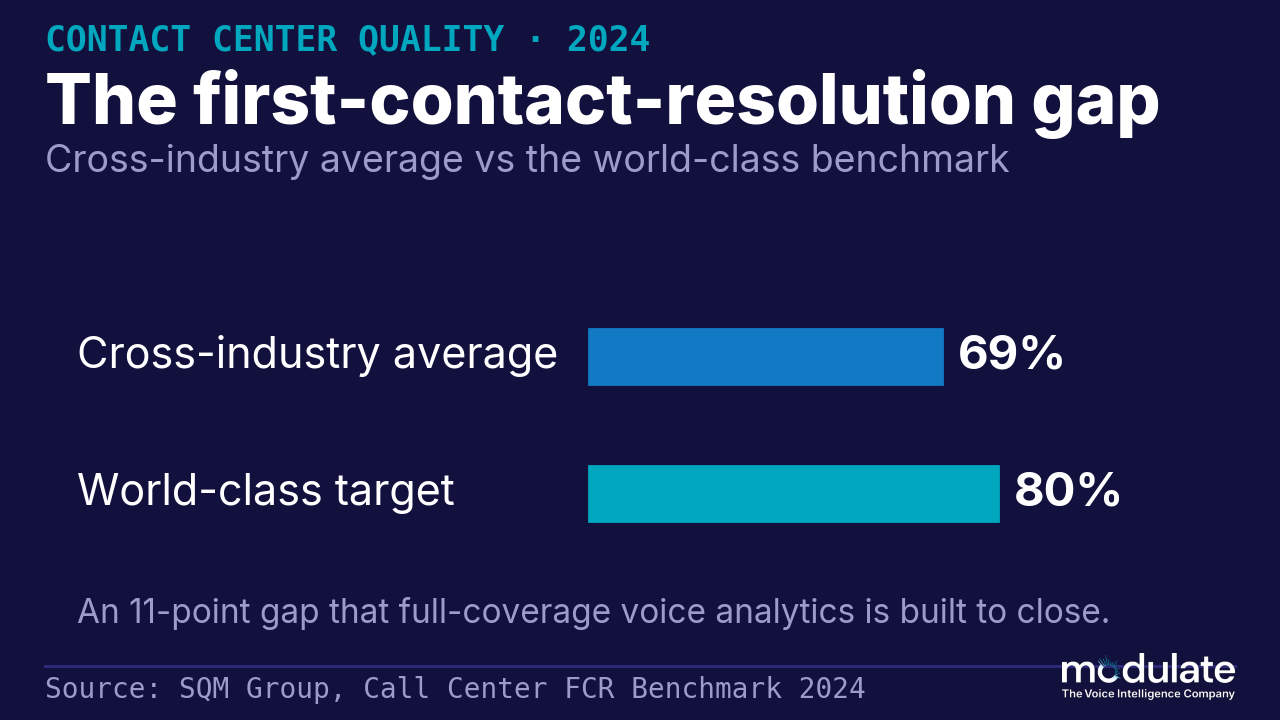
These signals feed into the operational metrics teams track daily. SQM Group's 2024 benchmarking showed that the cross-industry average for first-contact-resolution (FCR) is 69%, with world-class contact centers reaching 80% or better. Voice analytics lets teams identify the calls contributing to low FCR rates and improve the entire pattern, not just the ticket.
Where call center voice analytics pays off
Voice analytics has value whenever a call’s consequences are greater than what appears in a transcript. There are four primary use cases that demonstrate this value:
Quality at scale. Because manual QA teams can only review a fraction of customer calls, most conversations don’t receive any score. This complete call analysis eradicates the blind spots of sampling, grounding coaching in every interaction rather than a limited selection.
Fraud and deepfake defense. Fraud losses are exploding. U.S. consumers lost over $12.5 billion to fraud in 2024 alone, up 25% year-over-year according to the FTC, with phone fraud the second-most-reported method of contact. Voice analytics identifies both the urgent and manipulative speech patterns of a scam as it’s happening, as well as the acoustic artifacts of synthetic speech. If these patterns or artifacts are identified in post-call transaction monitoring, it’s already too late to take action. Learn about how Modulate’s technology fights fraud on our fraud prevention page.
Compliance and risk. Because scoring is happening in real time, risky language, omitted disclosures and escalations are caught as they occur, allowing a supervisor to intervene before the call spirals out of compliance rather than discovering the violation through QA a week later. Read more about real-time AI monitoring.
Agent coaching and well-being. By tracking agent stress and emotional indicators, we can see which agents might benefit from extra support and which calls should be reviewed for coaching, all tied to particular moments in the dialogue.
Real-time vs post-call voice analytics
Perhaps the single largest capability gap between voice analytics solutions today lies with timing. Post-call analytics scores conversations after they've completed. This is ideal for trend analysis, staffing decisions and historical QA. Real-time analytics scores the call while it is still open. This is the only way to act on a fraud attempt, compliance breach or escalating customer while the call is still happening.
“The question isn't whether your organization will encounter a deepfake voice attempt. It's whether your detection infrastructure was built to catch what's being deployed today — or to combat fraud techniques from two years ago.”
- Mike Pappas, CEO and Co-founder of Modulate
If you're aiming for intervention over retrospective analysis, real-time functionality is key.
How to choose call center voice analytics
Here are four things to consider when selecting a vendor.
- Coverage. Make sure it scores 100% of calls, not a sampling.
- Audio-native analysis. Ensure it analyzes the acoustic signal, not just the transcript. If you work in fraud or customer calls with high emotion, this is critical.
- Timing. Do you need real-time coaching or post-call reporting? Buy the tool that fits your workflow.
- Integration. Ensure it integrates with your CCaaS, CRM and workforce management tools so that the signals feed into the dashboards your teams are already monitoring.
The signal you’ve been missing
Transcripts will never be able to definitively capture the moment a customer is deciding to churn, or distinguish between a real person and a cloned voice. That’s the missing piece that transcript-based solutions leave you with, and that’s where Modulate’s Velma comes in: interpreting tone, stress, silence and voice authenticity from the raw audio of every call, as it happens, at 100% volume rather than a sample. For quality, fraud, compliance or CX teams, that’s the difference between responding to an issue after it’s too late and catching it while the call is still live.
If you’re scoring calls from a transcript, you’re only working with half the signal. See how Velma analyzes the entire voice stream.
Frequently asked questions
What’s the difference between call center voice analytics and speech analytics?
Speech analytics focuses primarily on the transcript and analyzes what was said. Voice analytics includes the acoustic layer: tone, stress, emotion, pacing and indicators of a synthetic voice. Both have value, but audio-native voice analysis can reveal intent and risk that text-based analysis cannot.
Is real-time analysis possible with voice analytics?
Absolutely. Newer platforms score the call as the audio stream is coming in. This allows for real-time fraud detection, compliance alerts and in-the-moment coaching. Post-call-only analysis tools don’t provide insights in time to prevent fraud or intervene in a call while it's happening.
Will voice analytics flag deepfakes and voice cloning?
Yes, if it’s audio native. Audio native systems analyze the acoustic fingerprint a voice produces and can flag clones or completely synthetic audio that cannot be detected in a transcript. This is critical, because voice cloning tools are becoming increasingly accessible to fraudsters.
How much call volume can voice analytics be applied to?
Purpose-built voice analytics can analyze 100% of calls. That's a massive improvement over manual QA, which can review only a tiny percentage of conversations, leaving most calls unscored.
Do I have to replace my contact center platform to implement voice analytics?
In most cases, no. Leading voice analytics vendors design their tools to integrate with your existing CCaaS and CRM stack, pushing real-time signals into your existing workflows rather than replacing them.