AI Agents Are Calling. Modulate Makes Routing Them Easy.
AI Monitoring Trends for 2026: Fraud, Guardrails, and Conversation Intelligence
July 22, 2026


Key Takeaways:
- AI is transforming contact centers. However, organizations are learning that deployment is just the start. Real time AI monitoring, full conversation analysis, and strong guardrails are quickly becoming necessities to safely handle fraud, compliance, workforce monitoring, and self-learning AIs.
- Under pressure from AI voice fraud, deepfakes, and self-learning AI conversations, enterprises must evolve customer interaction management from narrow manual QA and rigid rulesets to proactive, behavior-based AI-driven monitoring that doesn't sleep.
Monitoring is nothing new to customer service teams. Zendesk reports that 87% of CX leaders state that artificial intelligence (AI) has helped improve their organization’s customer interactions. Master of Code says businesses are implementing AI solutions to help their organizations answer customer queries faster (67%), reduce wait times (62%), increase data accuracy (53%), scale/create consistent experiences (42%), generate personalized responses (41%) and decrease costs (28%).
AI monitoring is key to realizing these benefits. As companies continue to adopt AI technology to automate customer service operations, they’ll need visibility into AI’s behavior during live customer conversations, how AI is handling risk, and where AI is creating opportunities for risk in compliance, fraud, or customer experience (CX). In this guide, we cover the top trends in AI monitoring that are impacting customer service teams including conversation monitoring, AI guardrails, voice fraud detection, workforce monitoring, and more.
Why AI Monitoring is the Defining Challenge of 2026

Enterprises have raced to deploy AI solutions in contact center and customer service environments, often outpacing their own efforts to govern what they’ve created. Stanford’s 2025 Annual AI Index report showed that AI was involved in 233 incidents in 2024 alone, a year-over-year increase of 56.4%. Gartner predicts that more than 40% of agentic AI projects will be canceled by the end of 2027 due to governance failures.
Analysts are beginning to warn that designing and implementing proper governance for AI deployments won’t be easy. "Instead of dazzling transformation, the year ahead will be defined by gritty, foundational work — the kind that rarely makes headlines but is essential to realizing AI's long-term promise," writes Kate Leggett, VP Principal Analyst at Forrester. In their 2026 predictions, the firm forecasts that a decrease in service quality will plague AI-first companies that deploy tools faster than they can build out supporting operations.
Building out that infrastructure starts with rethinking how monitoring applies to AI. "The role of AI and the CSR flips: AI addresses the majority of the work, while CSRs assist AI," says Leggett, who adds that organizations should look for vendors offering "tightly blended AI and CSR experiences and measurement and optimization frameworks for AI," rather than focusing solely on the AI technology itself.
That includes how companies monitor AI itself. "The rapid acceleration and increasing agency of AI agents necessitates a shift beyond traditional human oversight. As enterprises move towards complex multi-agent systems that communicate at breakneck speed, humans cannot keep up with the potential for errors and malicious activities," warns Avivah Litan, VP Distinguished Analyst at Gartner. One solution? Using AI to monitor AI. These are what Litan calls “guardian agents.”
But AI won’t solve every governance challenge. "Governance needs to move from static policy to continuous oversight: monitoring agent behavior, detecting deviations, and adjusting controls as systems evolve," according to Grant Thornton's 2026 AI Impact Survey. The cost of not properly monitoring AI will be significant: "The question is no longer whether your organization will experience an agentic AI failure. It is whether you will be able to explain it when you do. Most cannot — yet."
Customer Service Is Embracing AI
Companies are beginning to integrate AI into their support departments. As of 2025, 85% of customer service decision-makers were already testing generative AI, and many of those tests have evolved into active pilots. (LinkedIn)
Those initiatives will continue to expand. Analysts expect that within a few years, 70% of customer interactions will be touched by AI in some form, including conversational voice agents, automated support, and assisted workflows. (NICE)
AI usage in customer support environments steadily climbed from 2023 through 2025 as organizations looked for ways to scale support without increasing burnout. (Statista)
Brands are also increasingly turning to AI to improve customer experience, not just reduce costs. Statista reported continued growth in AI adoption for CX initiatives throughout 2025, a trend that’s expected to continue. (Statista)
Contact centers are on the front lines of AI adoption. AI adoption at contact centers increased by 15% between 2023 and 2025, and contact center workers’ access to AI tools increased by 50% in 2025. Perhaps most indicative of where AI adoption is headed: The percentage of organizations with greater than 40% of AI projects deployed into production will double in six months. (Deloitte)
But there’s still a wide gap between AI adoption and AI maturity. Sixty-seven percent (67%) of customer care leaders have invested in AI, but only 31% say they’re using AI in advanced or immersive ways. Translation: Many companies have bought shiny new tools, but few have learned how to put them to truly meaningful use. (McKinsey)
It’s only a matter of time before more CX teams learn to do this. Deloitte forecasts that 25% of enterprises using generative AI will adopt AI agents in 2025. By 2027, that percentage will increase to 50%. Developers of AI tools should find these forecasts encouraging. But it also means those tools will need to be monitored more closely than ever. (Deloitte)
Smarter Self-Service Reduces Call Volume

Self-service systems used to be robotic and frustrating for customers. AI is changing that. 42% of customer care leaders say they’ve successfully reversed rising inbound call volumes through smarter self-service and digital deflection strategies. (McKinsey)
AI maturity is a competitive advantage, too. 40% of customer care leaders reported significantly improved customer experience scores in the past year, compared with just 12% of companies that didn’t use AI. (McKinsey)
One quarter of brands (25%) believe successful simple self-service interactions will increase by 10% by the end of 2026 as conversational AI systems get smarter and more human-like. (Forrester)
Companies are also doubling down on personalized automation. Organizations expect to see AI-powered personalized self-service increase by 53% by the year 2027. Self-service resolution rates are expected to improve by 47% by the same year. (IBM)
Despite this, many organizations find themselves somewhere in the middle of deployment. Over half of businesses surveyed say that they’ve only minimally automated customer communications. 49% of respondents stated that they only partially automate support inquiries and feedback workflows. (IBM)
There’s a lot to gain from getting this right. Organizations with AI-enabled call centers are reporting resolutions like 95% call containment, 92% routing accuracy, $0.45 average cost per call, and 95% CSAT. (Deloitte)
Full-Conversation Monitoring Over Samples and Spot Checks
Legacy call QA approaches struggle with visibility. Many manual QA programs sample between 2% and 5% of calls. That leaves 95-98% of customer conversations completely unchecked. (Enthu.AI)
When spot-checks do occur, they happen far less frequently than one might expect. Contact centers reviewing only 2-4 calls per agent per month won’t catch significant trends. (McKinsey)
AI customer monitoring completely changes the game. With AI call monitoring, organizations can review 100% of interactions, not just small samples. (Giva)
Analysis is faster too. AI driven transcription and diagnostics can be 400% faster than traditional means, helping businesses close the loop between detection and resolution that much quicker. (McKinsey)
Early adopters of these AI monitoring techniques have seen a 16% increase in call deflection, a 21% decrease in AHT, and have improved CX by 15-22%. (Cisco)
AI Voice Fraud Is On The Rise

Synthetic voice fraud is quickly becoming one of the most prevalent (and convincing) risks organizations face. Fraud is only getting worse. Deepfake call activity surged by 1,337% in 2024. By year’s end, about 1 in every 106 calls that contact centers received were synthetic. (Parloa)
Identity fraud losses rose 19% year over year to reach $27.2 billion worldwide. (Parloa)
It’s no surprise legacy fraud systems can’t compete. Basic rule-based systems had a false-positive rate of 20% versus 5% for AI-driven systems. Organizations have no choice but to rely on real-time AI monitoring instead of pre-written rules. (Parloa)
Voice cloning fraud surged 680% YoY. AI deepfakes were responsible for 30% of high-impact corporate impersonation attacks. (BriefGlance)
Simply knowing about voice cloning fraud isn’t enough. 97% of executives are aware of AI voice fraud tools. However, nearly half of leaders don’t think current solutions can effectively combat fraud. (Yahoo Finance)
AI Guardrails Are Non-Negotiable
Consider the money at risk. Businesses that utilized security AI and automation solutions experienced data breach costs that were $1.76 million less than companies who lacked AI-enabled defenses. (AssemblyAI)
Contact centers have paid over $200 million in fines for TCPA and data privacy infractions in 2023 alone. But manual monitoring isn’t a scalable solution for today’s compliance standards. (Elision Technologies)
There’s a trust issue around autonomous AI agents. While companies are interested in AI automation, many are reluctant to fully embrace the technology. Only 6% of companies trust AI agents to operate end-to-end business processes without human intervention. Just 12% reported that governance controls for ai agents were fully implemented, and only 20% believe their infrastructure can currently support AI automation. (Fortune)
That apprehension is understandable as AI removes the human element from real-time decisions. While 78% of decision-makers who work with AI say they trust their output, trust won’t cut it if there are no controls monitoring those decisions. (Forrester)
Voice AI is only going to become more autonomous, which means businesses require tools to help keep those agents in line. AI guardrails help minimize compliance risks around PHI exposure, PCI violations, and sensitive transcript handling before they become expensive problems. (AssemblyAI)
Workforce Oversight Is Changing Thanks to AI Monitoring

AI employee monitoring already runs rampant in customer service. Sixty-five percent (65%) of customer service workers in the U.S. say all their conversations are recorded at work. Nearly half reported that monitoring for tone and emotion takes place at work. (Statista)
Organizations prefer to listen rather than observe. Voice recognition is the most utilized AI technology used to monitor employees in contact centers. AI camera monitoring came in second at only 23% of workers being monitored by it. (Statista)
Constant surveillance isn’t always welcome. Over 30% of employees surveyed viewed AI monitoring negatively versus only around 7% of employees who felt this way about monitoring by fellow humans. (Cornell University)
Deploying AI everywhere without carefully designing the experience around it can backfire. In fact, customer and employee experience scores actually dropped by an average of 0.5 points between 2023 and 2025 despite increased AI adoption. (Deloitte)
Employee burnout hasn’t helped matters. Call center agents continue to leave their jobs at a rate of between 30-45% annually due to burnout and mundane tasks. (Elision Technologies)
New hire costs are also expensive. Replacing a call center employee can cost companies $10,000-$20,000 when training and onboarding costs are considered. Customer experience teams that implement AI technology and management practices retain more agents. (Abstrakt)
AI-to-AI Interactions Are the Next CX Challenge
Smarter AI starts with smarter knowledge management. 83% of participants in one study said knowledge bases were their primary agent-facing AI initiative in 2024. (HBR)
Organizations are also deploying generative AI across a growing number of customer touchpoints: 73% in instant messaging and chatbots, 61% in email, 55% in personalized services and recommendations, 49% in text messaging, and 46% in personalized advertising. (HBR)
It’s a lot of implementations to keep track of. That’s why IBM advises defining metrics like satisfaction scores, resolution rates, and escalation rates to measure AI effectiveness on an ongoing basis. (IBM)
There’s a strong economic motive for that monitoring, too. Labor expenses account for more than 90% of contact center costs, so hiring robots to handle low-complexity work can help cut costs. (HBR)
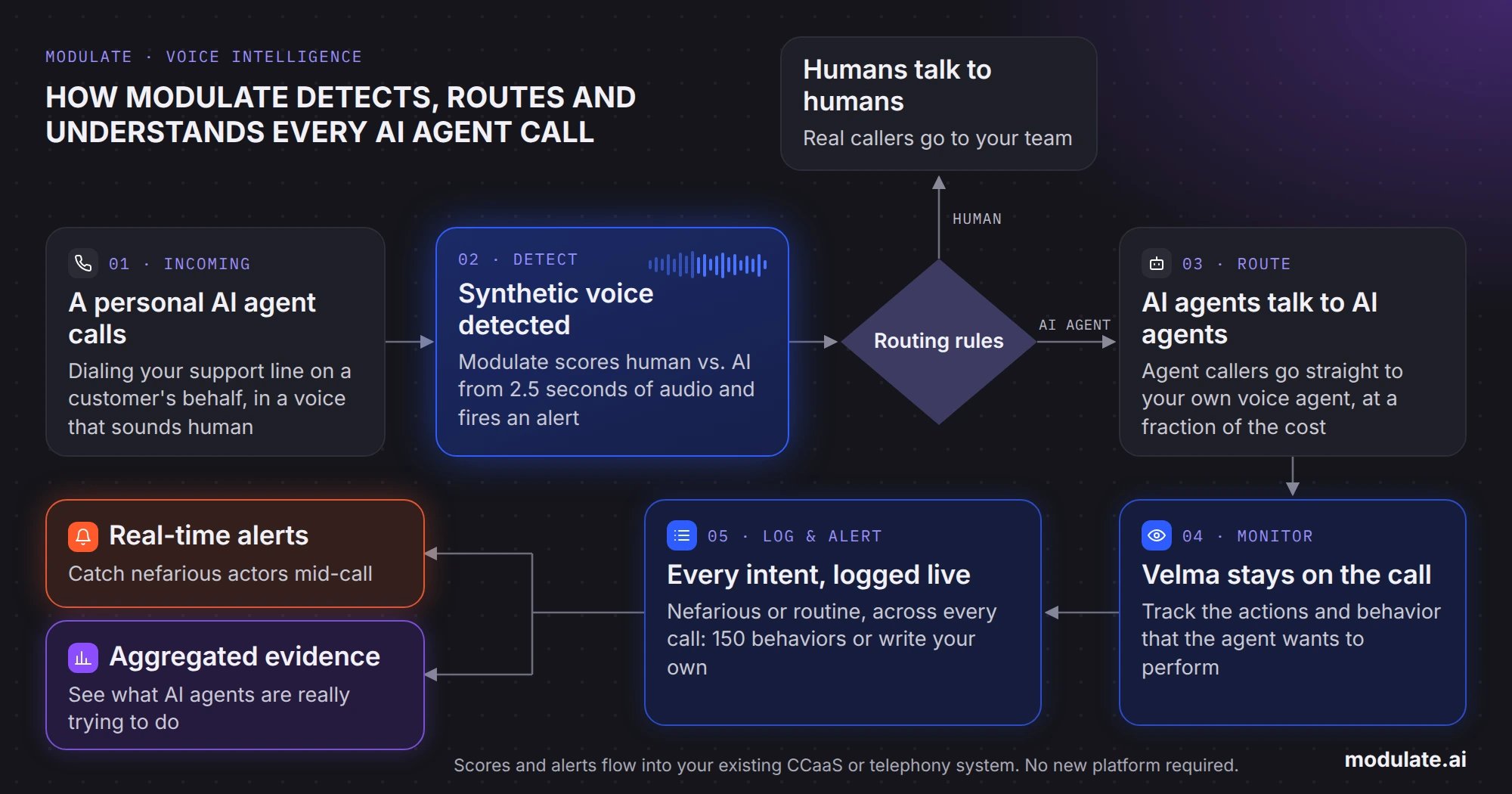
AI-to-AI communication is also something customer care teams will need to plan for. Forrester predicts that brands will experience single-day call volume spikes 100 times above normal levels because of consumer-developed AI agents. Soon, contact centers may not just be handling humans; they’ll need to handle other AIs, too. (Forrester)
Frequently Asked Questions
Will AI monitoring eliminate human QA teams?
No. In fact, AI monitoring will serve as a force multiplier for QA pros. Rather than poring over conversations themselves, QA analysts will focus on identifying trends, triaging escalations, coaching agents, reviewing high-risk conversations, and more.
Voice-specific AI threats are becoming more difficult to detect. Why?
Voice deepfakes are getting harder to detect because generative AI models are advancing so quickly. Today’s AI can mimic tone, cadence, emotion, accents, and speech patterns. Many organizations will move to behavior analysis and real-time voice authentication solutions.
What are AI guardrails and how can they protect my voice applications?
AI guardrails refer to safety mechanisms that act as operational guardrails for your AI systems. They’re not one tool with one specific feature, but rather a layered system of overlapping safety net catch mechanisms.
In voice applications, guardrails can keep agents from sharing sensitive information, block hazardous content, flag policy violations, escalate risky conversations to human teams, and limit the actions that autonomous chatbots can take in high-risk situations.