AI Agents Are Calling. Modulate Makes Routing Them Easy.
AI Fraud Detection for Insurance: What Voice Reveals That Data Can’t
July 21, 2026


Key Takeaways:
- AI-powered fraud detection allows insurance companies to listen to and understand what customers say and how they say it in real time to uncover risk signals that rules-based systems miss.
- As fraud becomes more nuanced and voice-based (think AI-generated scams), identifying suspicious behavior as soon as it happens in the native voice channel, before a claim is even filed, becomes critical.
Insurance fraud costs more than $308 billion every year. It’s always been a concern, but thanks to new technology, fraud is getting even harder to spot. Today’s fraudsters don’t just submit suspicious paperwork or trigger obvious red flags. Fraudsters are using technology solutions to beat traditional detection models. They’re using deepfakes, synthetic identities, device spoofing, and fingerprint manipulation, in conjunction with organized groups of scammers that share successful scripts and playbooks. They’re also beginning to weaponize autonomous AI agents that can automatically perform fraud attempts at scale and wear down customer care teams with volume and tenacity.
These new attacks are a problem for insurers that still rely on automated rules and retrospective reviews to detect risks. Fraud tactics evolve rapidly. If your tools can’t adapt, how can you hope to respond to rapidly evolving attacks? By the time a conversation raises red flags in retrospect, the most useful indicators have already passed. Automated AI fraud detection for insurance actively monitors live conversations. This allows insurers to see the risk indicators that fly under the radar of traditional fraud frameworks.
Learn why fraud is so hard to detect in the age of AI and how AI-powered fraud detection beats swindlers at their own game.
What Makes Insurance Fraud So Hard to Detect?

Large scale Insurance fraud is rarely obvious. Even smaller fraudulent claims can account for more than 10% of insurer payouts. The clues are often subtle, such as a claim that doesn’t quite add up or a caller whose story changes when asked follow-up questions.
Timing is a big part of the problem where many detection solutions fall short. “Most of them only run a single check during the early moments of the call,” says Mike Pappas, CEO and co-founder of Modulate. That leaves most of the call tree (where the useful nuggets tend to reveal themselves) unchecked.
Fraudsters know this, and they readily exploit it. “Sophisticated fraudsters know that once they’re past that check, they’re home free,” explains Pappas. Instead of raising alarms early, they work to slip through the cracks and avoid detection.
Rules-based systems and after-the-fact claims analysis can’t catch that. They work off disconnected pieces of data, not a live conversation. By the time you analyze a claim or flag a conversation, the opportunity to take action on those signals to prevent fraud has already passed.
Voice Fraud is the New Frontier
More fraudsters are using phone calls and even video recordings to dupe your company out of payments. In fact, Pindrop found that insurance companies experienced a 475% increase in synthetic voice fraud attacks in 2024.
Fortunately, there have been some advances in fraud detection. The way someone speaks (their tone, pacing, and word choice) can reveal signals that structured data never will. Traditional fraud detection can’t detect those signals in real time, but AI systems can now pick up on:
- Hesitation or over-explaining
- Emotional inconsistencies (e.g., calm tone describing a “stressful” event)
- Scripted vs. natural responses
While AI makes it easier for scammers to commit fraud, you can use the same technology to beat them at their own game.
How AI Fraud Detection Works in Insurance

It may sound like new-fangled technology, but AI fraud detection for insurance is the next frontier in fraud prevention. According to Deloitte, P&C insurers could save as much as $160 billion by 2032 with AI-powered tools.
AI fraud detection in insurance works differently from traditional detection systems. Instead of looking for a single red flag, it combines layers of analysis to understand what someone is saying and how they’re saying it.
At a high level, these systems process customer interactions (most often calls) using two technologies:
- Natural language processing (NLP): AI models use this technology to analyze the content of the conversation.
- Acoustic analysis: This feature evaluates vocal characteristics like pacing and stress.
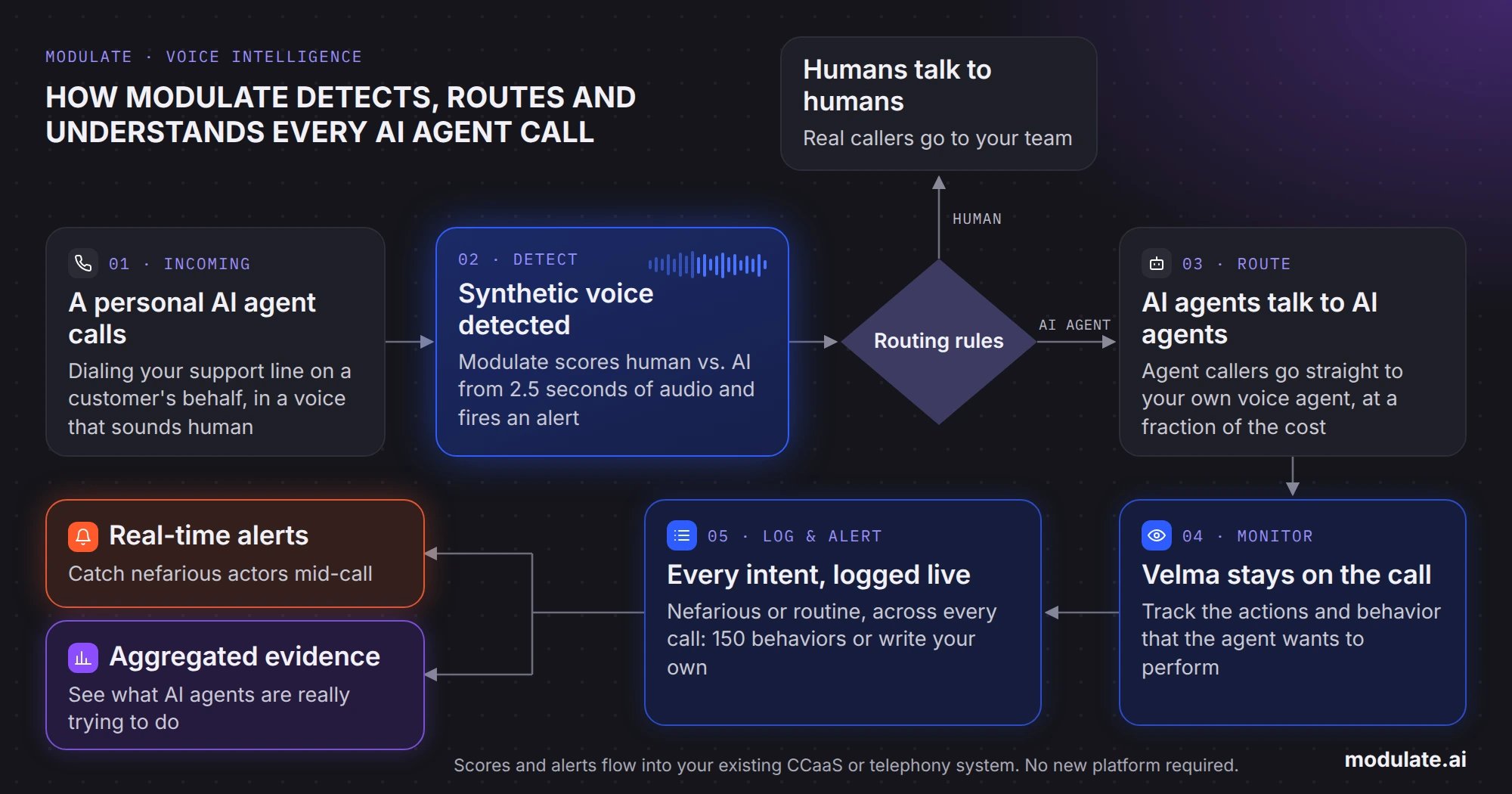
Together, these features build a more complete picture of risk. But these technologies are just the baseline. Advanced systems like Modulate’s Velma can identify signs of fraud in real time by:
- Capturing the conversation: AI systems ingest your audio and convert it into structured data.
- Conducting real-time audio analysis: Instead of simply recording the conversation, the tool analyzes it. It looks for inconsistencies, vague descriptions, hesitations, and a lot of other factors based on both the recording and the transcript.
- Surfacing risk signals: You don’t have to wait until a claim is filed to detect fraud. AI fraud detection for insurance actually spots it in real time. Most systems assign a risk score to a claim and highlight areas of concern for your team to review and act on.
- Integrating into your workflows: You don’t need to hop between different software platforms to spot fraud. AI detection systems work within the tools you already use for processing claims and chatting with customers.
AI can help you spot subtle signs of fraud, but not all solutions are the same. Your best bet is to go with a voice-native approach. With this setup, your AI fraud detection platform analyzes conversations as they happen, even with the natural ambiguities and chaos of human speech. They can even perform well with background noise and overlapping speakers, helping you uncover fraud when scammers try to obscure their intentions.
Fraud Has a Voice. Are You Listening?
Subtlety is the new norm for insurance fraud. You’ll find it in small inconsistencies and behavioral cues that don’t quite add up. That’s why you need more than automated rules or retrospectives: you need tools to detect risk in real time.
AI makes that possible by turning voice into a fraud signal. When you can analyze both what’s being said and how it’s said, you can surface suspicious behavior before it turns into losses. See how Modulate helps insurers detect fraud signals hidden in seemingly innocent conversations.
Frequently Asked Questions
Will AI fraud detection eliminate the need for human investigators?
No. AI should be used to augment investigators, not replace them. Using AI fraud detection tools can help analyze volumes of calls and claims interactions exponentially faster than a team of humans. However, humans are still needed to make the judgment calls required for stopping large, high-stakes fraud cases.
At what stage of the claims process should insurers detect fraud?
The sooner the better. Most useful fraud signals occur before a claim is fully filed. Many happen during the first notice of loss or other early claims interactions. By detecting risk earlier, you can investigate more quickly and avoid spending time on claims that have gone too far in the process to do anything about.
How does rules-based fraud detection differ from voice-based?
Rules-based systems can identify patterns in structured data like claim amounts or suspicious activity. Voice-based fraud detection analyzes speech patterns like stress, pitch, pacing, and consistency to identify lies and inconsistencies that you can’t find in structured data.