Audio Event Detection Now Available via Modulate API
What Is a Call Center? Types, Metrics and How They Work
September 24, 2026


The call center is undergoing a significant transformation from the ground up. Routine customer inquiries are now being addressed by AI. On top of that, AI handles tasks after calls conclude and scores interactions as they happen. Still, teams are finding it hard to catch up with the pace of new technological developments.
Fortune Business Insights estimates the worldwide call center artificial intelligence market will grow from $2.98 billion in 2026 to $13.52 billion by 2034, at a compound annual growth rate of 20.80%. McKinsey reports that 88% of organizations say they’re using AI for at least one business function, up from 78% in early last year. But buying tools and integrating them into your operation are two different endeavors. Many centers have AI tools they aren’t actually using.
Here’s a look at the types of call centers, the tech stack, the metrics that matter and the security concerns that are reshaping the industry.
 MODULATE
Call Center Benchmark Scorecard
Enter your numbers to see how your center compares to 2024–2025 industry benchmarks across five core metrics. All scoring is computed in your browser.
0
Score out of 100 vs. industry benchmarks
Benchmarks and sources used
Each metric is scored against a published 2024–2025 benchmark. Green = at or better than benchmark, amber = within a tolerance band, red = needs attention.
- First call resolution target 76.2%, per SQM Group FCR Benchmark 2024
- Healthy occupancy ceiling 85%, per HiringBranch 2025
- Call abandonment target 6%, per HiringBranch 2025
- Industry turnover midpoint 37.5%, per Insignia Resources 2025
What Is a Call Center?
A call center is an organization designed for high-volume telephone conversations with customers, both incoming and outgoing. Inbound call centers address support inquiries, billing issues and service requests. Outbound call centers conduct sales, collections, surveys and proactive customer outreach. “Contact center” expands on this concept to include email, chat, SMS, and social channels. But voice is still the medium most customers turn to when they need to speak with someone about an urgent or complicated issue.
The nature of the work is metric-driven and operational. Incoming calls are routed through software to an available agent. Agents often work from scripts and knowledge base articles. Managers measure performance against a few key numbers. Today's call center is less about a sea of agents wearing headsets and more about a sophisticated data flow where human interaction is key.
The Main Types of Call Centers
There are a few basic call center models. Many larger operations utilize a combination of these.
Inbound call centers receive calls placed by customers: tech support, order status, account updates. Quick resolution and complete customer resolution are the goals.
Outbound call centers make the calls: sales, lead qualification, debt collection and appointment callbacks. Compliance and contact rates are your primary drivers.
Blended call centers shift agents between inbound and outbound call flows based on queue length. This allows agents to remain busy during slow inbound times.
Virtual and remote call centers are spread out with agents in home offices instead of being located in one building. According to Insignia Resources, these distributed operations see a 15 to 20 percentage point reduction in turnover over traditional call centers. This is just one of several reasons the model survived beyond 2020.
Outsourced or BPO call centers operate customer service departments for other companies. They may serve multiple clients and languages out of one facility.
How a Call Center Works: The Technology Stack
Four systems do the majority of the work. Automatic call distribution (ACD) queues calls as they come in and routes them according to skill, priority or language. Interactive voice response (IVR) allows callers to self-serve or sort themselves before reaching an agent. Customer relationship management (CRM) gives the agent access to the caller’s history the moment he or she connects. Workforce management software analyzes historical trends to forecast call volume and then uses that information to generate schedules ensuring the queue is properly staffed.
Layered on top of all that is a quickly growing layer of AI. Eighty-eight percent (88%) of organizations say they currently use AI for at least one business function, up from 78% in early 2024, McKinsey reports. Within the contact center AI is being used to power real-time agent assist, automated post-call summaries, sentiment scoring and voice-based fraud screening. The challenge? Operational maturity. Many call centers deploy long before they integrate. Too many contact centers already have AI tools sitting idle because they haven’t been incorporated into day-to-day work.
The Metrics That Define Performance
A call center monitors performance against a short list of metrics.
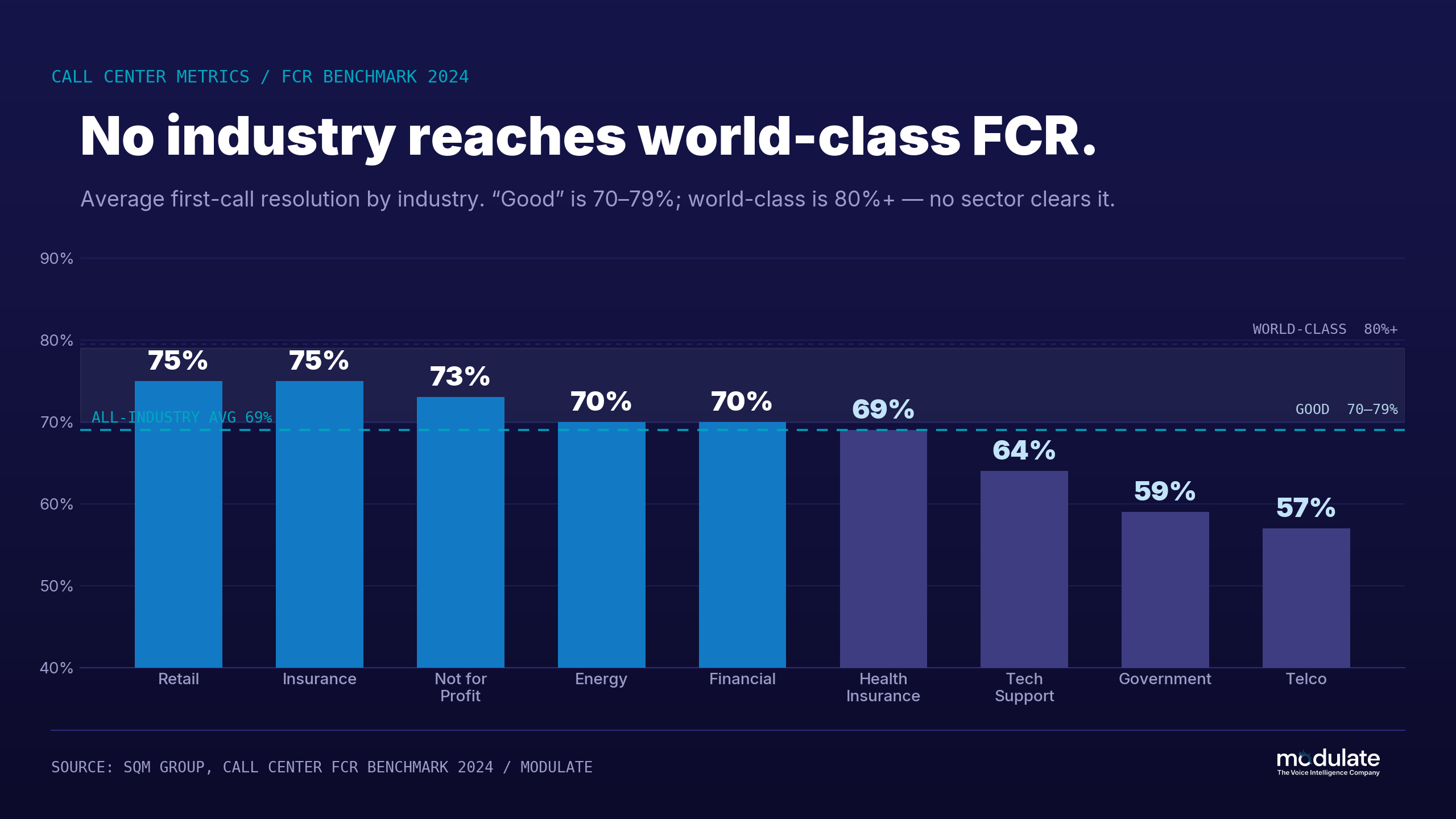
First call resolution (FCR), defined as the percentage of issues resolved during the first call, was measured at an industry-wide average of 69% across all industries in 2024, according to SQM Group, with the FCR rate ranging from 43% to 88%. FCR between 70-79% is considered good performance. Just 5% of contact centers measure world-class performance at 80% or higher. Leading industries for FCR include retail, not- for-profit and insurance call centers with averages ranging from 73-75%.
Average handle time (AHT) refers to the amount of time an agent spends servicing an interaction, start to finish. This starts when the call is connected and continues through any hold time and after-call notes. Industry-wide analysis in 2025 shows average handle times range from 6 to 8 minutes on average, with some industries seeing as much as a 20% difference, depending on the complexity of the call. Technical support and financial services have longer AHTs, while retail usually has shorter hold times.
Customer satisfaction (CSAT) captures how the caller felt afterward. A good CSAT score ranges from 75-85%, while scores from 85-100% are considered excellent, according to SurveyMonkey. Many contact centers track NPS (Net Promoter Score), which asks customers if they would recommend the organization to others on a scale ranging from -100 to +100. Any NPS above 0 is considered good, and a NPS above 20 is considered favorable. If your NPS is above 50, it indicates strong customer loyalty. Businesses with scores over 70 are world-class leaders in their industry.
Service level measures the percentage of calls answered by a live agent within a predetermined period of time. The traditional standard in the industry is the 80/20 rule, meaning that 80% of calls are answered by a live agent within 20 seconds. Many call centers view this as the baseline and strive to be higher or lower depending on call complexity and customer expectations.
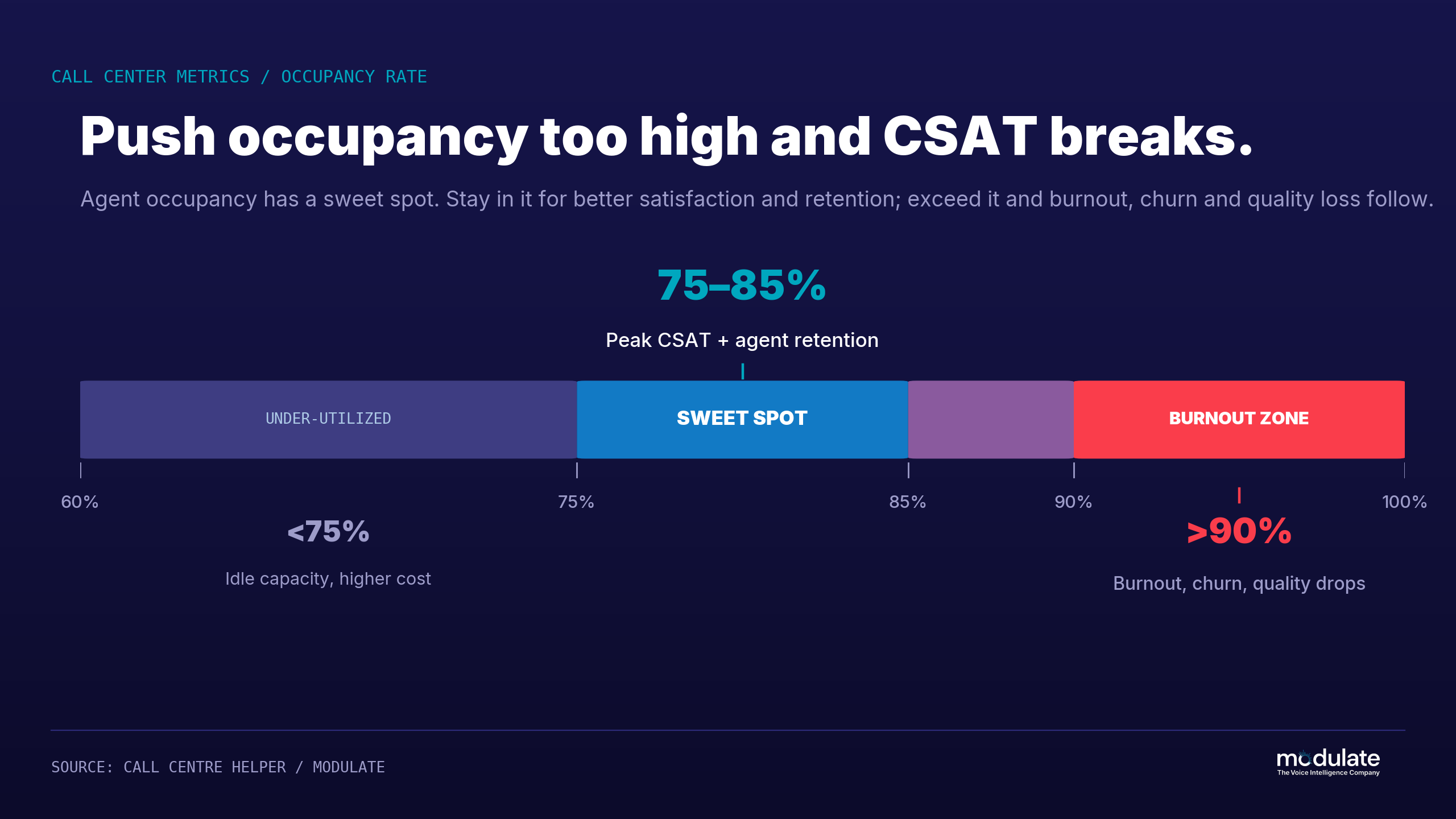
Occupancy rate is the amount of time your agents are spending actively answering calls versus the total time logged into the system. The industry standard for occupancy rates ranges from 75-85% for most inbound centers (Call Centre Helper). Call centers that maintain occupancy within that range perform significantly better in customer satisfaction and agent retention than those who operate over 90% consistently. The higher you go past that 85-90% range, the more burnout you'll experience. You'll also see a decrease in quality and an increase in agent churn.
Call abandonment rate is defined as the percentage of callers who hang up before speaking to anyone. Experts generally recommend a call abandonment rate between 2-5%, although the call abandonment rate considered good varies across industries. A call abandonment rate above 5% can adversely affect other metrics like CSAT in industries like retail. Technical support operations tend to have a higher call abandonment rate, but customers are often willing to wait longer to get the answers they need to complex technical issues.
Average wait time drives abandonment rate: for every additional 30 seconds of hold time, call abandonment will increase. Abandonment rate and service level are inversely related.
The Pressures Reshaping the Modern Call Center
Two prevailing forces are at play in today’s call centers. The first is people. Annual agent turnover runs 41% to 46% industry-wide, which is about 2.5-3x higher compared to other industries. First-year attrition is far worse, which means a center can lose most of a hiring class before it ever becomes proficient. Between hiring costs and lost productivity, each departure costs employers $10,000 to $20,000 to replace, according to McKinsey & Company. That's in line with Gallup's estimate that it costs about 40% of a frontline employee's annual salary to replace them.
The second is fraud. For criminals, the contact center has become a gateway for fraud.
“Through the use of tactics such as spoofed phone numbers and social engineering, combined with personal information obtained from identity theft scams and data breaches, fraudsters have become more focused on call centers as a target to access and take over accounts (ATO). More than ever, it’s critically important for call centers to find effective and efficient ways to separate legitimate callers from potentially fraudulent, high-risk ones in a way that reduces friction for the consumer.”
- Lance Hood, Senior Director of Omnichannel Authentication at TransUnion.
In a 2023 TransUnion survey of financial-industry call center workers, nearly two-thirds of respondents believed that the majority of account takeovers start at their call center. Further, 90% of respondents said that attacks had increased. There were $12.5 billion in reported losses from consumer fraud in 2024, according to the FTC. Phone calls were the second most popular way scammers reached victims.
Voice cloning AI raises the stakes: McAfee found 1 in 4 adults have been targeted by an AI voice scam. As Modulate CEO Mike Pappas explains:
“Sophisticated fraudsters know that once they're past that check, they're home free. So they open calls with a real voice — their own, a colleague's, a quick recording — and switch to the AI clone once they're past the gate. The system flags nothing. The fraud proceeds.”
This is precisely where voice intelligence shines, as it scores calls live and flags synthetic or spoofed audio for agents before they grant access or authorize a transaction. Learn more about monitoring and scoring conversations as they happen in our guide to call center monitoring and our comparison of the best call center monitoring software.
Where Call Centers Go From Here
A stronger signal powers the call center of the future. Routine interactions are automated, freeing agents for high-stakes conversations. AI is working quietly in the background scoring sentiment, summarizing calls and identifying fraud. Voice intelligence has become an operational necessity as the need for effective fraud detection continues to grow.
Velma is Modulate's proprietary voice intelligence platform built for this task from the ground up. Other tools rely on call transcription services to analyze calls after the fact. Velma processes audio natively. Hundreds of specialized models analyze the audio as the conversation happens, pinpointing emotion, stress, shifts in intent and danger signals. Higher-risk calls can be escalated as they happen, triggering instant alerts to supervisors and fraud teams.
We give the deepfake threat its own layer of defense. Velma's deepfake detection model (currently #1 on Hugging Face's Speech Deepfake Arena) scores every four seconds of audio in a call with two seconds of overlap, not just the initial handshake. Continuous deepfake detection matters because advanced attackers authenticate calls with a real voice, only switching to a synthetic clone after the handshake is complete. Continuous deepfake scoring allows us to detect that mid-call swap. Pricing starts at $0.25 per hour of audio. That’s scalable, affordable protection. See Velma in action.
Frequently Asked Questions
What's the difference between a call center and a contact center?
A call center deals with voice calls only. A contact center manages voice plus digital channels like email, chat, SMS, social media, etc.
What should my first call resolution rate be?
The cross-industry average is around 69%. Centers performing above 80% are considered top performers.
Are call centers going to be replaced by AI?
Not entirely. While AI will handle routine contacts and augment agents, complex, sensitive and high-value conversations will still be routed to humans.